
Open  instagram for five minutes and you'll find someone standing next to a rented Lamborghini, claiming their
  Dropshipping store did "$47k this month, all profit." Search "Dropshipping salary" on
  Google and you'll land on pages promising to show you the real number.
So here's the version built from actual data instead of screenshots. Most dropshippers make far less than the gurus claim. A small group makes a real full time income. And almost nobody explains the difference between revenue and what actually lands in your pocket, or that the most quoted "average Dropshipping salary" online isn't measuring store owners at all.
Quick answer: how much do dropshippers make?
Most active Dropshipping store owners net somewhere between $0 and $6,000 a month. Experienced operators can clear $9,000 to $30,000+ a month, but they're a small minority. Here's how that breaks down by stage, based on TrueProfit's analysis of 1,200+ stores:
Stage | Typical monthly profit | Typical annual profit | Realistic timeline |
|---|---|---|---|
Beginner | $0 to $1,200 | $0 to $14,400 | 0 to 6 months |
Intermediate | $2,250 to $6,000 | $27,000 to $72,000 | 6 to 18 months |
Advanced | $9,000 to $30,000+ | $108,000 to $360,000+ | 18+ months |
The rest of this guide covers where those numbers come from, what a store really costs to run, why most sellers never get past the beginner row, and how long the climb actually takes.
If you're weighing Dropshipping against other paths into online business, our step by step guide to starting dropshipping and our breakdown of whether dropshipping is still worth it are worth reading alongside this one.
The "$40,970 dropshipping salary" and why it's misleading
The number you'll see quoted everywhere is ZipRecruiter's average of $40,970 a year (about $19.70 an hour, as of August 2026). Zippia's dropshipping income breakdown lands in almost the same place:
Source | 25th percentile | Average | 75th percentile |
|---|---|---|---|
ZipRecruiter | $36,000 | $40,970 | $45,000 |
Zippia | $34,000 | About $40,000 | $44,000 |
Here's the catch most articles skip. ZipRecruiter's figure is salary data for jobs with "drop shipping" in the title: people employed to process orders, manage suppliers or run fulfillment for someone else's business. It's not a measure of what store owners take home.
That's why the range is so narrow. Real owner profits don't cluster between $36,000 and $45,000. They spread from losses to six figures, with most people near the bottom. Treat $40,000 as "what a Dropshipping job pays," not "what a Dropshipping store makes."
Revenue vs profit: what dropshipping income actually means
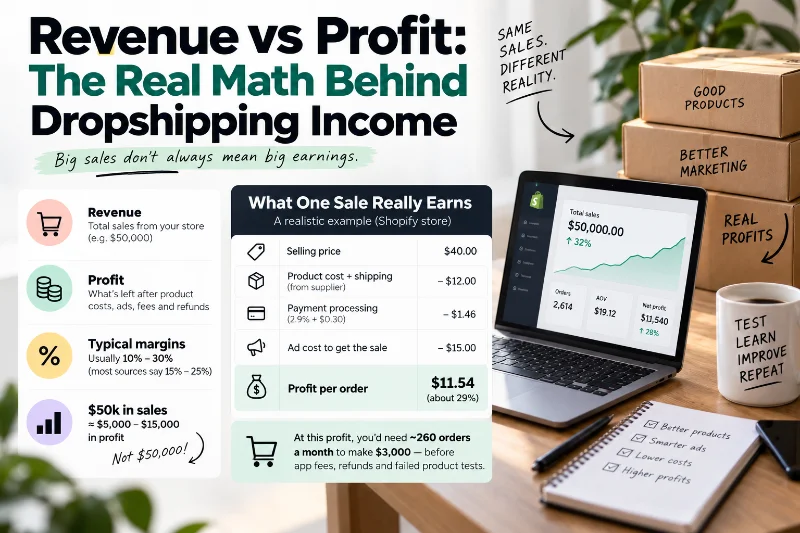
Almost every inflated screenshot you've seen confuses revenue (total sales) with income (what's left after product costs, ad spend, app fees and refunds). A store doing $50,000 a month in sales is not making $50,000.
Net margins in Dropshipping usually land between 10% and 30%. Carro puts the typical range at 10% to 30%, TrueProfit calls 15% to 25% a healthy benchmark, and plenty of first year stores run thinner while they're still testing products.
Run a "$50k month" through those margins and you get roughly $5,000 to $15,000 in actual profit, before the owner pays themselves or reinvests in ads.
What one sale really earns
Here's a simple, realistic example of a single order on a  Shopify store:
Line item | Amount |
|---|---|
Selling price | $40.00 |
Product cost plus shipping from supplier | minus $12.00 |
Payment processing (2.9% + $0.30) | minus $1.46 |
Ad cost to get that sale | minus $15.00 |
Profit per order | $11.54 (about 29%) |
At that profit, you'd need about 260 orders a month just to clear $3,000, and that's before app subscriptions, refunds and the products you tested that didn't sell. This is why ad costs make or break the whole model. If your cost per sale creeps from $15 to $25, that same order drops to about $1.50 in profit.
Our roundup of r/dropshipping and r/ecommerce discussions backs this up: sellers who post real numbers almost always break out revenue, ad spend and creative costs separately, not a single "I made $X" headline.
Dropshipping income by experience level
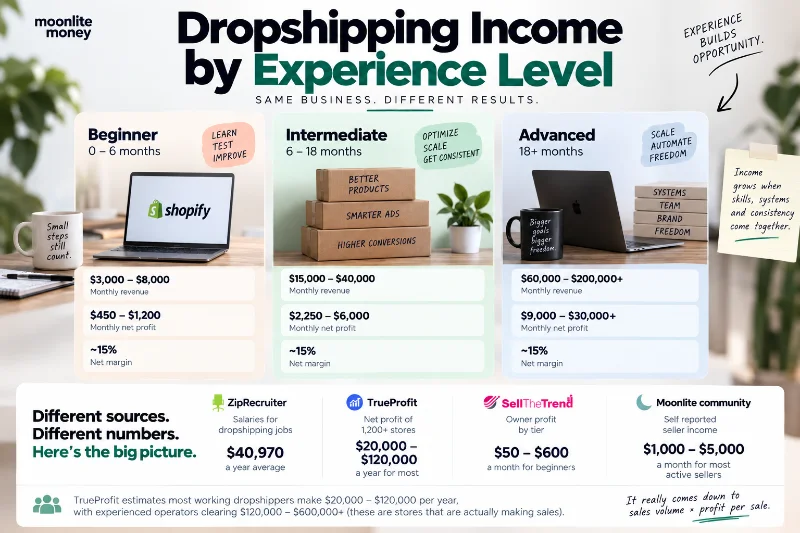
TrueProfit's analysis of more than 1,200 dropshipping stores is the most detailed breakdown available. Notice how much revenue it takes to produce the profit figures:
Experience level | Monthly revenue | Monthly net profit | Implied net margin |
|---|---|---|---|
Beginner (0 to 6 months) | $3,000 to $8,000 | $450 to $1,200 | About 15% |
Intermediate (6 to 18 months) | $15,000 to $40,000 | $2,250 to $6,000 | About 15% |
Advanced (18+ months) | $60,000 to $200,000+ | $9,000 to $30,000+ | About 15% |
Over a full year, TrueProfit puts most working dropshippers between $20,000 and $120,000, with experienced operators clearing $120,000 to $600,000+. Keep in mind these are stores that are actually making sales. Plenty of beginners never reach the first row.
Three sources, three answers
Different sources measure different things, which is why you'll see such wildly different numbers online:
Source | What it measures | What it says |
|---|---|---|
Salaries for | $40,970 a year average | |
Net profit of 1,200+ stores | $20,000 to $120,000 a year for most | |
Owner profit by tier | $50 to $600 a month for beginners | |
Self reported seller income | Most active sellers at $1,000 to $5,000 a month |
The Moonlite community breakdown also found profit per sale averaging around $20 after ad spend and fulfillment. It really does come down to sales volume times profit per sale, multiplied out over a month.
What it costs to run a dropshipping store
An income figure means little without knowing what it cost to get there. Unlike a laundromat or a window tint business, Dropshipping has a low barrier to entry. But low doesn't mean free, and ongoing costs quietly eat into profit. Here's a realistic monthly breakdown based on TrueProfit's startup cost guide and AutoDS's Shopify cost breakdown:
Cost | Lean | Mid range | Scaling |
|---|---|---|---|
| $29 to $39/mo (Basic) | $79 to $105/mo (Grow) | $299 to $399/mo (Advanced) |
Supplier and fulfillment app | $0 | $29 to $99/mo | $99+/mo |
Product research tools | $0 | $20 to $49/mo | $49 to $80/mo |
Reviews, upsell and email apps | $0 | $20 to $50/mo | $50 to $150+/mo |
Ad spend | $50 to $300/mo | $500 to $1,000/mo | $1,000 to $5,000+/mo |
Monthly total | About $80 to $340 | About $650 to $1,300 | About $1,500 to $5,700+ |
Then there are one time and per sale costs: a domain runs $15 to $25 a year, a premium theme $150 to $400, product samples $20 to $500+, and ad creatives $100 to $500+ per product if you outsource them. Shopify also takes 2.9% + $0.30 per card payment on the Basic plan. Tools like  AutoDS and
  Zendrop cover sourcing and fulfillment, but each adds another subscription.
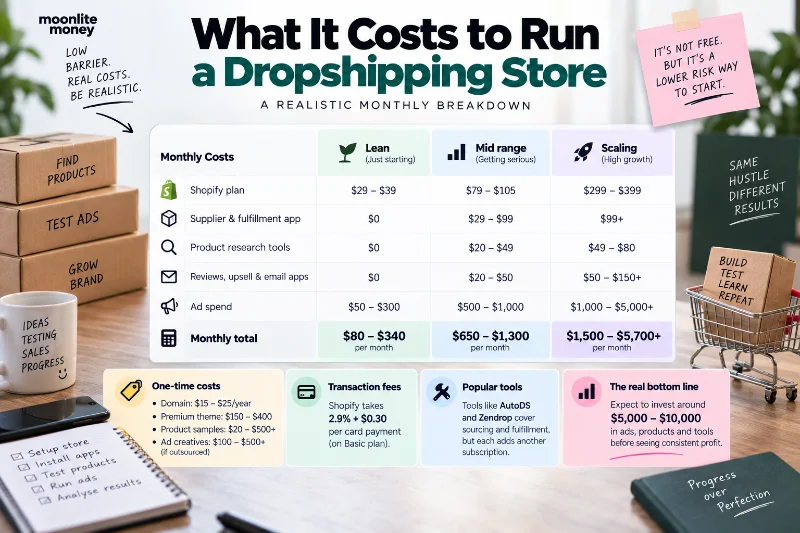
Add it all up and TrueProfit's conclusion is hard to argue with: expect to invest around $5,000 to $10,000 in ads, products and tools before seeing consistent profit. That's a long way from the "start Dropshipping for free" pitch some courses lead with. On  reddit, r/dropshipping lands on a similar floor, usually citing $500 to $1,000 a month in ad spend just to test products properly.
Why most dropshippers never hit these numbers
Most stores never get far enough to hit even the beginner range consistently. Here's what the main data sources say:
Outcome | Share of stores | Source |
|---|---|---|
Reach profitability in year one | 10% to 20% | |
Reach consistent, repeatable profitability | 1% to 5% | |
Fail or stop within the first year | 80% to 95% | Carro and TrueProfit |
Cross $50,000+ in monthly revenue | About 1.5% |
None of that means Dropshipping doesn't work. It means the income data is skewed by a small number of sellers who treated it like a real business, testing products methodically, tracking margins and reinvesting profit, while a much larger group quit after a few weeks of running ads with no clear offer or supplier. If you want the bigger picture on whether the model still has room, read Is Dropshipping Dead in 2026?
Where dropshippers sell, and how it affects income
The platform you choose changes your costs, your traffic source and even what's allowed:
- Shopify stores: the classic setup. You own the store and the customer, but you pay for every visitor, usually through
 Facebook and instagram ads. Carro reports that 68% of successful stores get traffic from Meta Ads.
  TikTok and TikTok Shop: organic videos can bring sales without ad spend, which is why so many new sellers start here. The trade off is less control, platform fees and constant content creation.
 Amazon: huge demand, but Amazon's drop shipping policy requires you to be the seller of record and bans buying from another online retailer to ship to your customer. Many "Amazon dropshippers" get suspended for exactly this.
 Etsy: better suited to Print-on-demand and handmade style products than generic Dropshipping.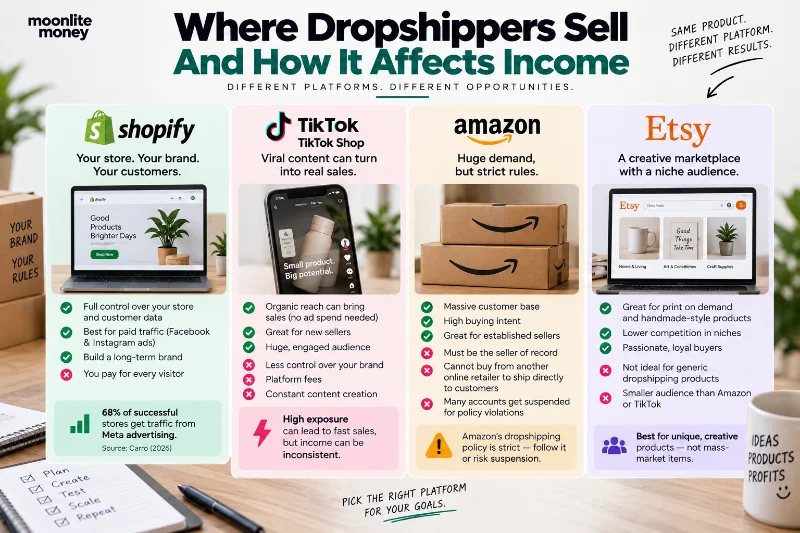
A real seller's numbers from Reddit
Averages are one thing. A real breakdown from someone doing it is another. In our Reddit research roundup on r/dropshipping and r/ecommerce, one seller shared a transparent breakdown of $83,521 in revenue from November 2025 through early 2026, publishing their ad spend, creative costs and store design decisions instead of just flashing a screenshot. Another seller reported crossing six figures in profit for 2025, but was upfront that the first stretch of "learning the game" was slow and mostly unprofitable before it clicked.
The community's own rules for what separates winners from losers match the data above:
"Sell something that is NOT available on
Amazon." If a customer can find your product with Prime shipping, you lose on price and speed every time.Test small, then scale what works. Most beginners over invest in one product instead of testing 5 to 10 products on small budgets first.
Supplier speed is a competitive edge. Sellers using 7 to 10 day shipping agents or U.S. based suppliers consistently outperform anyone still shipping generic products in 30 days.
Keep the tool stack simple. Winners use AI for product research and ad creative, but don't subscribe to every tool that promises an edge.
How long it takes to earn a real income
Timelines vary by niche and budget, but the pattern across income reports is consistent. The first and third rows come from TrueProfit's data; the others reflect what sellers commonly report:
Milestone | Typical timeline | What it usually takes |
|---|---|---|
First sale | 7 to 14 days | A tested product and active ads |
First $1,000 profit month | 1 to 3 months | Consistent testing; many stores still lose money here |
$5,000 to $10,000 a month | 6 to 12 months | Continuous testing, creative iteration, margin fixes |
$10,000+ a month, consistently | 12 to 24 months | A repeatable system for finding and validating products |
If you're still figuring out your first product or platform, our guide to starting dropshipping covers the setup decisions that most affect how fast you move through this timeline.
Should you buy a dropshipping course?
Here's something worth knowing: many of the loudest Dropshipping names now earn more from teaching than from their stores. That doesn't make every course bad, but it should shape how you read their income claims. If you're considering one, we've reviewed the popular options:
 Biaheza's Dropshipping Course by
  Biaheza: see our Biaheza dropshipping course review
 Dropshipping Guild - Community: see our Dropshipping Guild review
 GOD TIER ECOM: see our God Tier Ecom review
 Jordan Welch's programs: see our Jordan Welch AI.com Academy review
Our advice: don't spend on a course until you've tested a few products with your own money. You'll learn what you actually need help with, and you'll spot vague, recycled content much faster.
Dropshipping vs other online side hustles
Dropshipping isn't the only low barrier path to online income. Here's how its cost and income profile compares with a few others Moonlite covers:
Path | Typical startup cost | Realistic year one income | Income ceiling |
|---|---|---|---|
$500 to $10,000 | $0 to $14,000 | Six figures+, rare | |
$0 to $2,000 | Highly variable, client dependent | Six figures+, more sellers reach it | |
$100 to $2,000 | Lower than | Lower ceiling, thinner margins | |
$2,000 to $10,000+ | Often reinvested into inventory | High, but capital heavy | |
$0 to $500 | $0 to a few thousand | Depends on content output |
If you're comparing Dropshipping with the agency model, our Agency Navigator review and Agency Incubator review break down what it costs to build an  Iman Gadzhi style agency instead. For lower cost routes, see our TikTok affiliate marketing guide, our list of digital products to sell, or the top Amazon FBA YouTube creators if inventory based selling appeals more.
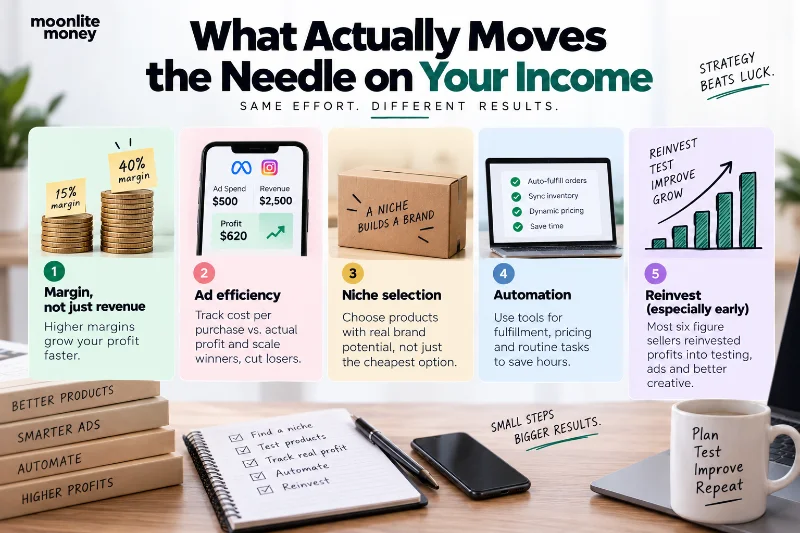
What actually moves the needle on your income
The gap between someone earning $500 a month and someone earning $30,000 a month usually comes down to a handful of factors, not luck:
Margin, not just revenue. A store with 40% margins and $10,000 in sales nets more than one with 15% margins and $20,000 in sales.
Ad efficiency. Sellers who track cost per purchase against actual profit per order (not revenue) cut losing products faster and scale winners with less guesswork.
Niche selection. Products with room for a real brand, not just the cheapest version of something on
Amazon, support higher margins and repeat customers.Automation. Automated fulfillment and pricing tools save hours every week once order volume picks up.
Reinvestment discipline. Most six figure dropshippers didn't pull profit out early. They reinvested into testing budget and better creative for the first several months.
AI tools now help with a lot of this, from product research to ad scripts. Our list of AI tools to make money covers the ones worth trying.
FAQ: dropshipping income and salary
What is a realistic dropshipping salary in your first year?
A realistic first year range is $0 to roughly $14,000 in net profit, with many stores breaking even or losing money while they test products. Reaching $40,000 a year in profit typically takes longer than 12 months.
Is the $40,970 average dropshipping salary accurate?
It's accurate for what it measures: ZipRecruiter salary data for jobs with "drop shipping" in the title. It doesn't measure what store owners earn, which ranges from losses to six figures.
Can dropshipping replace a full time income?
It can, but it's the exception in year one. Sellers earning $40,000 to $100,000+ a year are almost always 12 to 24 months in, with a tested product, steady ad performance and margins above 20%.
What percentage of dropshippers make money?
Carro estimates 10% to 20% reach profitability in year one. TrueProfit puts consistent, repeatable profitability at just 1% to 5%. The rest break even, lose money or stop before the model has time to work.
How much does it cost to start dropshipping before you see a profit?
Plan on $500 to $1,000 minimum for a first real round of ad testing, plus $30 to $80 a month in platform and app costs. Most sellers who reach consistent profit have invested $5,000 to $10,000 in total by the time they get there.
How many sales do you need to make $1,000 a month dropshipping?
At a typical profit of $10 to $20 per order, you'd need roughly 50 to 100 sales a month to net $1,000, after ad costs.
Is dropshipping income the same as profit?
No. Store "revenue" in screenshots is total sales before costs. Always check whether a source is reporting revenue, profit or employee salary before comparing it to your own numbers.
The bottom line
Most dropshippers make far less than the six figure months you see in ads, and the $40,000 "average salary" you'll find online isn't even measuring store owners. Real profit comes to sellers who stick with it well past the point where most people quit.
That's not a reason to write Dropshipping off. It's a reason to plan for the real timeline and real costs instead of the highlight reel. Track profit over revenue, budget at least $500 to $1,000 a month for product testing, give yourself six to twelve months before judging results, and treat every "I made $50k this month" post with the same skepticism you'd give any other unverified income claim.