

Google "laundromat business startup costs" and you'll get answers that don't even sound like they're describing the same business. $25,000 here. $500,000 there. A few sites will tell you to budget over $1 million and move on. Here's the thing: none of those numbers are actually wrong. They're just describing three completely different ways into the same industry: building a laundromat from scratch, buying one that's already running with paying customers, or franchising into a system someone else already built. This guide doesn't average those together into a useless range. You get a real cost table for each path, what laundromats actually sold for in 855 real transactions, an honest income and profit-margin breakdown backed by one named owner's actual numbers, and a legal checklist, so you walk away with a plan, not just a headline figure.  Laundromat Business
If you're weighing a laundromat against a lower-cost path into business ownership, our Agency Navigator review and Agency Incubator review both break down what it costs to build an Iman Gadzhi-style agency instead.
There's no such thing as a single "average laundromat startup cost." There are three genuinely different businesses hiding behind that keyword, and here's how they compare before we go deep on each one:
Path | Realistic Startup Range | Best For |
|---|---|---|
Buying an existing laundromat | $50,000–$300,000+ | First-time owners who want cash flow from day one |
Building new from scratch | $200,000–$500,000+ | Owners with capital who want full control of location and equipment |
Franchise | $231,000–$1,515,000+ | Owners who'd rather pay for a proven system and brand |
Most first-time laundromat owners actually buy an existing store rather than build one, and the data backs that up: buying gets you a business with a real revenue history on day one, while building means months of construction before your first customer ever walks in.
Why Laundromat Startup Cost Estimates Are All Over the Map
Most articles that answer "how much does it cost to open a laundromat" quote one number, which is exactly why nothing lines up. A distressed 20-machine store in a small town and a brand-new 60-machine flagship store in a dense city both get called "a laundromat," but the money involved has almost nothing in common.
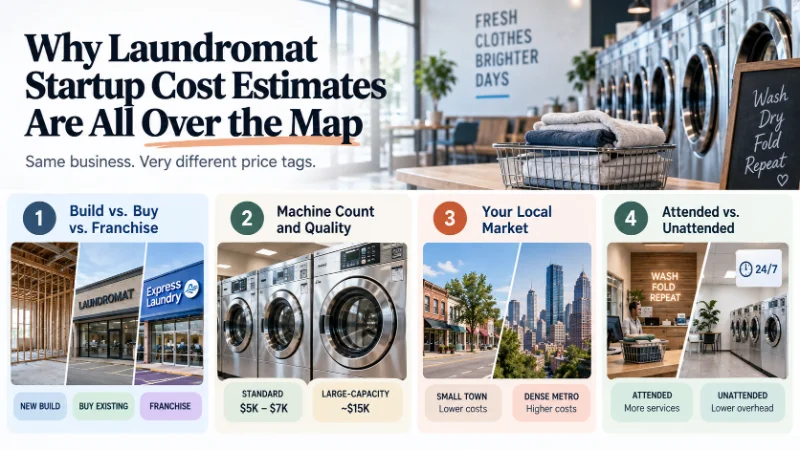
Four variables move that number more than anything else:
New build vs. existing purchase vs. franchise. This alone explains most of the $25,000-to-$1.5 million spread you've seen across other articles.
Machine count and quality. A standard store runs 25–60 combined washers and dryers, and a single large-capacity washer alone can run $15,000 versus $5,000–$7,000 for a standard one.
Your local market. Rent, water/sewer rates, and buildout costs swing wildly between a small town and a dense metro, and laundromats are unusually water- and utility-intensive compared to most retail businesses.
Attended vs. unattended operation. Staffing a store around the clock adds real labor cost but unlocks wash-and-fold and pickup/delivery revenue that a coin-only, unattended store can't touch.
Instead of picking one number, the rest of this guide walks through buying, building, and franchising side by side, each with its own real cost data, so you can find the range that actually matches the business you're planning to run.
Buying an Existing Laundromat: What They Actually Sell For
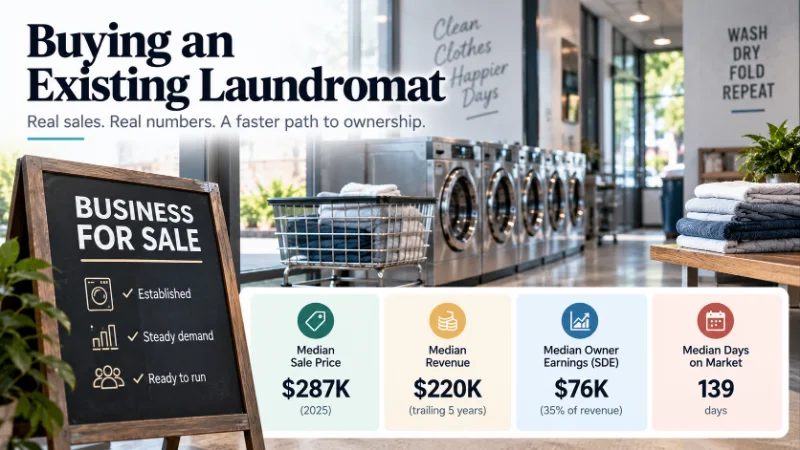
Buying beats building for most first-time owners, and it's also the option with the best real data behind it. Sellers can't fudge the numbers when 855 actual sold listings are on the record. According to BizBuySell's valuation benchmarks, pulled from those real transactions, here's what laundromats are genuinely selling for: Laundromat Business
Metric | Figure |
|---|---|
Median sale price (2025) | $287,000 |
Median asking price (2025) | $300,000 |
Median revenue (trailing 5 years) | $219,878 |
Median owner discretionary earnings (SDE) | $76,560 (34.8% of revenue) |
Median SDE multiple | 3.50x (range 2.72x–4.50x) |
Median revenue multiple | 1.21x (range 0.93x–1.64x) |
Median days on market | 139 days |
That SDE multiple is the number to actually understand before you shop for a laundromat: sellers and brokers price these businesses primarily as roughly 2.7x to 4.5x annual owner discretionary earnings (what a working owner actually takes home before their own "salary"), not as a flat price per machine. A store earning $80,000 a year in owner earnings realistically prices somewhere between $215,000 and $360,000, with $280,000 being about the median outcome.
On the low end, a distressed or dated laundromat that needs new equipment or a facelift can sell for as little as $50,000–$100,000, and the full range across all listing sizes stretches from roughly $25,000 for a tiny, run-down single store up to several million for a large multi-store portfolio. Median sale prices have climbed steadily too, from $220,000 in 2021 to $287,000 in 2025, so waiting for a "cheap" market isn't really a strategy here.
What to actually check before buying: trailing 12-month revenue and profit-and-loss statements, remaining useful life on the machines (most commercial washers and dryers last 15–20 years), the lease terms and years remaining, water/sewer costs (laundromats are among the heaviest water users in retail), and whether the seller's asking price lines up with the SDE multiples above or is priced on hope rather than earnings.
Building a New Laundromat: Startup Cost Breakdown
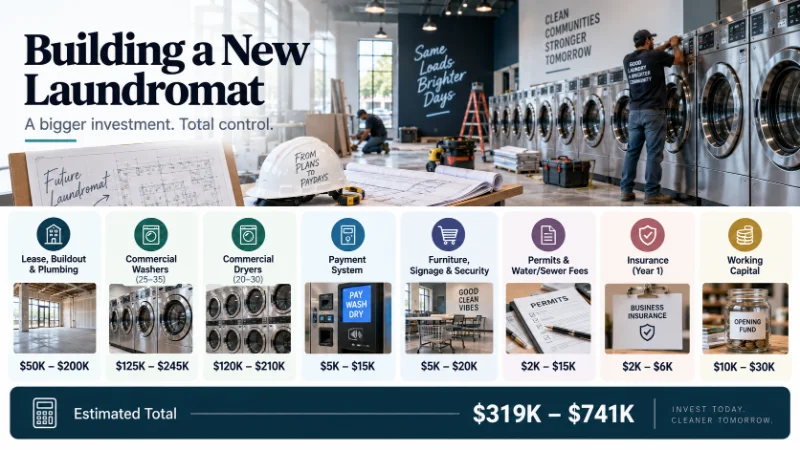
Building from scratch means nobody's cutting you a deal on an existing customer base or machines that already work. You're paying for a shell, permits, plumbing built for laundromat-level water volume, and every washer and dryer new. In exchange, you control everything: the location, the layout, the equipment brand, all of it. Here's a realistic range for opening a standard-size, new self-service laundromat: Laundromat Business
Startup Expense | Low-End | High-End |
|---|---|---|
Lease deposit, buildout, plumbing & electrical | $50,000 | $200,000 |
Commercial washers (25–35 units) | $125,000 | $245,000 |
Commercial dryers (20–30 units) | $120,000 | $210,000 |
Change machine & payment/card system | $5,000 | $15,000 |
Folding tables, carts, signage, security cameras | $5,000 | $20,000 |
Business licenses, permits & water/sewer fees | $2,000 | $15,000 |
Insurance (first year) | $2,000 | $6,000 |
Working capital reserve | $10,000 | $30,000 |
Estimated Total | $319,000 | $741,000 |
That lines up with the wider industry estimate of roughly $200,000 to $500,000 for a standard build. Push into prime urban real estate with premium rent and a bigger machine count, and total costs climb past $1 million. Some aggregated industry sources even cite figures as high as $3 million once you're buying land instead of leasing it. Equipment alone, just the washers and dryers, typically runs $60,000 to $500,000 depending on machine count and whether you buy new or reconditioned.
The cost people actually underestimate isn't a line item, it's the calendar. Between securing a lease, permitting, plumbing and electrical work (laundromats need far more water, drainage, and electrical capacity than a typical retail buildout), and equipment installation, a new build commonly takes 6–12 months from signed lease to opening day. Every month of that, you're paying rent and loan payments with zero revenue coming in.
Laundromat Franchise Cost
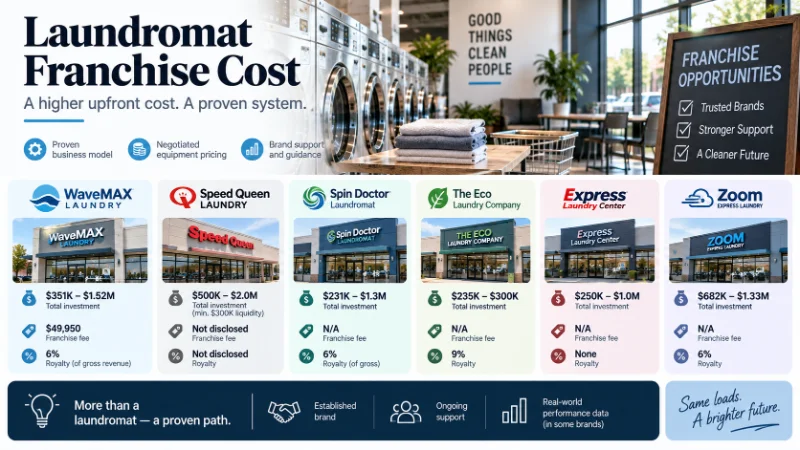
Franchising sits between the other two paths: you pay a premium over buying independent, but you get a proven system, negotiated equipment pricing, and, in a couple of cases, real disclosed performance data instead of a guess. Here's what actual, verifiable laundromat franchises charge: Laundromat Business
Franchise | Total Investment | Franchise Fee | Royalty |
|---|---|---|---|
WaveMAX Laundry | $351,000–$1,515,000 | $49,950 | 6.0% of gross revenue |
Speed Queen Laundry | $500,000–$2,000,000 (min. $300K liquidity, $2M net worth) | Not publicly disclosed | Not publicly disclosed |
Spin Doctor Laundromat | $231,000–$1,300,000 | N/A | 6% of gross |
The Eco Laundry Company | $235,000–$300,000 | N/A | 9% |
Express Laundry Center | $250,000–$1,000,000 | N/A | None |
Zoom Express Laundry | $682,000–$1,325,000 | N/A | 6% |
WaveMAX has the most independently verifiable numbers of the group: per its Franchise Disclosure Document, the brand's roughly 51 units disclosed an Average Unit Volume of $382,000 in annual revenue, and an independent read of that FDD put payback period at 3–7 years depending on the investment level. Speed Queen Laundry, backed by the commercial laundry equipment manufacturer of the same name, cites an ROI of 28–41% in Item 19 of its FDD, though that number comes from the franchisor itself, not an independent audit, so treat it the way you'd treat any franchisor-reported ROI claim: directionally useful, not a guarantee.
Franchise fees on their own aren't the real cost here. Most run $40,000–$50,000 where disclosed, similar to franchise fees in other service industries. What actually separates a $231,000 franchise from a $1.5 million one is the franchisor-mandated buildout package, equipment tier, and market size requirement. Always pull the franchisor's current FDD directly before treating any of these figures as final, since franchise costs and territory requirements change between disclosure years.
New Build vs. Buying Existing vs. Franchise: Side-by-Side
Here's every factor side by side, no flipping back and forth between sections required:
Factor | Buying Existing | New Build | Franchise |
|---|---|---|---|
Startup cost range | $50,000–$300,000+ | $200,000–$741,000+ | $231,000–$1,515,000+ |
Time to open | Days to weeks (existing revenue from day one) | 6–12 months | 6–12 months, franchisor-dependent |
Revenue history | Real, verifiable trailing revenue | None, you're starting from zero | None, but AUV data may exist from other units |
Equipment condition | Variable, inspect carefully | New, under warranty | New, franchisor-mandated tier |
Support & training | None, you're on your own | Self-taught or hired staff | Structured, franchisor-led |
Ongoing fees | None beyond normal opex | None beyond normal opex | Royalties, typically 6–9% of gross |
Laundromat Equipment Costs
Whether you're buying a store's existing equipment or pricing out a new build, the machines are the single biggest line item, full stop. Here's what they actually cost: Laundromat Business
Item | Cost Range |
|---|---|
Commercial washer (standard capacity) | $5,000–$7,000 per unit |
Commercial washer (large capacity, 60–80 lb.) | Up to $15,000 per unit |
Commercial dryer | $6,000–$10,000 per unit |
Change machine | $1,300–$10,000+ |
Card reader / payment system (per machine) | $400–$7,000+ |
Typical machine lifespan | 15–20 years |
Typical store size | 25–60 combined washers and dryers |
A mid-size store commonly runs around 30 washers and 45 dryers. Washers do the heavy lifting on revenue too: across the industry, washers generate roughly two-thirds of total machine revenue, with dryers making up the remaining third, worth remembering if you're ever deciding where to spend on upgrades first.
How Much Do Laundromat Owners Actually Make?
This is the part most cost breakdowns skip entirely, and it's arguably more important than the startup number itself. It's the exact question ("laundromat owner salary," "how much do laundromats make a month") most people searching this topic actually want answered. Laundromat Business
The industry-wide numbers, from IBISWorld's 2025 industry report, put the average laundromat at roughly $378,000 in annual revenue (derived from $7.1 billion in total industry revenue across 18,711 US laundromats) with a 13.9% net profit margin. That's the honest, full-industry baseline. You'll also see plenty of operator-facing blogs citing 20–35% net margins, some claiming up to 40–50% for well-run, larger stores. That gap isn't really a contradiction, it's a difference in who's being measured: IBISWorld's 13.9% blends every laundromat in the country, including older, under-invested, or poorly-located stores, while the higher figures tend to describe specific, well-run operations bragging about their best year. Plan around something closer to the IBISWorld baseline until your own numbers prove otherwise.
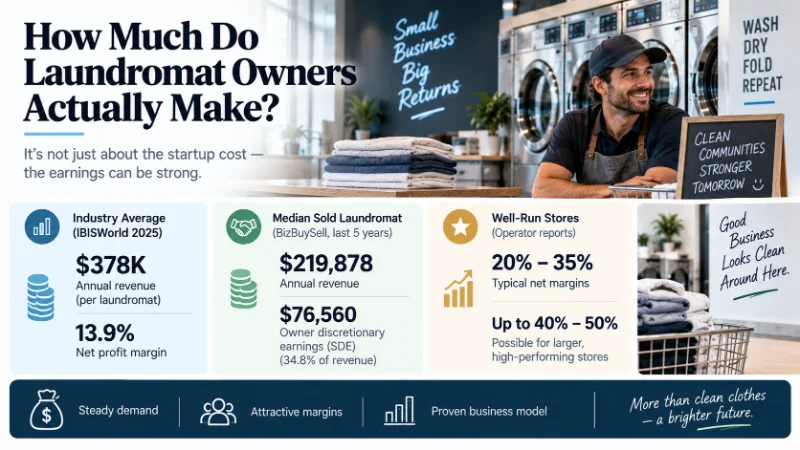
BizBuySell's real transaction data backs this up from a different angle: the median laundromat that actually sold in the last five years generated $219,878 in revenue and $76,560 in owner discretionary earnings, 34.8% of revenue. That SDE figure includes the owner's own labor and benefits though, so it's not the same as pure profit if you're also drawing a market-rate manager's salary out of the business.
A Real Owner's Numbers: Queen City Laundry
Averages are one thing, a real name attached to real numbers is another. Dave Menz, owner of Queen City Laundry, bought his first location for $85,000, financed with $30,000 of his own savings and a small business loan. Seven months in, that first store was grossing $14,000 a month, but after expenses, he was netting just $1,500 a month. That's the reality check worth sitting with: year-one margins are thin, no matter what the long-run averages say. Once the business stabilized, two of his locations combined were producing $7,000 a month in profit, and a third, after renovation, was generating $3,000–$4,000 a month. By 2022, his four combined locations were pulling in $1.8 million in annual revenue, and he employs 40 people across the portfolio. It took years of reinvestment to get there, not one lucky store.
Unit Economics: What Each Machine Actually Earns
Zoom into the machine level, and industry estimates put net revenue per machine at roughly $150–$200 a month after utilities and maintenance. Vend pricing varies by machine size and market: self-service washes commonly run $2.00–$6.50 per load and dryers $1.50–$2.50 per cycle, though the Coin Laundry Association's own member survey found top-load washer vend prices ranging from $2.85 for the most popular machine size up to $9.18 for 75–80 lb. machines. Value-added wash-and-fold service typically runs $1.25–$2.50 per pound, with pickup-and-delivery pricing often set higher, around $2.49 per pound with a $40 minimum in one commonly cited operator example.
Monthly Operating Costs for an 80-100 Machine Store
For a store running 80–100 machines with round-the-clock attended staffing, typical monthly costs break down like this:
Expense | Typical Monthly Range |
|---|---|
Staffing (24/7 attended) | ~$11,286 |
Gas (water heating, dryers) | $4,820–$12,050 |
Electricity | $9,564–$23,909 |
Water | ~$56.64 per machine |
Insurance | ~$339 |
Card/payment processing | ~$884 |
Rent | ~$1,917 |
Utilities, not rent, are usually the biggest recurring cost in this business, which surprises a lot of first-time owners coming from other retail concepts. An unattended, coin-only store cuts that staffing line to close to zero, but caps you out of wash-and-fold and pickup/delivery revenue entirely.
Model | Labor Cost | Revenue Ceiling | Best For |
|---|---|---|---|
Unattended (coin/card only) | Minimal | Capped to self-service vend revenue | Owners prioritizing passive income and low overhead |
Fully attended | Highest | Highest, unlocks wash-and-fold & pickup/delivery | Owners wanting a full-service, higher-margin business |
Hybrid (part-time attendant) | Moderate | Middle ground | Most first-time owner-operators |
Pickup-and-delivery and wash-and-fold aren't a rounding error either: industry data puts the average pickup/delivery order at $79.81 and drop-off orders at $44.19, both well above a typical $5–$15 self-service visit. It's also worth knowing that laundry cards create their own small float. Roughly 5–10% of annual self-service revenue sits as unspent, loaded balance on customer cards at any given time, and about 40% of customers tend to drive around 90% of a store's lifetime self-serve revenue, so retaining your regulars matters more than chasing new foot traffic.
Realistic Payback Period
Most laundromat purchases pay back within a 3–7 year range across sources, and that holds whether you're looking at WaveMAX's own FDD-disclosed payback window or independent aggregator estimates. Buying an established, already-profitable store obviously shortens that timeline compared to a new build, since you're not paying construction and ramp-up costs on top of your purchase price.
Laundromat Licensing, Insurance, and Legal Checklist
Every path above assumes you'll handle the legal basics, and laundromats have a few requirements most other small businesses don't, mainly around water and drainage. Here's the checklist to work through before you take on customers: Laundromat Business
Business entity. Register an LLC (or sole proprietorship where allowed) to separate personal assets from business liability.
EIN. A free Employer Identification Number from the IRS, needed to open a business bank account and hire staff.
Sales tax permit. Required in most states, even though coin-operated laundry income is tax-exempt in some jurisdictions, so verify your state's specific rule.
Zoning permit / certificate of occupancy. Confirms the space is legally zoned for a laundromat before you sign a lease.
Building, plumbing, and electrical permits. Laundromats need significantly more water supply, drainage, and electrical capacity than typical retail space, so this step is rarely a formality here.
Water/sewer discharge permit. Many municipalities specifically require this given how much wastewater a laundromat generates; don't assume a standard commercial water hookup covers it.
Health and fire department permits. Covers exits, fire suppression, and general safety compliance.
Environmental permit, if you're adding on-site dry cleaning using chemical solvents like perchloroethylene; a pure wash-and-dry laundromat carries a much lighter environmental compliance burden than one with attached dry cleaning.
Sign permit and any local permit specific to coin-operated or vending equipment, which some municipalities require separately.
Insurance to have in place before opening a laundromat:
Insurance Type | What It Covers |
|---|---|
General liability | Customer injuries and property damage claims |
Property/contents coverage | Your machines, fixtures, and buildout |
Equipment breakdown coverage | Repair or replacement when a washer or dryer motor fails; the most laundromat-specific policy on this list |
Business interruption insurance | Lost income if the store has to close temporarily |
Workers' compensation | Required once you have employees |
Business Owner's Policy (BOP) | Bundles general liability and property at a lower combined cost |
Commercial auto coverage | Required if you offer pickup/delivery, since personal auto policies exclude business use |
CLA, The Laundry Association (formerly the Coin Laundry Association) is the industry's main trade body, with over 60 years serving laundromat owners. It publishes Full Cycle Magazine, runs an annual member survey with real vend-price and equipment data, and offers member insurance and financing programs. It's worth joining before you buy your first store, not after.
For financing, SBA-backed loans are the standard route: 7(a) loans up to $5 million, CDC/504 loans up to $5 million specifically for major fixed assets like real estate and large equipment packages, and SBA microloans up to $50,000 for smaller needs. Expect a minimum 10% down payment on SBA 504 and 7(a) loans, more depending on your credit and the store's cash flow. Start at SBA.gov's loans page or your local Small Business Development Center to find an SBA-approved lender who's actually financed laundromats before, since not every lender is comfortable underwriting this asset class.
Which Path Should You Choose?
Still torn between the three? Here's the short version. Want cash flow starting day one and don't mind inheriting someone else's equipment and lease? Buying an existing laundromat is the most common path, and the most supported one, since the BizBuySell benchmarks above give you real numbers to negotiate against instead of trusting whatever the seller's asking price implies. Got $200,000-plus in capital, a location you're already sold on, and want every equipment and layout decision to be yours? Build new, and accept 6–12 months of zero revenue before your first customer walks in. Would rather pay a premium for a system that already works, with negotiated equipment pricing, training, and (in WaveMAX's case) real disclosed performance numbers? Franchise, budget $231,000 minimum, often well north of $500,000 for bigger territories, and be ready to operate inside someone else's brand and royalty structure. Laundromat Business
For a look at how a completely different service business compares on cost and margin, see our Window Tint Business Startup Costs breakdown, which walks through the same mobile-vs-shop-vs-franchise decision for an industry with a much lower barrier to entry.
Frequently Asked Questions
How much does it cost to open a laundromat?
Depends entirely on which path you're taking. Buying an existing store runs $50,000 to $300,000-plus based on real BizBuySell transaction data. Building new runs roughly $200,000 to $741,000 for a standard store. Franchising runs anywhere from $231,000 to over $1.5 million depending on the brand and territory size.
Is a laundromat a profitable business?
Yes, though the honest, full-industry average net margin is 13.9% per IBISWorld, not the 20-50% figures you'll see floating around, which usually describe one well-run store's best year rather than the industry as a whole. BizBuySell's data lands closer to the middle: the median sold laundromat generates $76,560 in owner discretionary earnings on $219,878 in revenue, about 35%, though that figure bakes in the owner's own labor, not pure profit stacked on top of a salary.
How much do laundromat owners actually make a year?
It varies enormously by store size and whether it's attended or unattended. Industry-wide average revenue per store sits around $378,000 per IBISWorld, but real numbers tell a slower story: Queen City Laundry owner Dave Menz netted just $1,500 a month from his first store seven months in, growing to $7,000 a month in profit from two combined locations once things stabilized. Plan for a slow ramp, not an instant payday.
Is it cheaper to buy an existing laundromat or build a new one?
Buying wins on both cost and speed almost every time. Median sale price was $287,000 in 2025, for a store with real, verifiable revenue history already attached. Building new runs $200,000 to $741,000-plus and takes 6–12 months before your first customer walks in, though you get equipment under full warranty and total control over the buildout.
How much does a laundromat franchise cost?
It swings widely by brand. WaveMAX Laundry's total investment runs $351,000 to $1,515,000, with a $49,950 franchise fee and 6% royalty. Speed Queen Laundry runs $500,000 to $2,000,000 and requires $300,000 in liquid capital plus a $2 million net worth just to qualify. Smaller brands like Spin Doctor Laundromat start around $231,000.
How long does it take a laundromat to break even?
Most sources, including WaveMAX's own FDD-disclosed payback window, put breakeven at 3 to 7 years. Buying an already-profitable existing store usually shortens that timeline versus building new, since you skip the construction and ramp-up period entirely.
The Bottom Line
Next time someone quotes you a single laundromat startup cost number, you'll know to ask which path they're describing. Buying, building, and franchising aren't points on one scale, they're three different businesses, with different risk levels, timelines, and income ceilings. Now you've got real transaction data, a worked income example from an actual owner, and a legal checklist for each one, instead of a number that doesn't mean much on its own.
Still deciding? Start with the "Which Path Should You Choose" section above, then use the tables here as your starting framework and build your own numbers around the specific store, market, and machine count you're actually considering. Water, sewer, and utility costs swing more by location in this business than almost any other service industry, so treat every figure here as a well-sourced starting point, not a quote. Laundromat Business