
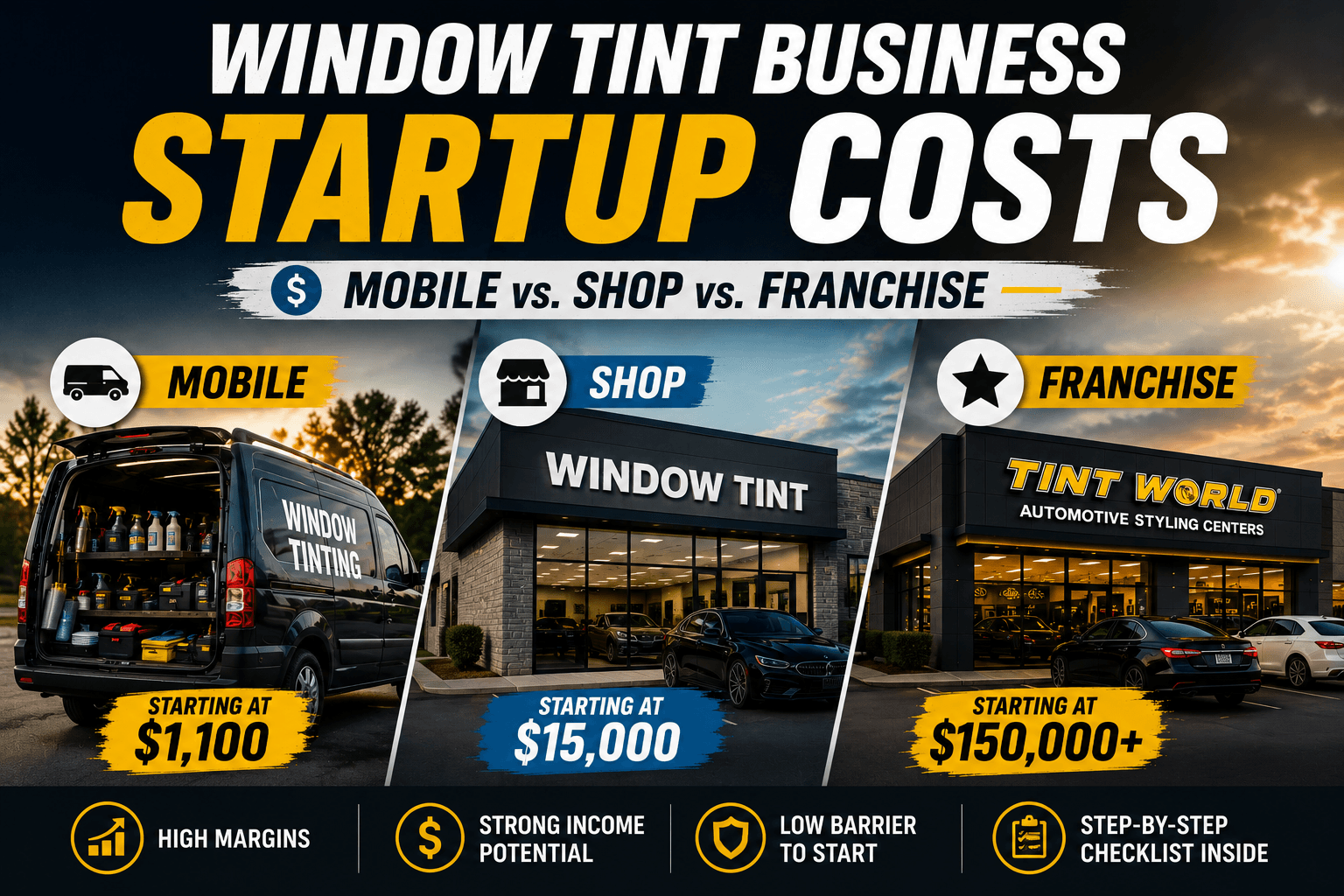
If you've searched for  Window Tinting Business startup costs, you've probably run into wildly different numbers. Depending on what you mean by a window tint business, costs can range from roughly $1,100 for a bare-bones mobile operation to more than $400,000 for an established franchise. Neither number is wrong, exactly, they're just describing entirely different businesses. This guide breaks the cost down by business model instead of averaging everything into a meaningless range, with a real cost table for each model (film, tools, licensing, insurance, and a vehicle where it applies), a profit-margin breakdown backed by real franchise disclosure data, and a step-by-step launch checklist so you leave with an actual plan instead of just a number.
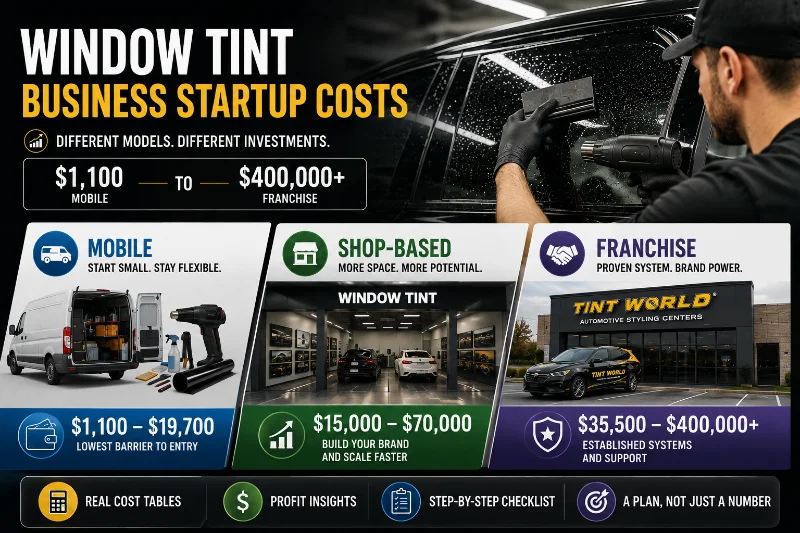
There is no meaningful "average window tint business startup cost." There are effectively three different businesses hiding behind that keyword, and here's how they compare before we go deep on each one:
Model | Realistic Startup Range | Best For |
|---|---|---|
Mobile | ~$1,100-$20,000 | First-time owner testing demand |
Independent shop | ~$15,000-$70,000+ | Scaling beyond one installer |
Established franchise | ~$150,000-$450,000+ | Capitalized owner wanting a proven system |
The franchise fee alone is typically $40,000-$50,000, but that's a fraction of what an established brand actually requires once buildout, working capital, and liquid-capital minimums are factored in, more on that in the franchise section below.
Why Window Tint Startup Cost Estimates Are All Over the Map
Most articles that answer how much does it cost to start a Window Tinting Business quote a single figure, which is exactly why the numbers don't line up. A single technician tinting cars out of a wrapped minivan and a retail shop with a lease, a showroom, and four installers are both "window tint businesses," but they have almost nothing in common financially. Add franchising into the mix, where you're paying for a brand, a training pipeline, and a proven system, and you get a third cost structure entirely.
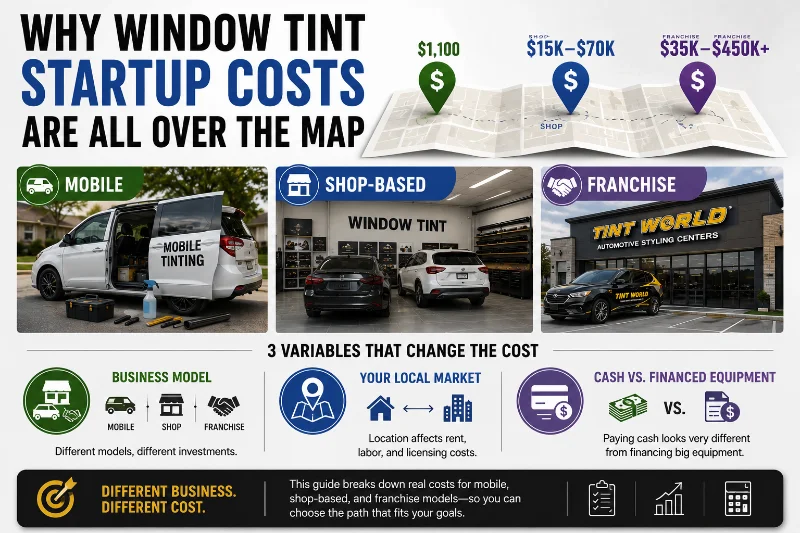
Three variables move that number more than anything else:
Business model: mobile, shop-based, or franchise. This alone accounts for most of the $1,100-to-$450,000 spread you've seen across other articles.
Your local market: rent, labor, and licensing costs can swing a shop build-out by tens of thousands of dollars between a small town and a major metro area.
Cash vs. financed equipment: buying a used heat gun and a starter roll of film outright looks nothing like financing a plotter, a tint booth, and a wrapped van.
Instead of picking one number, the rest of this guide walks through the three models side by side, mobile, shop-based, and franchise, each with its own real cost table, so you can find the range that actually matches the business you're planning to build.
Mobile Window Tinting Business Startup Cost
Mobile tinting is the entry point for most people researching this industry, and it's also where the lowest numbers you've seen, sometimes as low as $1,100, come from. In its leanest form, a mobile setup means film, hand tools, a way to get to the job, and the licensing to operate legally. Here's a realistic range for launching a one-person mobile window tinting operation.
Startup Expense | Low-End | High-End |
|---|---|---|
Window film (starter inventory) | $300 | $900 |
Tool kit (squeegees, heat gun, blades, gloves) | $200 | $600 |
Vehicle decal, wrap, or magnetic signage | $150 | $1,200 |
Vehicle (if you don't already own one to use) | $0 | $15,000 |
Business license & LLC filing | $50 | $500 |
General liability insurance (annual) | $400 | $1,200 |
Booking software / simple website | $0 | $300 |
Estimated Total | $1,100 | $19,700 |
The realistic range for mobile window tinting startup cost is roughly $1,100 to $5,000 if you already own a usable vehicle, or up to $19,700 if you need to buy one. That gap explains most of the confusion you've seen online: articles quoting $1,100 assume you're using your own car and doing your own installs with a basic tool kit, while higher estimates build in a dedicated work vehicle. Film cost is the one number that stays fairly stable across sources, since a quality roll of automotive film from a brand like 3M, LLumar, SunTek, or XPEL runs a similar price whether you're mobile or in a shop. Estimates above are synthesized from current supplier pricing, insurer quotes, and state filing fees; actual costs vary by location.
How to Launch a Mobile Window Tint Business Step by Step
Get trained before you buy anything. A short in-person or manufacturer-run installer course (often a few hundred dollars) will save you far more than that in wasted film once you factor in a learning curve of bubbled, misaligned installs.
Buy a professional-grade tool kit. A heat gun, hard card, squeegees, a quality utility knife, and application solution are the non-negotiables; skimping here is the single biggest cause of bubbled or peeling installs that cost you a redo and a refund.
Register the business and get licensed. Form an LLC (or start as a sole proprietor if your state allows it), get an EIN from the IRS, and pull whatever city or county business license applies to mobile services.
Get insured before your first job, not after. General liability insurance protects you if a job goes wrong (a scratched window, a damaged interior); if you'll drive to jobs in a dedicated vehicle, add commercial auto coverage since personal policies typically exclude business use.
Set up simple booking and payments. A basic website or even a well-organized
 instagram /Google Business profile with an online booking link and card-reader payments removes most of the friction that costs new mobile techs their first bookings.
Land your first 10-15 jobs at a discount. Offer a limited-time launch price to friends, local car groups, and
 Facebook Marketplace car communities in exchange for photos and reviews. Reviews are what convert your next 50 customers, so treat the first batch as marketing spend, not lost margin.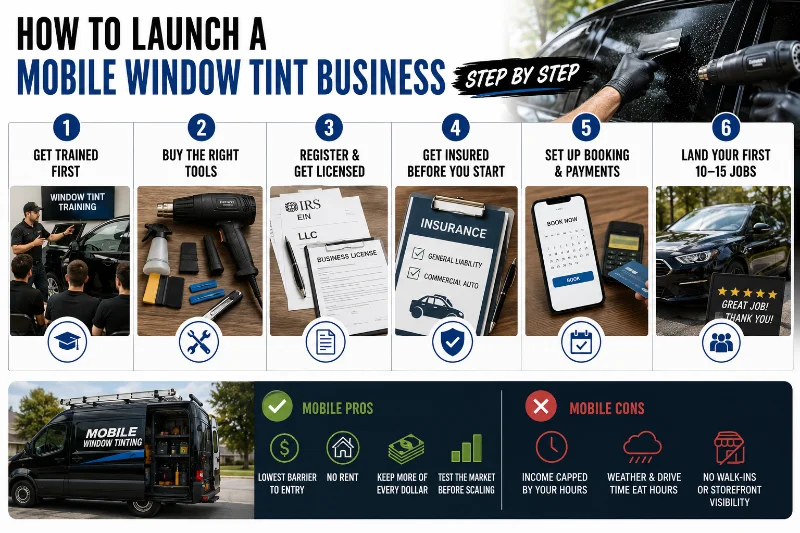
Mobile pros: lowest barrier to entry, no rent, you keep nearly 100% of what you charge above material cost, and you can test the market before committing more capital.
Mobile cons: income is capped by your own installing hours, weather and driving time cut into billable hours, and you have no walk-in traffic or storefront visibility to build passive demand.
Shop-Based Window Tint Business Startup Costs
A shop-based model trades lower overhead for a higher ceiling. You're now paying for a physical location, which means rent, build-out, and enough inventory to serve walk-in customers instead of scheduling one job at a time. This is where a lot of the $15,000 to $70,000 figures you've seen come from, and the table below shows why.
Startup Expense | Low-End | High-End |
|---|---|---|
Lease deposit & build-out | $5,000 | $35,000 |
Film & tint inventory | $3,000 | $10,000 |
Equipment (tint booth, plotter, tools) | $4,000 | $12,000 |
Signage & branding | $1,000 | $5,000 |
Business licenses & permits | $200 | $1,500 |
Liability & commercial property insurance | $1,200 | $3,500 |
POS/scheduling software & launch marketing | $600 | $3,000 |
Estimated Total | $15,000 | $70,000 |
The wide swing here, $15,000 on the low end to $70,000 or more once you factor in a prime location and full build-out, is the single biggest reason competing articles disagree so much on Window Tinting Business startup costs. A shop in a low-rent area with used equipment looks nothing like a shop in a busy retail corridor with a full showroom. Estimates above are synthesized from current lease/build-out costs, equipment supplier pricing, and state licensing fees; actual costs vary by location.
A Quick Breakeven Example
Say your shop's fixed monthly overhead (rent, insurance, software, a helper's wages) runs about $6,000. At an average ticket of $200 per vehicle and roughly 70% gross margin, each job nets you around $140 in gross profit after materials. That means you'd need approximately 43 jobs a month, or roughly 10-11 a week, just to cover overhead before you pay yourself. How quickly a shop hits that number varies a lot by market and marketing effort, some get there within a few months once word of mouth and local search visibility build, others take longer, which is why build-out quality and location matter as much as the sticker price on your lease.
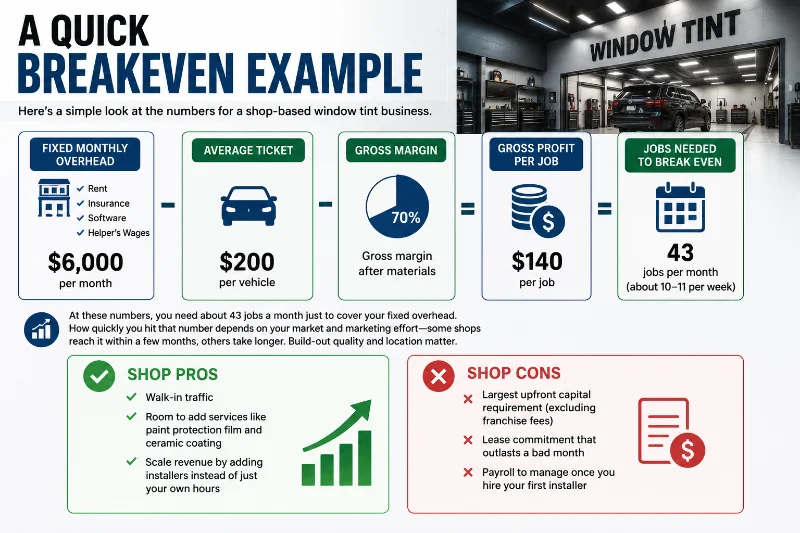
Shop pros: walk-in traffic, room to add services like paint protection film and ceramic coating, and the ability to scale revenue by adding installers instead of just your own hours.
Shop cons: the largest upfront capital requirement of the three models if you exclude franchise fees, a lease commitment that outlasts a bad month, and payroll to manage once you hire your first installer.
Window Tint Franchise Cost
Franchising is where the $150,000-plus figures come from, and it's also the model most competitor articles gloss over instead of breaking out separately. When you buy into a window tint or auto-appearance franchise, you're not just paying for equipment, you're paying for the brand, a training program, territory rights, and ongoing marketing support, and the franchisor usually requires a specific buildout and equipment package rather than letting you shop around for the cheapest option.
Startup Expense | Low-End | High-End |
|---|---|---|
Franchise fee | $15,000 | $50,000 |
Equipment & buildout package (franchisor-mandated) | $10,000 | $25,000 |
Initial film & product inventory | $3,000 | $8,000 |
Mobile unit or vehicle wrap (if required) | $0 | $12,000 |
Insurance & bonding | $1,500 | $4,000 |
Training & travel costs | $1,000 | $3,000 |
Grand opening marketing (franchisor-required) | $2,000 | $5,000 |
Working capital reserve | $3,000 | $8,000 |
Estimated Total | $35,500 | $115,000 |
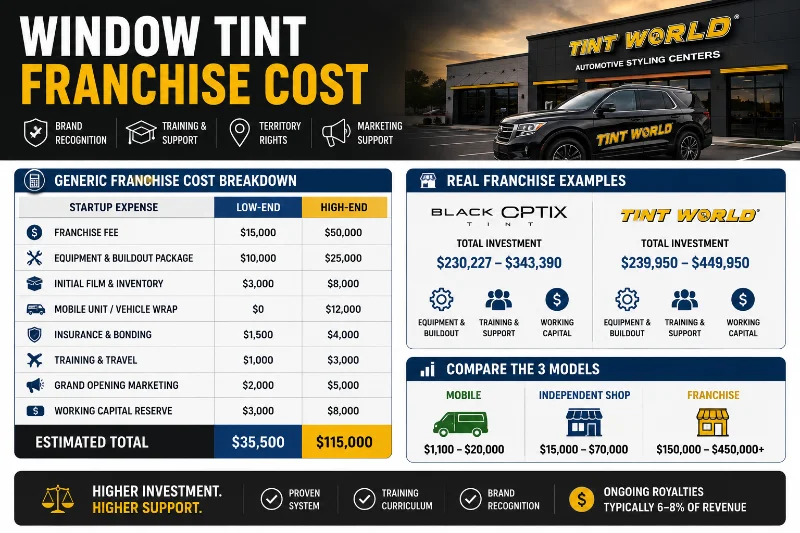
That $35,500-$115,000 range only covers a bare-bones franchise buy-in, and it's exactly why franchise costs get quoted so inconsistently. Named, currently operating franchises tell a very different story: Black Optix Tint's total investment runs $230,227-$343,390, and Tint World's runs $239,950-$449,950, once required buildout, working capital, and liquid-capital minimums are factored in (see the real examples below). Line the three models up and the story gets a lot more useful than any single number: mobile runs roughly $1,100-$20,000, an independent shop roughly $15,000-$70,000, and an established franchise realistically $150,000-$450,000 or more. The tradeoff for that franchise premium is brand recognition, an established training curriculum, and (in theory) a faster path to a full customer base, though you'll also owe ongoing royalties, typically a percentage of revenue, that cut into the margins covered later in this guide. The generic estimate table above is synthesized from franchisor fee schedules and equipment/buildout packages; actual costs vary widely by brand, which is why the named examples below matter more than the generic range.
What Real Window Tint Franchises Actually Charge
Generic ranges only tell part of the story, so here's what a few named window tint and auto-styling franchises actually disclose or have reported through franchise directories:
Tint World : total initial investment is $239,950-$449,950, including a $49,950 franchise fee. Tint World's own site lists a minimum net worth requirement starting around $150,000 and liquid capital starting around $100,000. Per its 2026 Franchise Disclosure Document (Item 19), the top 50% of Tint World stores averaged $1,066,581 in annual revenue, a 79% gross margin, and $318,463 in EBITDA.
Black Optix Tint : franchise directories list a franchise fee around $49,500 (reduced to roughly $39,600 for qualifying veterans), with an ongoing royalty around 6% of gross revenue.
Turbo Tint : franchise directories list a franchise fee around $45,000, positioned as a lower-cost entry point into branded auto-styling and tint franchising.
The spread between these real, named examples and the generic $35,500-$115,000 estimate above comes down to brand tier: some franchisors position themselves as an affordable path into a proven system, while others (like Tint World, with 151 locations across four countries (with 82 more in development) and over 40 years in business) charge closer to a full retail buildout because you're paying for a much bigger support infrastructure and brand footprint. Always request the franchisor's current Franchise Disclosure Document before signing anything; it's the only source of legally required, audited cost and earnings figures.
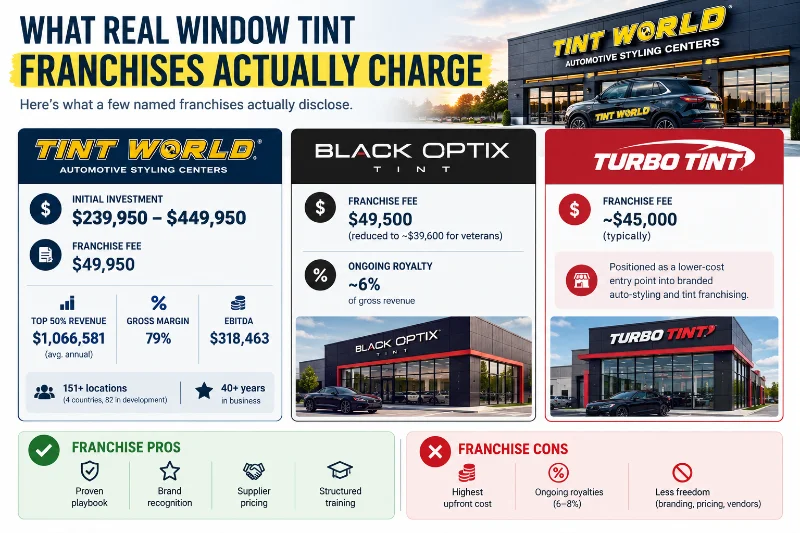
Franchise pros: a proven playbook, brand recognition on day one, negotiated supplier pricing, and structured training that shortens the learning curve most independent owners pay for through trial and error.
Franchise cons: the highest upfront cost of the three models, ongoing royalties (commonly 6-8% of gross revenue) that never go away, and less freedom to set your own pricing, branding, or vendor relationships.
Mobile vs. Shop vs. Franchise: Side-by-Side Comparison
Here's how the three models stack up once you put the numbers next to each other instead of reading about them in isolation.
Factor | Mobile | Shop-Based | Franchise |
|---|---|---|---|
Startup cost range | $1,100-$19,700 | $15,000-$70,000 | $35,500-$115,000+ |
Time to launch | 2-4 weeks | 2-6 months | 3-9 months |
Typical monthly overhead | Very low | Moderate-high | Moderate-high plus royalties |
Customer reach | Limited by drive time | Walk-ins + local reputation | Brand recognition helps |
Support & training | Self-taught or paid courses | Self-taught or hired staff | Structured, franchisor-led |
Growth ceiling | Capped by your own hours | Multiple bays, multiple techs | Multi-unit expansion possible |
Window Tinting Business Potential: US vs. UK vs. Australia vs. Canada
Startup costs are only half the story if you're weighing a Window Tinting Business against opportunities outside your own state. The legal tint limit in your market determines what you're even allowed to sell, and that shapes revenue far more than most cost guides admit. Here's how the numbers and regulations compare across four major markets.
Country | Legal Front-Window Tint Limit | Typical Full-Car Tint Price | What It Means for the Business |
|---|---|---|---|
United States | Varies by state: 20-70% VLT (CA 70%, NY 70%, FL 28%, TX 25%) | $150-$400 | Most fragmented rules of the four; permissive states support darker privacy-tint upsells, strict states push revenue toward ceramic/heat-rejection film instead |
United Kingdom | 75% VLT on windscreen, 70% VLT on front side windows (rear windows unrestricted) | £200-£500 | Practically no visible front-window tint is legal, so UK shops build revenue around rear-window privacy tint, ceramic/UV film, and MOT-compliance checks rather than full dark-tint jobs |
Australia | Varies by state/territory; Victoria: 70% windscreen, 35% front side windows, 20% behind driver (mirror-config caveat applies) | AU$300-$800 | In most states, a darker legal limit than the UK (and much of the US) supports fuller dark-tint jobs, but rules vary by state and territory, so installers need to verify local limits before quoting |
Canada | ~70% VLT in most provinces (rules vary provincially) | CAD $250-$600 | Similarly restrictive posture to the UK on front glass; provincial rules vary the way US state rules do, so installers need to verify local limits before quoting a dark-tint job |
Legal tint limits above are sourced from the UK government's official tinted-window guidance and Transport Victoria's window tinting rules for Australia; the U.S. figures reflect the state-by-state patchwork covered earlier in this guide, and every number should be reverified against your local regulator before you quote a job.
Window Tinting Business Profit Margins and Income Potential
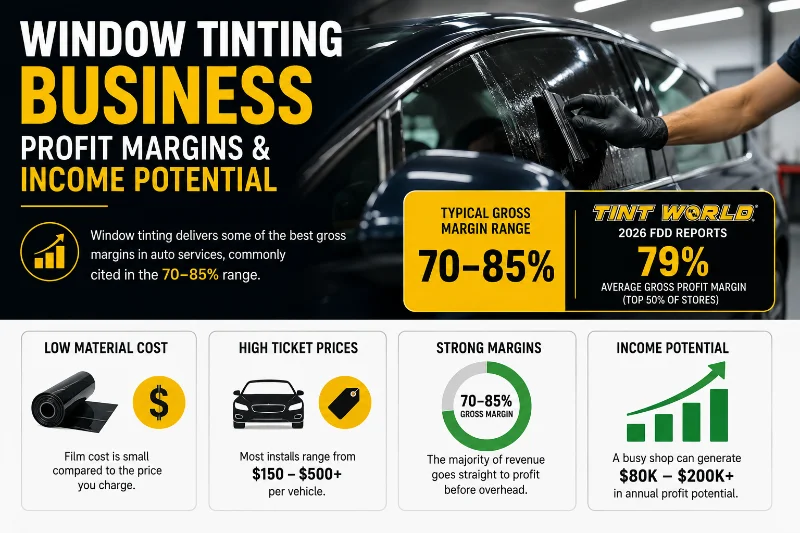
This is the part most cost breakdowns skip entirely, and it's arguably more important than the startup number itself. Window tinting carries some of the best gross margins in the auto services world, commonly cited in the 70-85% range, because the material cost of film is small relative to what customers pay for the labor and expertise of a clean install. That range isn't just an industry rumor: Tint World's own 2026 Franchise Disclosure Document reports a 79% average gross profit margin across the top half of its franchised stores, which lines up almost exactly with the commonly cited range.
A Worked Example: What One Job Actually Nets You
A full vehicle tint job might use $20-$40 of film but bill out at $150-$400 depending on your market and vehicle size. Here's roughly how that breaks down on a mid-range $250 SUV job:
Customer price: $250
Material cost (film, cleaning supplies): $30
Gross profit on the job: $220 (an 88% material margin — this is contribution before labor and overhead, not the same as the 70-85% business gross margin cited elsewhere)
Install time: roughly 1-1.5 hours for an experienced installer
Gross profit per billable hour: roughly $145-$220
Scale that out and a solo mobile operator completing just 4 jobs a day, 5 days a week, is grossing roughly $4,400-$5,000 a week before overhead. That math is exactly why window tinting shows up so often in "high margin side hustle" discussions, and why the income figures below aren't as far-fetched as they first sound.
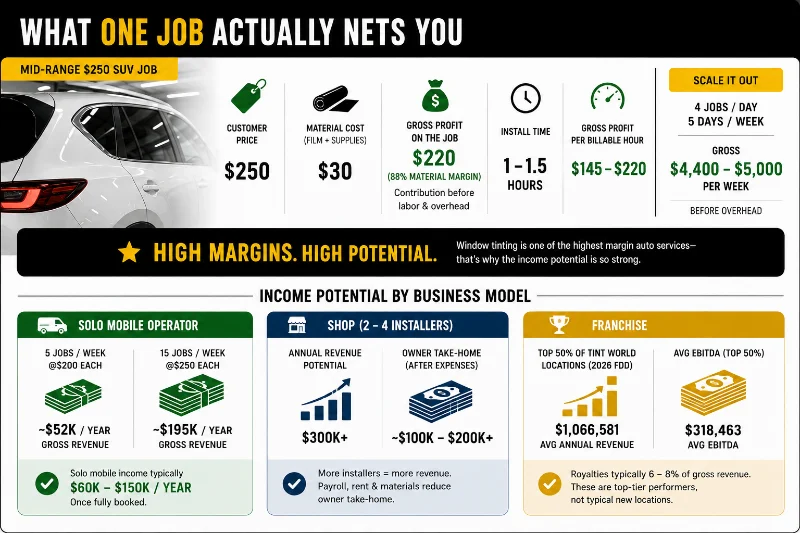
These are illustrative scenarios, not guarantees, but they show how the math scales with each model. A solo mobile operator doing 5 jobs a week at $200 each grosses roughly $52,000 a year; push that to 15 jobs a week at $250 and it's closer to $195,000, which is why solo mobile income is often cited in the $60,000-$150,000 range once someone is fully booked, since revenue is capped by one person's install hours. A shop with two to four installers can push well past $300,000 in annual revenue, and multi-bay shops with a strong retail presence are where the $700,000 figures come from, though owner take-home pay is naturally lower than gross revenue once payroll, rent, and materials are factored in. Franchises can reach similar or higher revenue to independent shops, backed by real disclosed numbers: The top 50% of Tint World locations averaged $1,066,581 in annual revenue and $318,463 in EBITDA (per its 2026 FDD Item 19), though royalty fees, typically 6-8% of gross revenue, come directly off the top before you calculate your own margin, and that figure represents top-tier performers, not a typical new location.
Which Model Should You Choose?
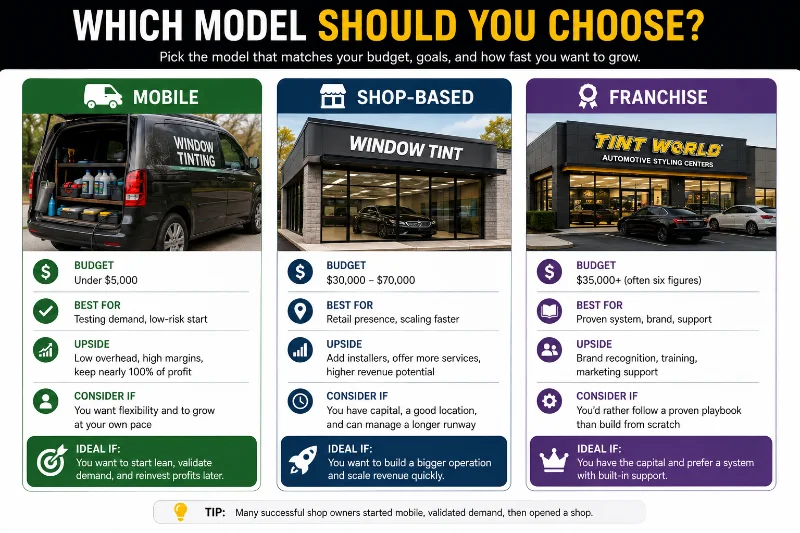
If your budget is under $5,000 and you want to validate demand before committing further, mobile is the obvious starting point, and plenty of successful shop owners started exactly this way before reinvesting profits into a location. If you already have $30,000-$70,000 in capital, retail experience, or a strong location in mind, a shop lets you build a bigger operation faster, but plan for a longer runway before you're consistently profitable. Franchising makes the most sense if you'd rather pay for a proven playbook than figure out marketing, pricing, and operations yourself, and you have $35,000 or more (often well into six figures for established brands) plus the patience to work within someone else's system.
Still weighing your options? See how the numbers stack up in our Amazon FBA Startup Costs breakdown, or check out the Amazon FBA vs. Dropshipping vs. Print on Demand comparison if you're deciding between business models more broadly.
Window Tint Business License Requirements, Insurance, and Legal Checklist
Every tier above assumes you'll handle the legal basics, and skipping them is one of the most common ways new owners lose money later. Here's the actual checklist to work through before you take your first paying job:
Business entity. Register an LLC (or start as a sole proprietor if your state allows it) to separate your personal assets from business liability.
EIN. Get a free Employer Identification Number from the IRS, even as a solo operator, since most banks and suppliers require one to open a business account.
General business license. Pull whatever city or county license applies to your service type; requirements vary widely by state and municipality.
Sales tax / reseller permit. In most states, film and product sales are taxable, and you'll often need a reseller certificate to buy inventory tax-free from distributors.
Trade or contractor license, if required. A handful of states and cities require a specific license for auto glass or window film work, so verify locally before you assume you don't need one.
General liability insurance. Close to non-negotiable; it protects you if a job damages a customer's vehicle or property.
Commercial auto insurance (mobile operators). Personal auto policies typically exclude business use, so a mobile setup needs a commercial policy or a rider.
Workers' compensation. Required in most states the moment you hire your first employee, even part-time.
Surety bond, if required. Some states, cities, and franchise agreements require a small surety bond before you can legally operate or advertise.
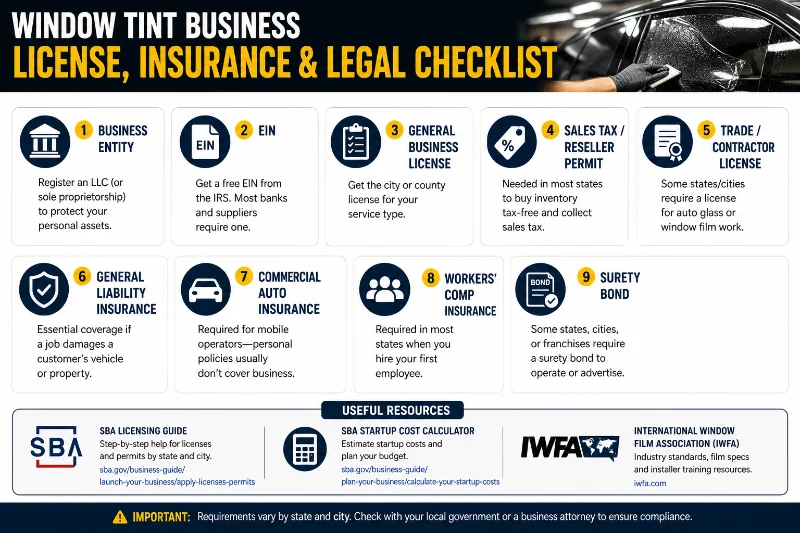
The SBA's guide to applying for licenses and permits is a good starting point for figuring out exactly what your state and city require, and its startup cost calculator can help you build a more detailed budget once you've picked a model. For film specifications and installer training resources, the International Window Film Association is the industry's primary trade body and a solid reference before you buy your first roll of film.
Frequently Asked Questions
How much does it cost to start a Window Tinting Business ?
It depends entirely on the model. Mobile runs $1,100-$19,700, shop-based $15,000-$70,000, and franchises $35,500-$115,000 or more, often well into six figures for established brands. There's no single correct number, only a correct one for the model you're building.
What is the average profit margin for a Window Tinting Business ?
Most window tinting businesses run gross margins between 70% and 85%, since film and consumable costs are low relative to labor charges; Tint World's 2026 FDD puts its top-half stores at 79%. Net margin, after rent, payroll, insurance, and marketing, is typically lower, often 15-30% depending on the model and how efficiently it's run.
How much can a Window Tinting Business make per year?
Annual revenue potential ranges from roughly $60,000-$150,000 for a solo mobile operator to $300,000-$700,000 or more for an established multi-installer shop, and top-performing franchise locations have disclosed averages north of $1 million. Owner take-home is lower than gross revenue after expenses, though tinting's high margins mean more of each dollar stays with the business than in most service industries.
How much does a window tint franchise cost?
Generic estimates run $35,500 to $115,000 or more, but real, named examples vary widely: Black Optix Tint and Turbo Tint list franchise fees in the $45,000-$49,500 range, while Tint World's total initial investment runs $239,950-$449,950. On top of the upfront cost, expect ongoing royalties of roughly 6-8% of gross revenue.
Is mobile window tinting profitable?
Yes, mobile is one of the more profitable ways to enter the industry, since startup costs are low and margins are high. A solo operator charging $150-$250 per vehicle with minimal overhead can reach solid take-home pay faster than a shop owner covering rent and payroll, though the tradeoff is a lower income ceiling since one person can only complete so many jobs a day.
Is a window tinting business profitable?
Yes, across all three models, gross margins commonly run 70-85% since material costs are low relative to what customers pay for installation. Mobile keeps the most profit per job since there's no rent or payroll, while shop and franchise trade some of that margin for the ability to scale past one installer.
Do you need a certification to start a Window Tinting Business ?
In most states, there's no specific license required just to tint windows, though you'll still need the general business licenses covered in the checklist above, and some states do require a trade license for auto glass or window film work specifically. Manufacturer-backed installer certifications from major film brands, or training through a body like the International Window Film Association, aren't usually legally required, but they help you land warranty-backed installs and higher-ticket commercial contracts.
The Bottom Line
The next time you see Window Tinting Business startup costs quoted as a single number, you'll know to ask which model that number is describing. Mobile, shop-based, and franchise operations aren't points on the same scale, they're three different businesses with different risk levels, timelines, and income ceilings, and now you have a real cost table, a worked profit example, and a legal checklist for each one instead of a vague range.
If you're still deciding, start with the guidance in the "Which Model Should You Choose" section above, then use the tables as a starting framework and build your own budget around the specific film brands, equipment, and location you're actually planning to use. Regional pricing for rent, insurance, and licensing can shift these numbers meaningfully in either direction, so treat every figure here as a well-sourced starting point, not a quote.