

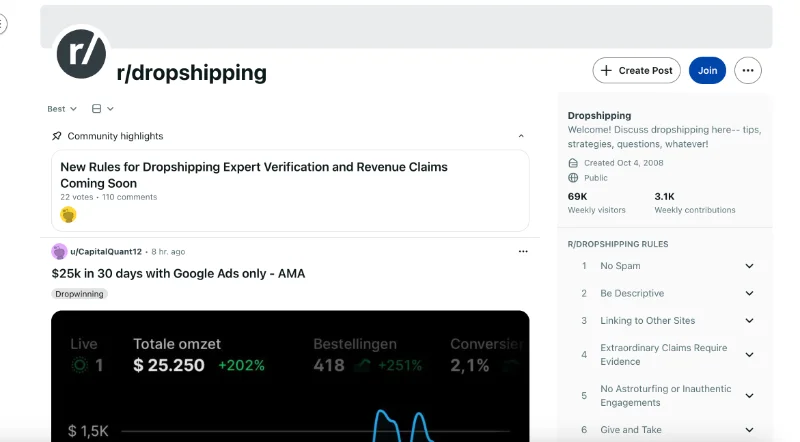
Let's be honest: if you've spent any time in r/dropshipping lately, you've seen the same argument play out on a loop. Someone posts asking if  Dropshipping is dead in 2026, a small flame war breaks out in the replies, and somewhere in the middle of it a genuinely useful nugget of advice gets buried under gatekeeping, guru-bashing, and at least one person asking "what about 2027 tho?" We went through dozens of these threads so you don't have to, pulled out what people are actually saying instead of what course marketing pages want you to believe, and put it together here.
The Quick Answer
No, Dropshipping isn't dead in 2026. The version of it that's dead is the lazy one: pick a random trending product, slap it on a generic store, run a few ads, and wait for passive income to roll in. Here's what the community consensus actually looks like once you filter out the noise.
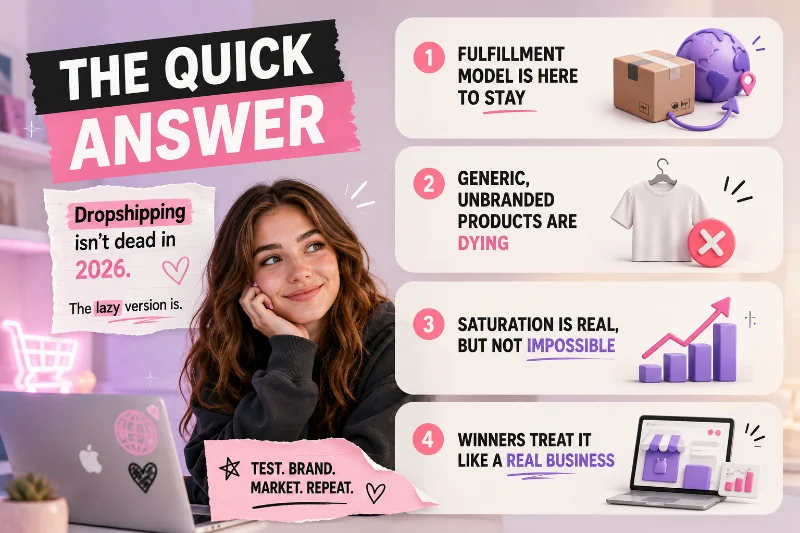
The fulfillment model (supplier ships directly to the customer) hasn't changed and isn't going anywhere.
What's actually dying is generic, unbranded products with zero differentiation.
Saturation is real, but it's competitive, not impossible, according to sellers still active in the space.
The sellers who are winning treat it like an actual business: testing discipline, branding, and marketing skill, not a shortcut to passive income.
The "Dropshipping Is Dead" Debate, Explained
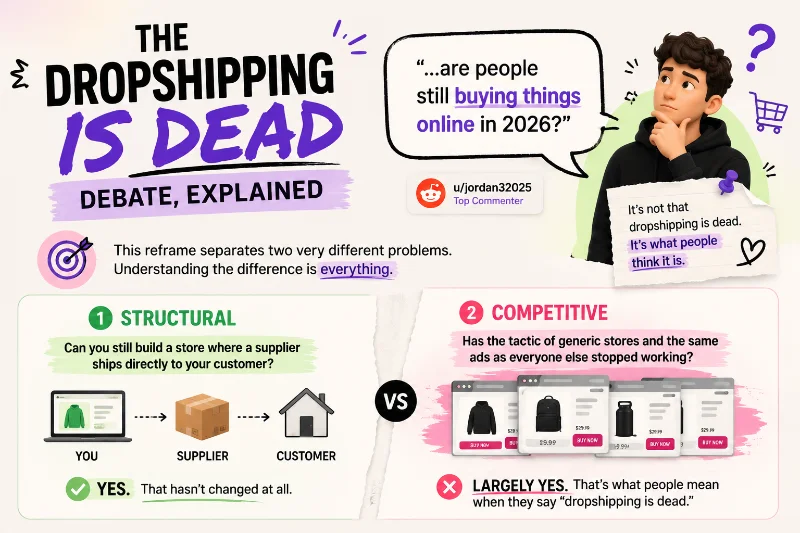
The phrase gets thrown around so often it's almost lost meaning. But in a recent thread asking directly whether Dropshipping is dead in 2026, one of the most upvoted replies reframes the whole question about as cleanly as anything we found digging through these threads. One commenter, jordan32025, broke it down like this:
"...are people still buying things online in 2026?"
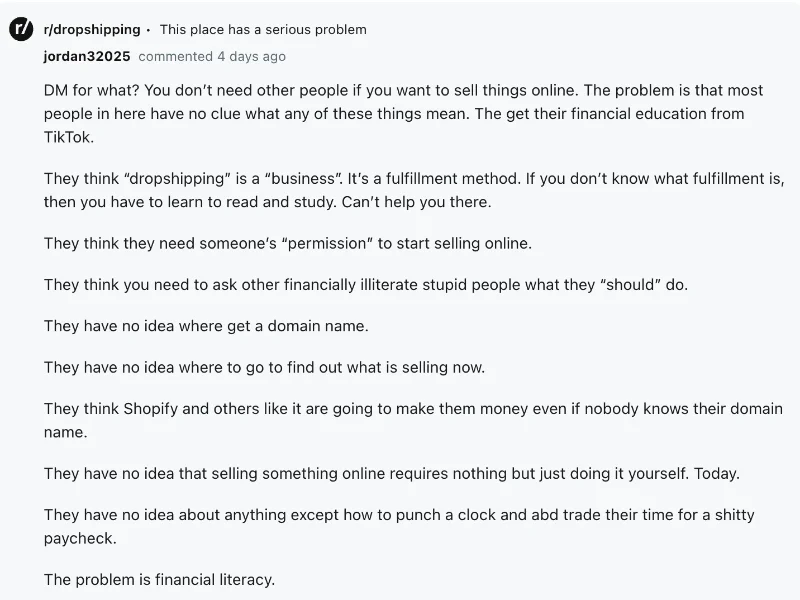
That reframe matters because it separates two very different problems. One is structural: can you still build a store where a supplier ships directly to your customer? Yes, that hasn't changed at all. The other is competitive: has the specific tactic of throwing up a generic store and running the same ads as everyone else stopped working? That part is largely true, and it's usually what people actually mean when they say dropshipping is "dead."
What Reddit Says Is Actually Killing It
Scroll through enough  reddit threads and the same complaints repeat like clockwork. Niche and product saturation comes up constantly. Generic, no-brand items copied from whatever's trending on TikTok are brutally competitive now, and sellers are blunt about it. One commenter summed up the current state of generic products pretty bluntly:
"Selling unbranded desk fans is definitely over unless u want to pump VOLUME on TikTok shop."
Then there's the guru economy. Posts from sellers who paid thousands for a mentorship or "accelerator" program are extremely common, and the sentiment toward expensive courses promising fast riches is overwhelmingly skeptical. One recent post from a seller who paid $6,000 for a dropshipping mentorship racked up dozens of comments, most of them some version of "I wish someone had talked me out of this."
There's also a real gap between the success stories that go viral and what most sellers actually experience day to day. One widely discussed post from a seller now clearing close to $2,000 a day walks through five to six months of failed products, restricted ad accounts, and near-total discouragement before anything worked. The comment section is split right down the middle, between people cheering him on and others openly questioning whether the numbers are even real, with one reply cutting straight to the point:
"If someone was making $2k profit a day...do you think they'd be here on Reddit?"
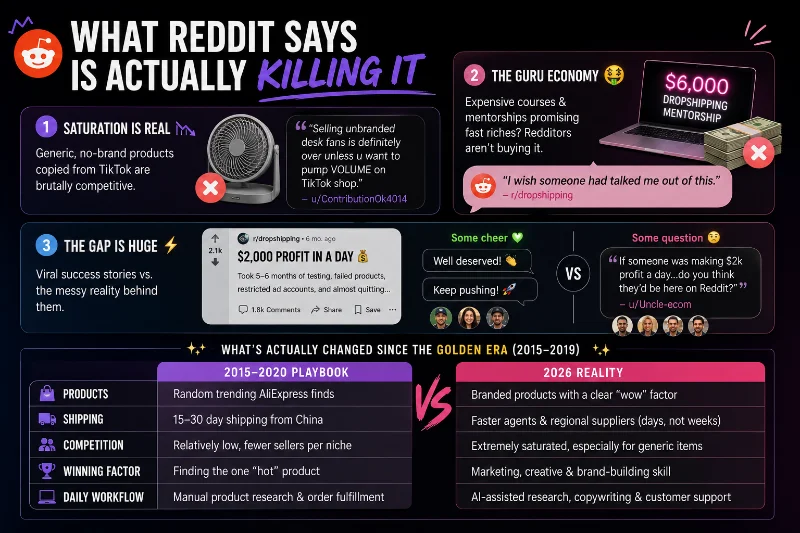
That mix of inspiration and suspicion is basically the emotional temperature of the entire subreddit right now. So what's actually changed since the "golden era" of dropshipping around 2015-2019? Here's the honest side-by-side:
Aspect | 2015-2020 Playbook | 2026 Reality |
|---|---|---|
Products | Random trending AliExpress finds | Branded products with a clear "wow" factor |
Shipping | 15-30 day shipping straight from China | Faster agents and regional suppliers cut delivery to days, not weeks |
Competition | Relatively low, fewer sellers per niche | Extremely saturated, especially for generic, undifferentiated items |
Winning factor | Finding the one "hot" product before anyone else | Marketing, creative, and brand-building skill |
Daily workflow | Manual product research and order fulfillment | AI-assisted research, copywriting, and customer support layered on top |
What's Actually Working in 2026
Underneath all the skepticism, a few consistent themes show up whenever someone describes an approach that's actually working for them right now.
Branding still separates survivors from everyone else. It's the flip side of the saturation complaints above: stores that build an actual identity around a product tend to outlast the ones just relisting whatever's trending.
Winning angles matter more than winning products. Multiple sellers make the point that the product itself often isn't the differentiator, since plenty of people sell the exact same item sourced through the same suppliers. The offer, creative, positioning, and audience targeting is where stores actually win or lose.
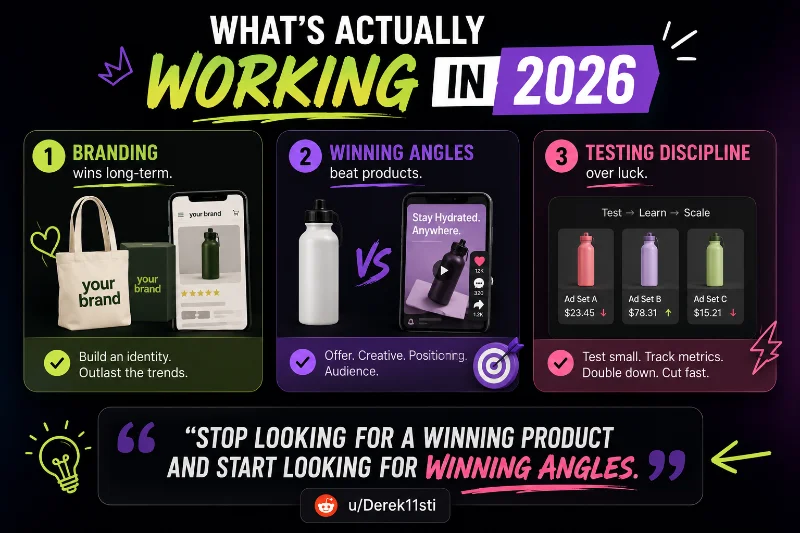
Testing discipline is non-negotiable. A recurring theme is treating product testing like a real process instead of a guessing game: test small, track margins and conversion rates closely, and cut underperformers fast instead of getting emotionally attached. One recent post breaking down a $3,221 sales day specifically credited a disciplined testing process, not luck, for the result.
None of this is secret information, either. As one seller who eventually built a profitable store put it after months of failure:
"Stop looking for a winning product and start looking for winning angles."
Tools Redditors Actually Mention (Not Just Gurus)
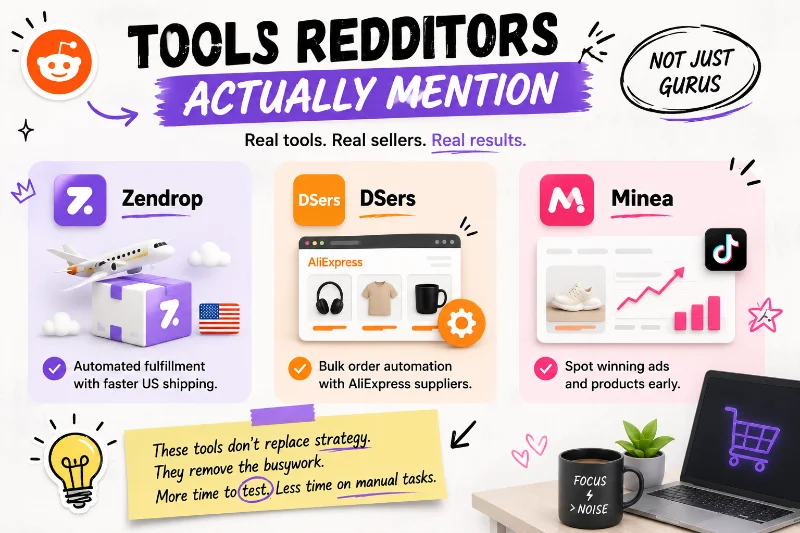
One thing that's genuinely different from the 2018 era is how much of the manual grind can now be handed off. When people talk about their actual toolkits instead of the "secret sauce" a course sold them, a handful of names come up over and over:
 Zendrop , for automated fulfillment with noticeably faster US shipping than the old China-direct model.
 DSers , for bulk order automation with AliExpress suppliers.
 Minea , for spotting winning ads and products before they're everywhere.
None of these replace strategy. They just take the busywork off your plate so you can spend more time testing and less time processing orders by hand.
Who Should (and Shouldn't) Try It in 2026
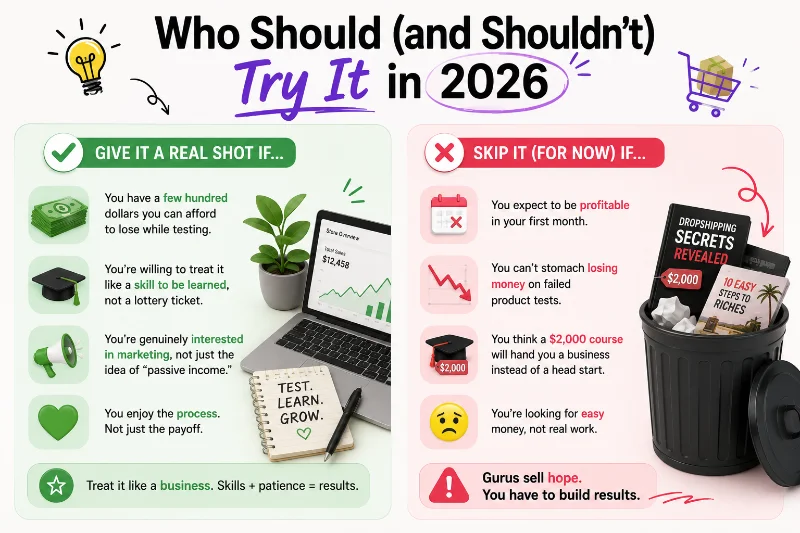
Give it a real shot if you've got a few hundred dollars you can afford to lose while testing, you're willing to treat it like a skill to be learned rather than a lottery ticket, and you're genuinely interested in marketing, not just the idea of "passive income." The people who stick around long enough to see results tend to be the ones who enjoy the process itself, not just the payoff.
Skip it, at least for now, if you're expecting to be profitable in your first month, you can't stomach losing money on failed product tests, or you're hoping a $2,000 course is going to hand you a business instead of a head start. As more than one burned-out Redditor has pointed out, the "gurus" selling the dream are almost always making more from the course than from the store they're teaching you to build.
Frequently Asked Questions
Is dropshipping still profitable in 2026?
Yes, for sellers who execute well. Profitability now depends much more on branding, testing, and marketing skill than on finding some undiscovered product. Stumbling into profit by luck alone is a lot rarer than it used to be.
Is dropshipping saturated in 2026?
Certain niches and generic products are, yes. But sellers actively in the space describe it as competitive rather than impossible, since new sub-niches and product angles open up constantly. The bar for winning is just higher than it used to be.
How much money do you actually need to start dropshipping in 2026?
There's no single number, but most sellers who talk openly about their budgets mention a few hundred dollars set aside specifically for product testing and ad spend, separate from store setup costs. Treat early losses as the cost of learning, not a sign you did something wrong. If you're starting from scratch, our step-by-step guide on how to start dropshipping walks through the full setup process.
Are dropshipping "gurus" and mentorships worth the money?
Rarely, based on how often they come up as cautionary tales rather than success stories. Most of the genuinely useful information (testing discipline, niche research, ad strategy) is freely discussed in communities like r/dropshipping on reddit . A paid program can offer structure and accountability, but it's not a shortcut past doing the actual work.
Can dropshipping actually scale into a real, long-term business?
Yes, though at that point it usually stops looking like "dropshipping" in the stereotypical sense and starts looking like a normal e-commerce brand, often with its own inventory, private-label products, or in-house fulfillment. Dropshipping is frequently just how people validate an idea before investing further.
The "is dropshipping dead" post is going to get made again next January, and the year after that, because declaring an entire business model dead makes for a better headline than admitting the real answer: it got harder, not extinct. The sellers still around in twelve months won't be the ones who found a loophole. They'll be the ones who stopped looking for one.