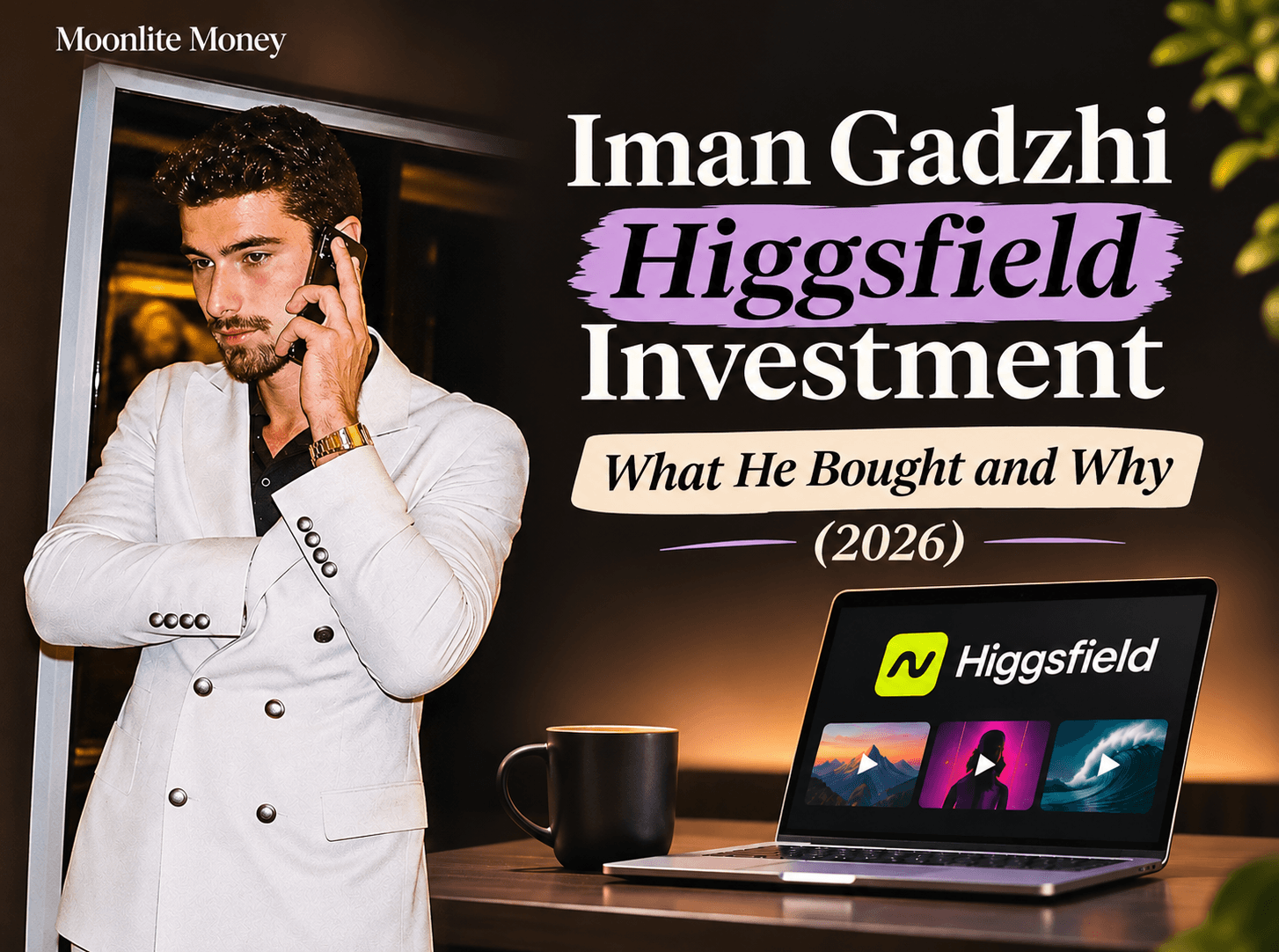

 Iman Gadzhi built his name teaching people how to run content agencies. In October 2026, he bought into the company that could make half of that work disappear.
The Iman Gadzhi Higgsfield deal went public on October 8 through a press release, and Iman confirmed it himself on X four days later. He's now an investor and advisor at  Higgsfield AI, an AI video company valued at $5.4 billion. What the announcement left out is how much he paid, what exactly he owns, and why the news landed just weeks before his biggest free challenge of the year.
We went through the press release, Higgsfield's own numbers, Iman's posts and a long trail of Reddit threads to piece together the full story.
The Iman Gadzhi Higgsfield Deal at a Glance
Detail | What we know |
|---|---|
Investor | Iman Gadzhi |
Company | Higgsfield AI, an AI video and image platform |
His role | Investor and advisor |
Announced | October 8, 2026 (press release) and October 12, 2026 (his X post) |
Amount invested | Not disclosed |
When he bought in | Earlier in 2026, kept private until October |
Higgsfield valuation | $5.4 billion (August 2026 Series B) |
Higgsfield revenue | Over $1 billion annualized run rate (September 2026, company reported) |
First, What Is Higgsfield?
If you've seen an AI clip of a celebrity dropped into a famous movie scene, there's a decent chance it came from Higgsfield. Its Iconic Scenes feature went viral in 2025 and put the company on the map for a lot of casual creators.
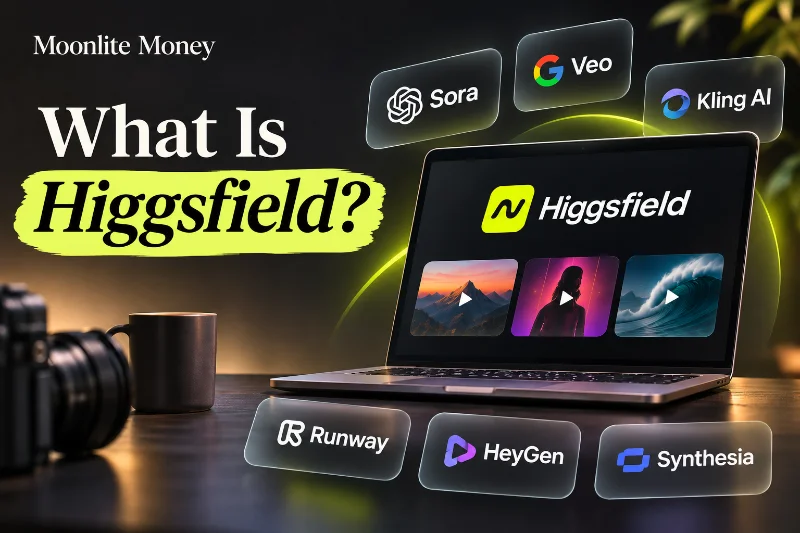
Behind the viral clips is a serious business. Higgsfield was founded in 2023 by Alex Mashrabov, who previously led generative AI at Snap, together with Yerzat Dulat and Mahi De Silva. The browser app launched in March 2025. The company is based in San Francisco, but its engineering and production teams work out of Almaty, Kazakhstan, which is where Iman filmed his announcement.
The simplest way to think about it: one subscription, a whole stack of video models. Alongside its own Soul models, Higgsfield gives you access to tools like  Sora, Google Veo,
 Kling AI and Seedance in one place. It has also added ready-made workflows for ads, short-form clips and AI influencers.
Its main rivals are  Runway on the cinematic side, and avatar tools like
 HeyGen and Synthesia. If you're weighing AI ad tools, our ClipLoft review is worth a look.
How Much Did Iman Gadzhi Invest in Higgsfield?
Nobody outside the deal knows. The press release, the Dealroom coverage and Iman's own posts all skip the amount and the percentage. What we do know is that he secured the position earlier in 2026 and kept it quiet until October.
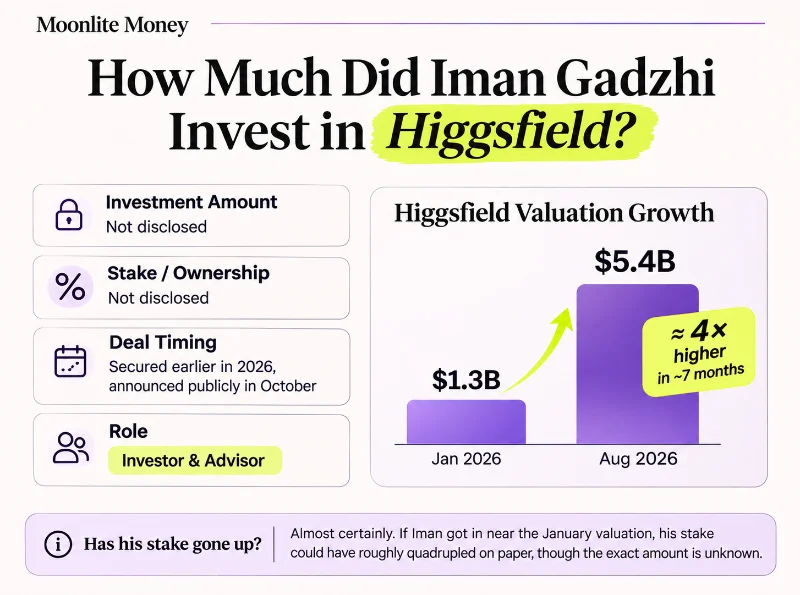
The advisor title is the more interesting part. On October 12, he posted that he was proud to be "an investor & advisor" at Higgsfield. By October 24 he was saying he works with the team every week and that the tool has changed how his own marketing department operates. That same day, he shared NVIDIA CEO Jensen Huang praising Higgsfield's founders, adding: "You know you made the right investment."
Has his stake gone up?
Almost certainly, though we can't say by how much. Higgsfield was valued at $1.3 billion in January 2026 and $5.4 billion by August. If Iman got in anywhere near the January price, his stake could have roughly quadrupled on paper in a few months. Without knowing his entry point, any headline claiming he "made millions" from Higgsfield is a guess.
Higgsfield's Numbers, and What They Actually Mean
Date | Milestone |
|---|---|
March 2025 | Browser app launches |
September 2025 | $50 million Series A |
January 2026 | $80 million extension at a $1.3 billion valuation, about $200 million run rate |
June 2026 | Reported $500 million run rate |
August 2026 | $400 million Series B led by DST Global at $5.4 billion, $700 million run rate |
September 2026 | Crosses $1 billion annualized run rate |
October 8, 2026 | Iman Gadzhi stake made public |
October 23, 2026 | NVIDIA and TCV join in a Series B extension |
That $1 billion figure needs one asterisk. It's a run rate, which Higgsfield calculates by taking its latest four weeks of revenue and multiplying by 13. It tells you the current pace, not money banked over a full year. Still, going from roughly $20 million to $700 million in twelve months, as The Next Web reported, is not normal for any software company.
The backers aren't hype money either. DST Global led the Series B, with Goldman Sachs, Intel Capital and Tribe Capital in the round, and NVIDIA and TCV joined in October. Higgsfield now claims more than 40 million users and nearly one million paying subscribers, and most of its revenue comes from businesses rather than individual creators.
Why Iman Says He Did It
His reasoning goes back to where he started. Before the courses and the YouTube channel, Iman ran a small media agency: one editor, one camera, a lot of all-nighters. If you didn't have a team or a budget back then, you couldn't compete on content. His argument is that a single Higgsfield subscription now replaces the editors, producers and designers he used to need.
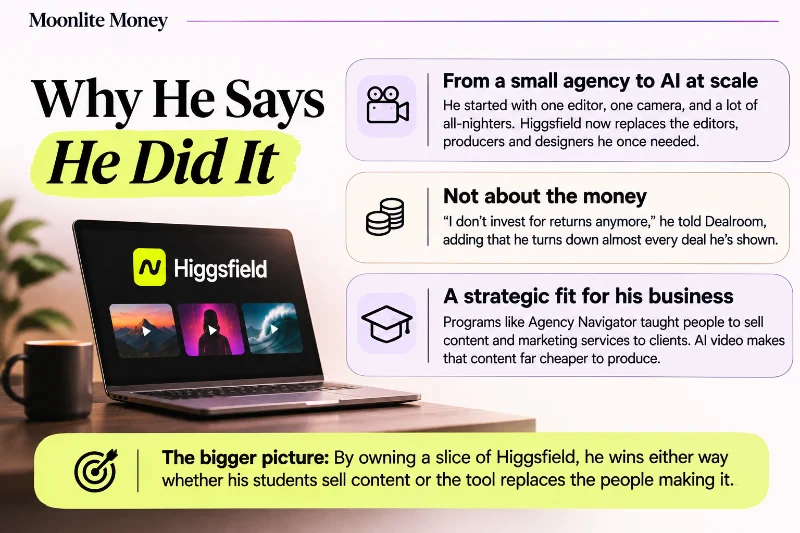
He also insists the money isn't the point. "I don't invest for returns anymore," he told Dealroom, adding that he turns down almost every deal he's shown.
It's a good line, and it may well be true. It's also worth noticing how neatly the deal fits his business. For years, programs like  Agency Navigator taught people to sell content and marketing services to clients. AI video makes that content far cheaper to produce. Owning a slice of the tool means Iman wins either way: whether his students sell content or the tool replaces the people making it.
Where the AI Income Challenge Fits In
A few weeks after the announcement, Iman launched his free five-day AI Income Challenge (November 7 to 15, 2026), co-hosted with  Mark Tilbury. Some critics have framed the whole thing as a Higgsfield sales funnel. The real picture is a bit more nuanced. For more on his co-host, see our Mark Tilbury net worth breakdown.
The "$373 a day" pitch isn't new. Iman was already using it in September 2025, in a video called "Laziest Way To Make Money With AI ($373/day+)", long before his stake was public. The core idea is selling AI-made digital products, and the paid next step is  Monetise, his education brand.
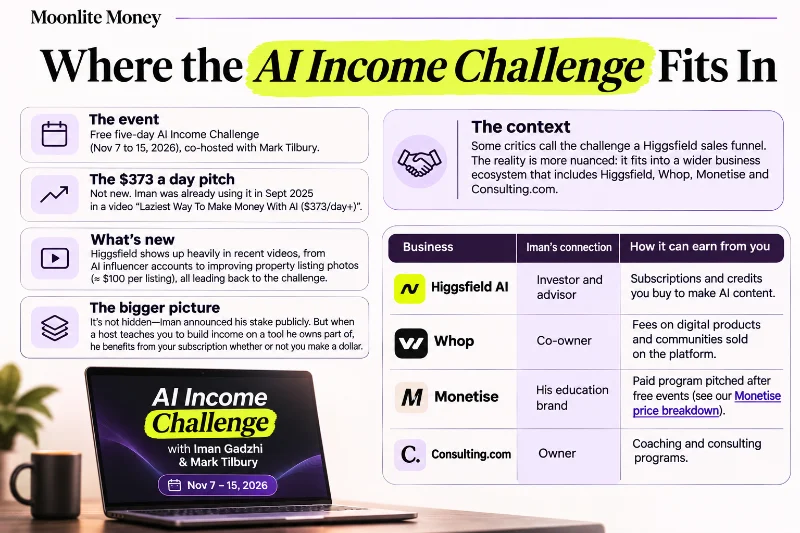
What's new is how much Higgsfield shows up around the challenge. Mark Tilbury's recent videos lean on it heavily. In one, he spends seven days building AI influencer accounts with Claude and Higgsfield. In another, the first money-making method he walks through is improving property listing photos with Higgsfield and selling them for around $100 a listing, and the video ends with a promo for the AI Income Challenge. Reviews of the November event also lead with Iman's Higgsfield investment.
None of this is hidden. Iman announced the stake publicly. But it's worth keeping in mind as you watch: when a host teaches you to build income on tools he owns part of, he benefits from your subscription whether or not you ever make a dollar. Our full review of the Iman Gadzhi AI workshop covers the challenge, the upsell and the earnings claims in detail.
Business | Iman's connection | How it can earn from you |
|---|---|---|
Investor and advisor | Subscriptions and credits you buy to make AI content | |
Co-owner | Fees on digital products and communities sold on the platform | |
His education brand | Paid program pitched after free events (see our Monetise price breakdown) | |
Consulting.com | Owner | Coaching and consulting programs |
 Whop
The Higgsfield Complaints You Should Read Before Paying
Higgsfield's growth has come with a loud stream of unhappy customers, and if the challenge pushes you toward a subscription, you should know what people complain about.
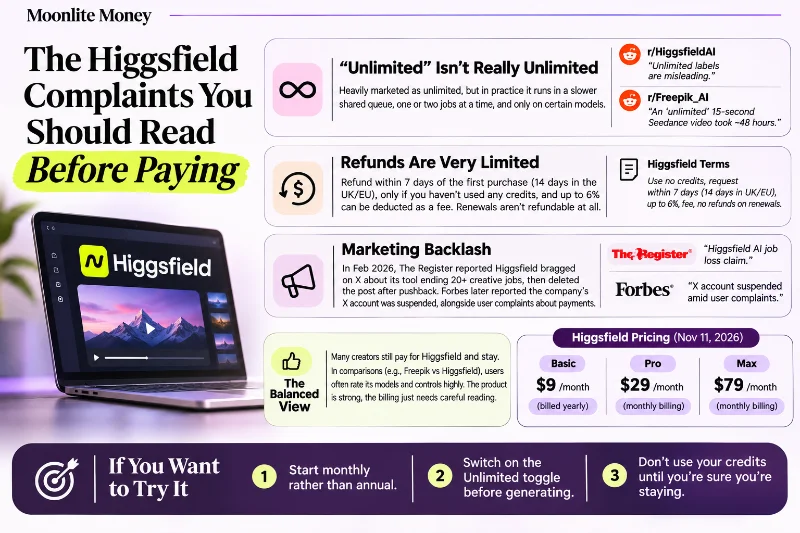
The biggest issue is the word "unlimited." Higgsfield has heavily marketed unlimited plans, but in practice unlimited generations run in a slower shared queue, one or two jobs at a time, and only on certain models. In one r/HiggsfieldAI thread, a user decided the pros outweighed the cons, while a commenter called the unlimited labels misleading. In another thread, a user said an "unlimited" 15-second Seedance video took about 48 hours to generate.
Refunds are the second sore point. Under Higgsfield's terms, you can only get a refund within 7 days of your first purchase (14 days in the UK and EU), only if you haven't used a single credit, and up to 6% can be deducted as a fee. Renewals aren't refundable at all. So if you accidentally buy an annual plan and generate even one image, that money is likely gone.
Then there's the marketing. In February 2026, The Register reported that Higgsfield bragged on X about its motion design tool ending more than 20 creative jobs, then deleted the post after artists who use the product pushed back. Forbes later reported that the company's X account had been suspended, alongside user complaints about payments.
To be fair, a lot of people pay for Higgsfield and stay. Creators comparing it with rivals in threads like this Freepik vs Higgsfield discussion often rate its models and controls highly. The product is strong. The billing just needs careful reading.
If you want to try it, start monthly rather than annual, switch on the Unlimited toggle before generating, and don't touch your credits until you're sure you're staying. When we checked the pricing page on November 11, 2026, individual plans started at $9 a month for Basic (billed yearly), with Pro at $29 a month and Max at $79 a month on monthly billing. Promotions change almost weekly, so check before you pay.
The Bigger Picture: Iman Isn't Just a Course Guy Anymore
Put his 2026 moves side by side and the direction is clear. He took full ownership of Consulting.com, he co-owns Whop, and now he holds a piece of one of the fastest-growing AI companies in the world. You can see the full list in our guide to Iman Gadzhi's companies.
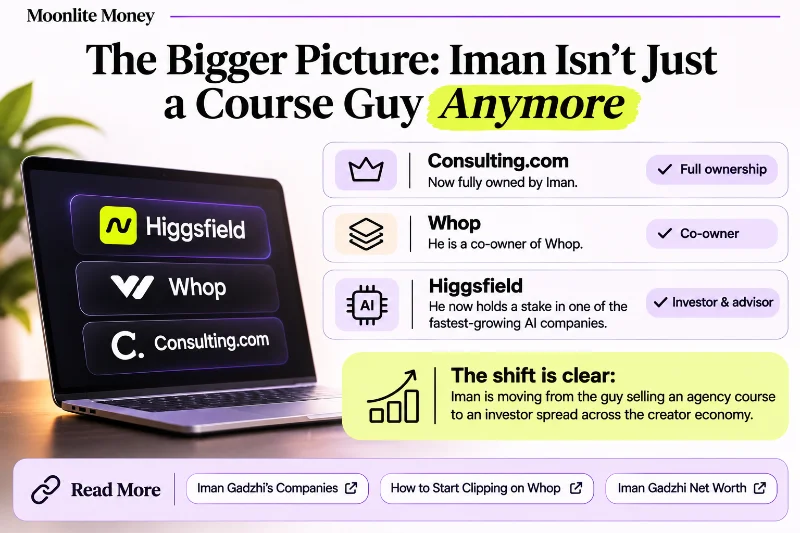
He's quietly moving from the guy selling an agency course to an investor spread across the creator economy. If you want to earn on Whop yourself, our guide on how to start clipping on Whop is the easiest place to begin. That also makes his wealth harder to estimate, since private stakes like this one never show up in public filings. Our Iman Gadzhi net worth breakdown explains what can and can't be verified, and is Iman Gadzhi legit covers the criticism he's faced over the years.
So, Should This Change Anything for You?
If you make content, Higgsfield is worth testing on its own merits. Run the same project through it, Kling and Runway, and pick whatever gives you the best result for your money. Don't pick it because someone with equity told you to. Our guide on how to make money with Higgsfield AI covers six realistic ways to use it.
If you're joining the challenge, free training is free training. Take notes, ignore the urgency, and remember that both the tool and the paid program at the end make money for the host.
And if you see a headline claiming Iman made a fortune from Higgsfield, skip it. The size of his stake has never been made public.
FAQ
Did Iman Gadzhi buy Higgsfield?
No. He bought an undisclosed minority stake and took an advisor role. Higgsfield is still run by its co-founder and CEO, Alex Mashrabov.
How much did Iman Gadzhi invest in Higgsfield?
The amount hasn't been disclosed by Iman, Higgsfield or any outlet covering the deal.
When did Iman Gadzhi invest in Higgsfield?
He secured the stake earlier in 2026 and announced it in October 2026, through a press release on October 8 and an X post on October 12.
Is Higgsfield AI legit?
Yes, it's a real company backed by DST Global, Goldman Sachs, Intel Capital, NVIDIA and TCV, with tens of millions of users. It also has a documented history of complaints about "unlimited" plans, billing and refunds, so read the terms before paying.
Is the AI Income Challenge built on Higgsfield?
Partly. The $373/day digital products pitch predates the investment, but co-host Mark Tilbury's money-making methods lean heavily on Higgsfield, and the investment features prominently in coverage of the November challenge.