
Making money is incredibly easy in 2026, but only when you know the right numbers to start with!
If you’re on Reddit looking for ways to make money in 2026, it’s highly likely to get lost in the flood of  Amazon FBA posts.
Sellers often share how much money you can make through FBA, or the best low-competition niches, yet they rarely mention the crucial information: Amazon FBA startup costs.
Worry no more. We’ve broken down all costs regarding Amazon FBA to help you start your business effortlessly.
Let’s get started!
What is FBA?
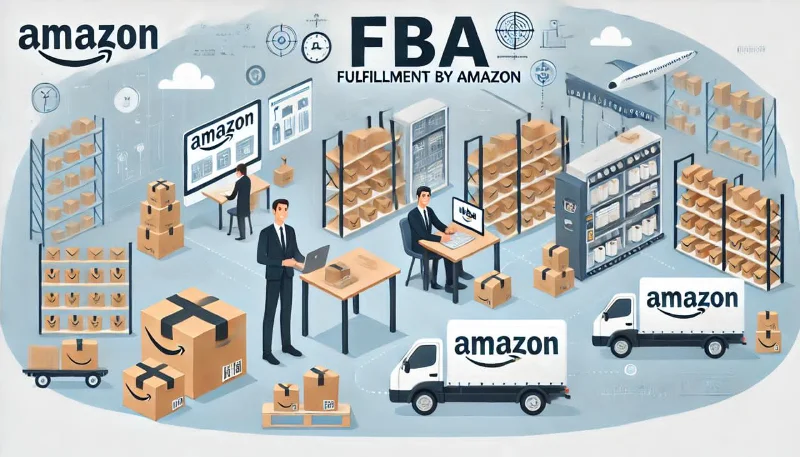
FBA or Fulfillment by Amazon is a program offered by Amazon to help you outsource order fulfillment to Amazon to provide free and quick (two-day) delivery through Prime.
Once you’ve enrolled in Amazon FBA, all you have to do is send your products to Amazon’s global network of fulfillment centers. From there, Amazon handles everything: they pick, pack, and ship orders on your behalf and also handle Customer Chat Support and returns after shipments.
How Much to Start Amazon FBA
Now that you know what Amazon FBA exactly is, we’re off to the big question, “How much does it cost to start an Amazon FBA business?”
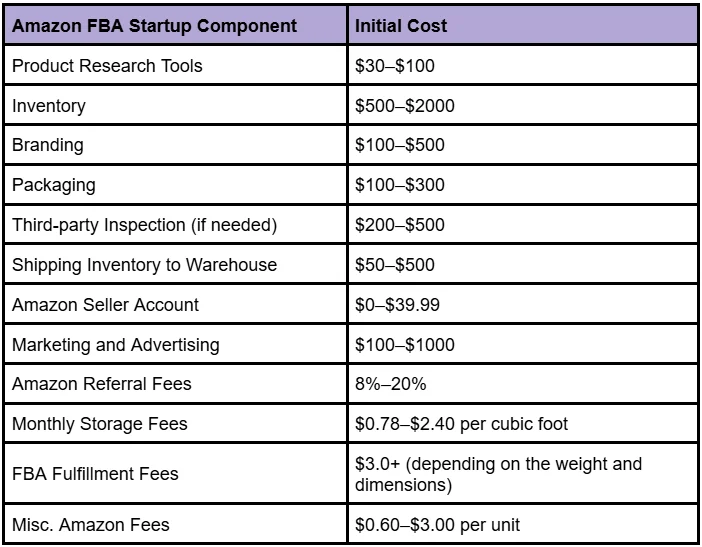
The cost of starting an Amazon FBA business includes multiple factors, such as product research, account fees, branding, packaging, marketing, and fulfillment.
Here’s everything you will need to consider when calculating your initial Amazon FBA investment (based on real seller cost breakdowns and Amazon's published fee schedule)
Product Research
You might think that manual research is enough for product research, but when you’re searching for high-demand niches on Amazon, you will need Amazon FBA tools to verify your data.
 junglescout and
  Helium 10 are among the most popular and effective tools, costing you between $30 to $100 per month. You can also use
  Keepa
Keepa  SmartScout or
 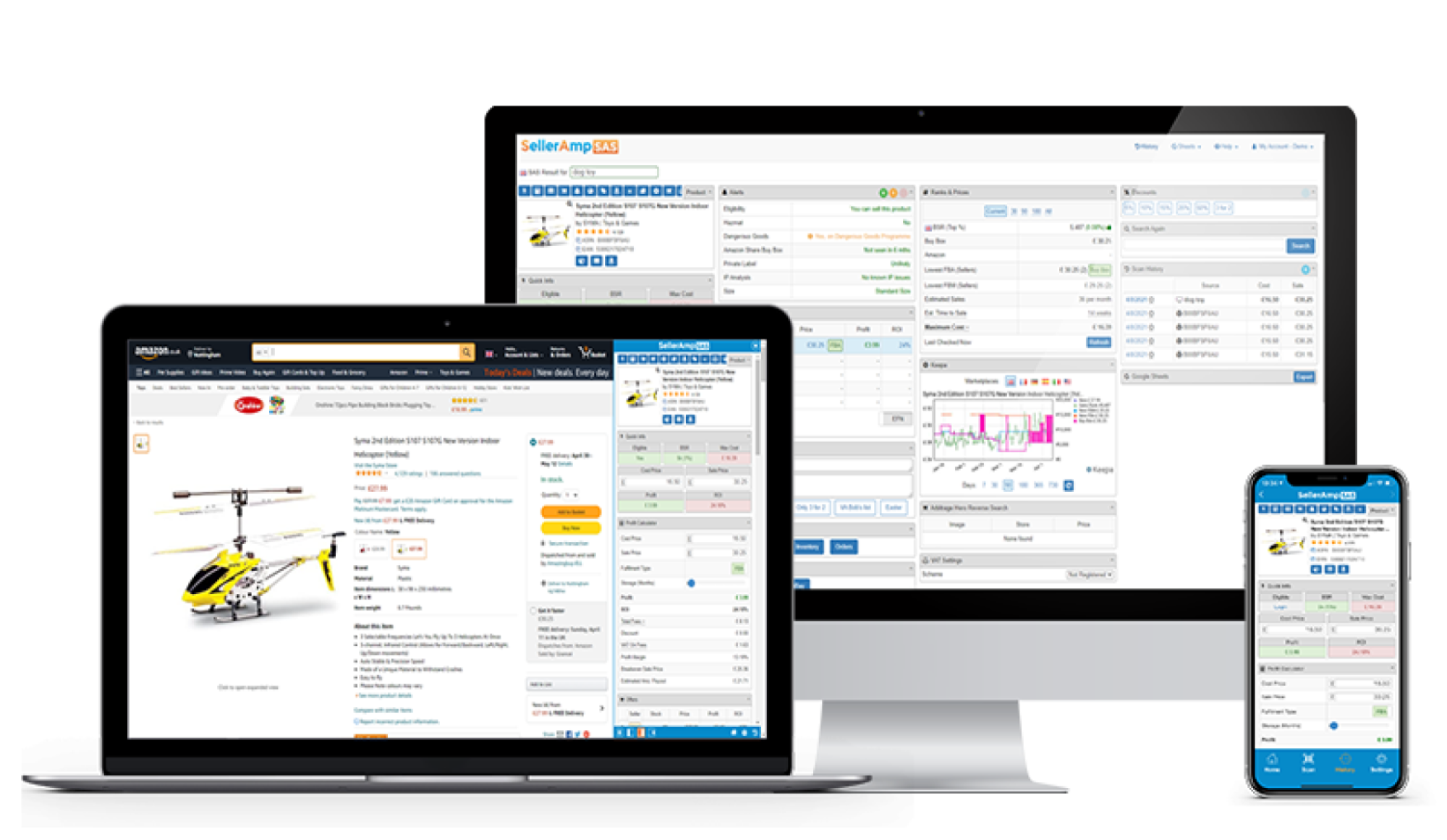 Seller Amp to find products for your Amazon business.
Inventory
Unless you opt for Dropshipping or Print-on-demand, inventory can cost you between $500 to $2,500, depending on the products you want to sell.
Amazon Seller Account
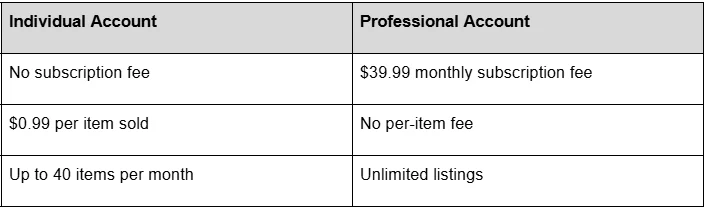
You can opt for an individual account or a professional seller account on Amazon.
Branding and Packaging
Branding for an Amazon Private Label business can cost around $100 to $500, whereas packing may cost an additional $100 to $300, according to your product’s packaging requirements.
Shipping
While Amazon fulfills the orders for you, it is important to consider the cost of shipping the inventory to Amazon when calculating Amazon FBA startup costs.
Amazon Fees
Amazon charges referral, fulfillment, and storage fees on every sale. Rates vary by category, size, and season — we break down the exact current numbers, plus the 2026 fee changes, in the full fee section below.
Marketing and Advertising
Advertising & Promotion is critical to Amazon FBA success as it helps drive traffic to your store. It is suggested to boost with $100 to $500 and increase or decrease ad spend according to results.
Moreover, influencer marketing and social media promotions could help you stand out. It is safe to start with $100 to $300 initially. Spend them wisely!
Amazon FBA Course
If you do not have a mentor to guide you about Amazon FBA, looking into some credible Amazon FBA courses on  Udemy or
  Coursera or platforms such as Helium 10 that offer
  Freedom Ticket by Helium 10 or could be helpful.
The top five Amazon FBA courses range from $999 to $5,000. Pick the Amazon course that suits you the best.
Amazon FBA Fees Breakdown for Startups
While Amazon is an excellent platform with a significant existing userbase, the platform is not free. Whether you want to go for FBA, dropshipping, or POD, you need to pay fees to use Amazon to sell your products.
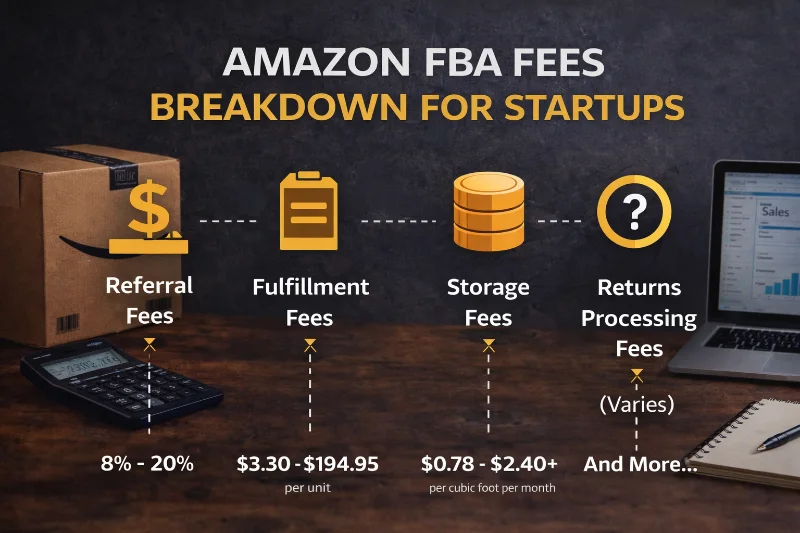
Amazon charges sellers for various services and features, such as referral fees, fulfillment fees, storage fees, returns processing fees, etc.
Your startup cost for Amazon FBA depends on various factors, but most importantly the scale of your business.
Though we all want to spend the least when starting a new business, some costs are inevitable.
A typical small startup requires an initial capital of around $2,000 to $5,000.
The amount may be higher or lower depending on the model you choose, such as private label (PL), wholesale, arbitrage, or dropshipping.
The following amazon FBA startup cost distribution tells you everything you need to know about your startup expenses and exactly where you are going to spend (or in fact, invest) your money.
Referral Fees
Referral fees refers to a per-item fee charged by Amazon for facilitating sales on its platform. The fee varies by product category.
Referral fee ranges between 8% for products with a total sales price of $10 or less, and 15% for items with a total sales price greater than $10.
Merchant fulfilled services have a 20% referral fee with a minimum referral fee amount of $0.30.
FBA Fulfillment Fees
FBA fulfillment fees, another among Amazon FBA startup costs, is charged by Amazon for picking and packing your orders, shipping them, and dealing with product returns and customer service.
The Amazon fee for approaches like Amazon FBA Online Arbitrage Business Amazon Private Label and others is based on the product size, weight, and dimension. Shipping weight is calculated based on the item’s unit weight or dimensional weight.
The fulfillment cost for non-apparel orders ranges between $3.06 and $194.95 for 2 oz. to 150 lb. Apparel shipment fulfillment by Amazon may cost a fee between $3.27 and $194.95 for 4 oz or less to 150 lb, respectively.
Storage Fees
Amazon charges a monthly inventory storage fee for keeping your inventory in its fulfillment centers. The fee is based on your daily average volume in cubic feet. This is calculated according to the size of the unit after being packed. Monthly inventory storage fees comprises:
Base monthly storage fees
Storage utilization surcharge (applied to sellers who have sent their first shipment to an Amazon fulfillment center in the U.S. more than 365 days ago, maintain an average daily inventory volume of at least 25 cubic feet for the product size tier, and have a storage utilization ratio above 22 weeks for that size tier)
Aged Inventory Surcharge
The aged inventory surcharge, formerly called the long-term storage fee, applies to inventory units that remain stored in Amazon’s fulfillment network for 181 days or more. It may range from $0.50 per cubic foot to $7.90 per cubic foot, depending on how aged the items are.
Returns Processing Fees
The startup cost for Amazon FBA also includes a returns processing fee charged by Amazon on products with high return rates (excluding apparel and shoes). It helps offset the operational costs associated with handling returns and to minimize waste.
The fee applies when a product’s return rate exceeds the threshold set for its specific fee category, and the amount charged per unit depends on the product’s size tier and shipping weight.
Low-level Inventory Fees
Low-level inventory fees in Amazon FBA startup costs is the fee you have to pay for storing very limited stock in Amazon’s fulfillment centers.
Very little stock makes it difficult for Amazon to distribute your products across different centers, which increases shipping charges before delivering the product to the customer. Thus, they charge you a fee. However, groceries are exempt from low-level inventory fees.
The fee is applied on inventory when the long-term historical days of supply (last 90 days) and short-term historical days of supply (last 30 days) are under 28 days.
Sellers must ensure the days of supply are as per the conditions to avoid low-level inventory fees.
Total Amazon FBA Startup Costs
Adding all the expenses that come with starting an Amazon FBA business, you can consider a rough estimate of $2,000 to $5,000.
The exact cost depends on the niche, products, quantity, Amazon FBA strategy (private label , online arbitrage or retail arbitrage , Wholesale , Dropshipping), ad spend, etc.
Here's how those startup costs actually break down by strategy, so you know what to budget for before you commit:
Lean/testing (retail arbitrage, small batch): under $1,000
Typical private label launch: $2,500 to $5,000, covering account fees, first inventory run, shipping, samples, and initial PPC
Aggressive brand launch (larger inventory, professional photography, bigger ad budget): $5,000 to $15,000+
Ongoing monthly costs to budget for: $30 to $100 for research/tracking software, plus storage and referral fees on every sale
Also worth noting: Amazon added a 3.5% fuel and logistics surcharge on top of FBA fulfillment fees starting April 17, 2026, so factor that into your per-unit fee estimates when budgeting for 2026.
Explore More Resources on MoonliteMoney
If you're still researching before launching your Amazon FBA business, platforms like Moonlitemoney can help you explore additional resources. Moonlite lists useful tools, courses, and creators focused on online business and side hustles.
You can discover software used by entrepreneurs, educational resources on E-commerce and automation, and experienced creators who share insights on building profitable online businesses. Exploring these resources can give you a better understanding of the tools and strategies many sellers use when starting their FBA journey.
If Amazon FBA feels a bit crowded for your taste, it's worth comparing it against a less saturated, service-based option like a Window Tint Business, where we break down startup costs across mobile, shop, and franchise models.
FAQs
Is Amazon FBA worth it in 2026?
Amazon FBA is a fruitful business in 2026, only if you do it with utmost focus and strategy. However, product selection and sourcing it from a reliable supplier can easily make or break the entire deal.
What are the biggest FBA mistakes to avoid?
The biggest FBA mistakes one can make are miscalculating Amazon FBA startup costs, choosing the wrong product, poor inventory management, and not monitoring customer feedback and returns. Focusing on these issues can solve half of the problems of your FBA startup.
Is FBA better than dropshipping?
Amazon FBA makes picking, packing, shipping, and customer service a breeze for the seller and offers quick delivery to the customer. In contrast, dropshipping demands low upfront investment, but offers slow delivery and less control over product quality.