
Profitable AI Automation Business Models: Ways To Make Money With AI Automation low cost 2026
As generative AI exploded onto the scene in 2023–24, everyone raced to publish AI‑generated blogs and create digital art. By 2026 the game has changed. Businesses are no longer paying for novelty they are investing in infrastructure that saves time, increases revenue and reduces risk.
According to entrepreneur and investor  Dan Martell companies spending on AI in 2026 “will not be chasing novelty they will be paying for outcomes like more time, more revenue and less chaos”. That shift from toy to tool is why AI automation is one of the most promising business ideas of 2026.
Why AI Automation Beats Content Generation
AI automation integrates multiple tools and workflows to solve expensive problems think CRM automation, lead routing, chat qualification and reporting. Unlike AI content services, which are saturated and commoditised, automation has a clear ROI.
Businesses paying for automation often reduce headcount pressure and compound efficiencies over time. For small and medium‑sized businesses (SMBs), automation isn't optional; it can cut operational costs by 15–45 percent and reduce manual processing expenses by 60–80 percent.
Key takeaway:
Building an AI automation business is not passive income. It requires strategy, systems design and hands‑on implementation. Throughout this guide you'll learn what makes an automation business work in 2026 and how to avoid the hype traps.
What Is an AI Automation Business?
An AI automation business designs, implements and maintains automated workflows that tie directly to business outcomes. It goes beyond selling AI prompts or one‑off scripts. Three common roles in the AI economy are:
Role | Scope | Examples |
|---|---|---|
Develops Al models or software platforms |
| |
Provides short-term tasks like writing prompts, training a chatbot |
| |
Designs end-to-end workflows, integrates tools and trains teams |
|
While  Freelancer sell outputs, automation businesses sell outcomes for example, designing a follow‑up system that reduces manual work by 50 percent or an intake bot that boosts conversion rates. Real‑world automations include:
Lead routing: AI qualifies leads in real time and assigns them to sales reps based on availability.
CRM automation: A system updates customer profiles, schedules follow‑ups and flags churn risk without human intervention.
AI chat qualification: Chatbots use LLMs to ask qualifying questions, then route customers to the right department.
Internal SOP automation: Standard operating procedures are embedded in workflows so tasks trigger automatically.
These automations require tool expertise like  Zapier,
  Make,
Make,  n8n but tools are only 10 percent of the value. The real differentiation lies in strategy, integration and ongoing optimisation.
Why AI Automation Is One of the Best AI Business Ideas in 2026
Businesses especially SMBs are overwhelmed by disjointed software. They don't want more tools; they want seamless outcomes. Research shows that AI automation can streamline manual work by up to 30% and reduce overall costs by 15–45 percent. A retail business that adopted AI‑powered inventory management cut overstocking costs by 30% and AI chatbots can reduce response times by 80 percent and increase satisfaction by 35%. These results prove that automation delivers clear financial returns.
Other reasons automation is a smart business idea in 2026:
Outcome‑oriented buyers: Companies paying for AI want measurable ROI, not gimmicks. Services that reduce headcount or accelerate revenue have strong pricing power.
Recurring revenue: Once workflows are integrated, clients often pay monthly retainers for maintenance and optimisation.
Lower competition: Unlike content creation, automation is still under‑served. Many generalist agencies focus on prompts or generic marketing; specialists who master workflow design face less competition.
Cross‑sell opportunities: Automation agencies naturally expand into consulting, productised packages and even SaaS.
The 10–20–70 Rule: Our Framework for AI Automation Businesses
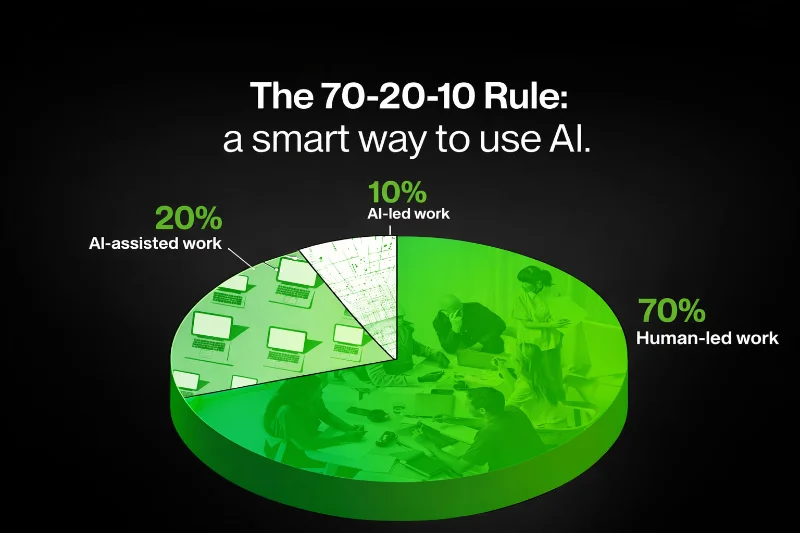
To help clients and operators focus on what matters, we use the 10–20–70 rule:
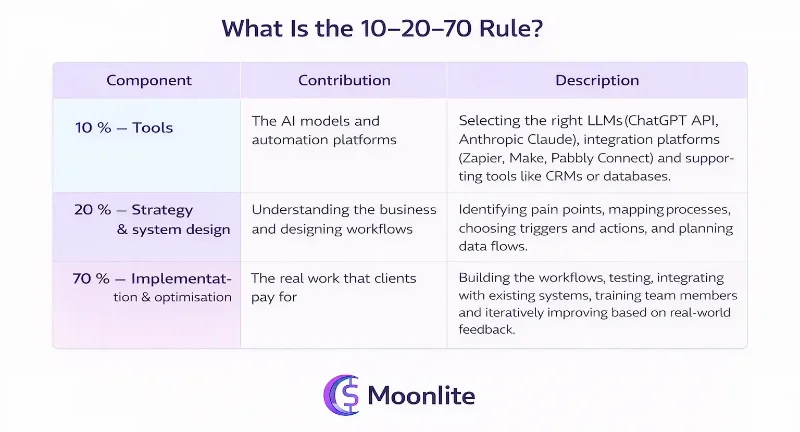
Many beginners focus 80 percent of their time on learning tools. In reality, AI is only 10 percent of the value. Strategy (20 percent) and hands on execution (70 percent) are what clients pay for.
Why Most AI Automation Agencies Fail
Tool obsession: They spend months mastering every new platform instead of learning operations.
Ignoring workflows: They don't map how leads, data or messages travel through a business.
Over‑promising AI magic: They sell unrealistic outcomes and lose trust.
Poor operations: They lack project management, documentation and quality assurance.
By adopting the 10–20–70 mindset, you differentiate yourself as a systems architect, not a prompt reseller. Link this philosophy back to the pillar article on How to Make Money with AI which emphasises that AI is leverage not a business model.
Applying the 10–20–70 Rule: Client Example
Consider a local law firm that struggles to respond to leads quickly. Here’s how you would apply the framework:
10 % (Tools): Use
 chatgpt API for drafting replies, Zapier for automations and the firm’s CRM.
20 % (Strategy): Design a lead qualification flow collect contact details, ask key questions (case type, urgency) and define triggers for follow‑ups.
70 % (Implementation): Integrate the chatbot on the website, connect it to the CRM, set up SMS reminders, test the flow, train staff and adjust based on results. This ensures the system reduces response times and improves conversions.
Five Profitable AI Automation Business Models
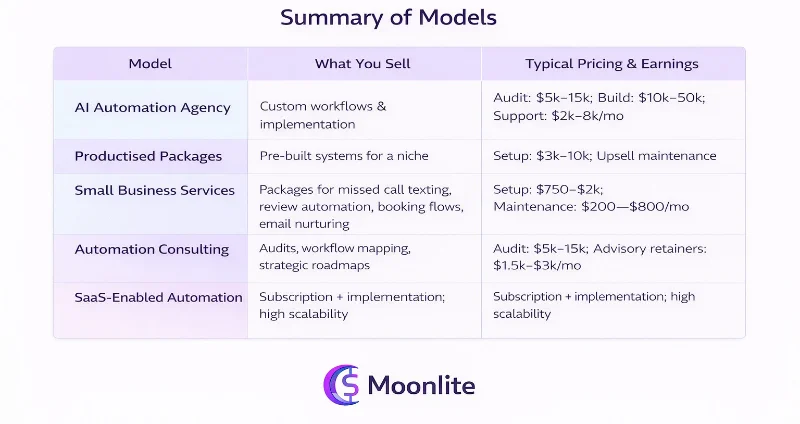
Below are five business models that leverage AI automation, each with its own pricing structure, revenue potential and ideal client.
1. AI Automation Agency
What you sell: Outcomes. An automation agency designs and implements custom workflows that reduce costs or increase revenue. According to pricing research, a two to four week AI Readiness Audit costs $5,000–$15,000, while a custom workflow build can range from $10,000–$50,000 depending on complexity. Ongoing support retainers typically range from $2,000–$8,000 per month.
Who to target: Professional services law firms, medical offices local businesses with established customer bases and startups drowning in manual tasks.
Revenue math: A solo operator landing one audit ($7,500 average), one build ($25,000) and three maintenance retainers ($3,000 each) per quarter could generate $40,500+ in revenue.
2. Productised AI Automation Packages
This model creates repeatable “kits” that solve specific problems for a niche. Example: a “Med Spa Lead System” that automates appointment booking, reminders and follow‑up emails. The package includes templates, pre‑built Zaps and training materials. Pricing typically comprises a one‑time setup fee ($3,000–$10,000) plus optional maintenance.
Benefits: Scalability (you sell the same system repeatedly) and lower client acquisition costs. However, you must choose a niche with common processes like dental offices, gyms and law firms to ensure the package fits most clients without heavy customisation.
3. AI Automation Services for Small Businesses
SMBs often lack technical teams yet have repetitive tasks that waste hours. Services may include:
Missed call text‑back: Automatically send an SMS when a call goes unanswered, prompting the prospect to book a meeting.
Google review automation: Trigger review requests after appointments to boost local SEO.
Booking flows: Integrate calendar booking with reminders and follow‑ups.
Email nurturing: Use AI to send personalised follow‑ups based on client behaviour.
Research on moonlite shows AI automation can save more than 30 percent of operational costs and shift business owners from spending 70 percent of their time on operations to 70 percent on strategic growth. These statistics resonate strongly with SMBs. Pricing for small business packages ranges from a $750–$2,000 setup fee with a $200–$800 monthly maintenance fee.
4. AI Automation Consulting
Some clients want guidance before implementation. Consulting services include:
Audits: Evaluate processes, identify high‑friction tasks and assess automation readiness. According to the pricing guide above, audits cost $5,000–$15,000.
Workflow mapping: Document how information flows through the organisation and design a high‑level automation strategy.
Roadmaps: Provide a step‑by‑step plan with ROI estimates. For example,
Dan Martell emphasises that businesses invest in AI services that relieve time pressure and reduce manual work.Enterprise‑lite model: For mid‑market companies not ready to hire a full agency, offer monthly advisory retainers ($1,500–$3,000) and training sessions.
5. SaaS‑Enabled Automation Business
In this model, you build or white‑label software that combines AI with automation workflows. Examples include a vertical CRM with built‑in AI chat assistants or a white‑labeled text‑back system for service providers. Revenue comes from subscriptions plus implementation fees. While this model requires software development, it offers high margins once the product is stable.
How to Start an AI Automation Agency in 2026: Step‑by‑Step
Starting an automation agency requires more than coding knowledge. Follow this framework to move from zero to revenue.
Pick a niche: Choose an industry where processes are repetitive and margins are high law, health, professional services or home services. Specialisation reduces competition and improves marketing clarity.
Identify repetitive workflows: Interview business owners to understand pain points such as manual data entry, lead follow‑ups or scheduling. Focus on tasks with clear ROI reducing churn, boosting conversions.
Apply the 10–20–70 model: Design your service around strategy and implementation, not just tool expertise.
Build one offer: Craft a clear deliverable “AI Lead Follow‑Up System” with setup and monthly maintenance. Use value‑based pricing rather than hourly rates.
Land your first three clients: Leverage existing networks, marketplaces
 upwork,
  fiverr and direct outreach. Offer a discounted pilot project to build case studies and testimonials.
Systemise delivery: Create documentation, standard operating procedures and templates so you can deliver consistently. Use project management tools
 Notion,
  ClickUp to manage tasks and track results.
Move to retainers: After proving ROI, transition clients to ongoing retainers for monitoring, maintenance and optimisation. This provides recurring revenue and deepens relationships.
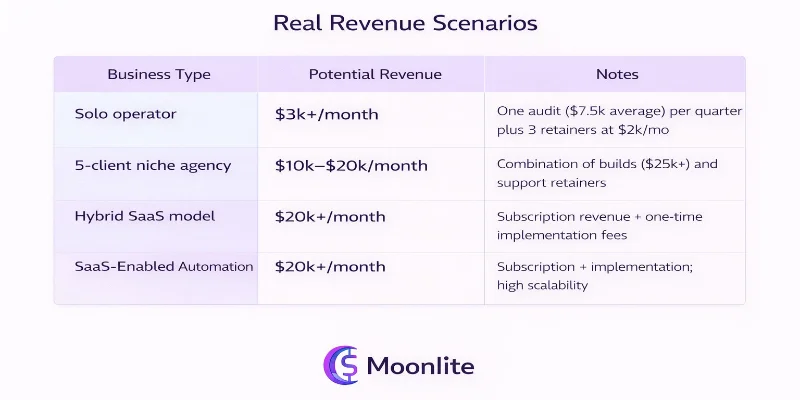
These numbers depend on positioning, niche and project complexity. The core principle is that automation businesses are capital‑efficient: your biggest investment is expertise and time.
Tools Required to Run an AI Automation Business
Building systems requires the right tools. Focus on a lean stack to avoid complexity:
Automation platforms: Zapier, Make, Pabbly Connect for connecting apps and services.
LLM APIs: OpenAI, Anthropic, Google Gemini choose based on use case and cost.
CRM tools: HubSpot, Pipedrive, Salesforce or niche CRMs for law, health or service businesses.
Voice and SMS tools:
 Twilio Flex, Plivo or Nylas for call/SMS automation; Aircall for voice AI.
Database connectors: Airtable, Google Sheets, Supabase to store and retrieve structured data.
Project & collaboration:
Notion, ClickUp, Slack for managing tasks, documentation and team communication.
Where possible, recommend open‑source or low‑cost options for clients just getting started. Encourage readers to visit Moonlite’s Tools Directory for detailed reviews and alternatives.
Common Mistakes in AI Automation Businesses
Avoid these pitfalls to build a sustainable agency:
Selling tools instead of ROI: Clients don’t care about the LLM version you use; they care about results. Tie pricing to savings or revenue generation.
Choosing no niche: Serving everyone leads to generic offerings. Specialising in a vertical improves messaging and referrals.
Overengineering: Complex stacks with six different AI services create fragile systems. Use as few tools as possible to achieve the goal.
Not productising: Custom one‑off projects don’t scale. Document processes and create packaged offerings when possible.
Ignoring integration: AI that doesn’t talk to core systems (CRM, accounting, scheduling) fails to deliver value. Always plan integration early.
Is the AI Automation Business Saturated in 2026?
The market is bifurcated: generic AI services are saturated but vertical specialists have blue ocean opportunities. High demand areas include lead automation, AI virtual assistants, compliance and cybersecurity. It is noted that businesses allocate budgets to AI services that reduce headcount pressure and deliver compounding improvements. Meanwhile, under‑served niches like local healthcare, real estate and trades offer room for growth. Position yourself as a specialist, not a generalist.
Final Thoughts and Next Steps
AI automation is no longer hype it’s a strategic lever for companies that want to operate efficiently and grow. For entrepreneurs, this presents a unique opportunity to build service based businesses with recurring revenue and high margins.
The 10–20–70 framework keeps you focused on strategy and execution rather than chasing every new tool. The five business models outlined here from custom agencies to productised packages and SaaS offer multiple entry points depending on your skills and resources.
Ready to get started? Explore Moonlite to find the right platforms for your niche and check out our cluster article on AI Freelancing for complementary strategies. By combining focus, expertise and a clear value proposition, you can build an AI automation business that stands out in 2026 and beyond.