

What AI Freelancing Actually Means in 2026
AI freelancing for beginners means offering AI powered services to businesses without needing to be a  Developer. As an AI freelancer, you use tools like
  chatgpt,
  Zapier,
  Make or chatbot platforms to solve real business problems faster and more efficiently than traditional methods. Instead of building AI tools you apply them to improve workflows, content systems and automation.
That is it. AI freelancing is not about building complex machine learning systems. It is about using existing AI tools to deliver measurable results for clients.
How AI Freelancing Is Different From Traditional Freelancing
Traditional freelancing often requires:
Years of experience in design, coding or marketing
Technical skills that take time to master
Competing with established professionals
AI Freelancing jobs are different because AI tools reduce the skill barrier.
For example:
Instead of writing 20 product descriptions manually, you build a structured AI workflow that generates them in minutes. Instead of manually replying to repetitive emails, you automate categorization and draft responses using AI.
You are not replacing skill. You are multiplying efficiency. That is why freelance AI services are growing quickly.
Realistic Earning Expectations
Let’s keep this honest. If you are a beginner AI freelancer, you should not expect $10,000 in your first month.
First 30 days: Learning + building a sample
Month 2: Landing your first $500 to $1,000 project
Months 3 to 6: $1,500 to $3,000 per month part time
At scale, once you specialize and raise prices:
$5,000 to $10,000 per month is achievable
Beyond that requires systems and possibly hiring help
The fastest way to reach your first $1,000 is offering one clear AI service to one specific type of client.
Who This Path Is Best For
AI Freelancing for beginners works best for:
Tech curious problem solvers
People who enjoy systems and workflows
Professionals who already understand one industry
Side hustlers who want flexible income
Anyone exploring AI gig work without coding
You do not need:
A computer science degree
Advanced programming knowledge
Experience in machine learning
You do need:
Clear communication
Basic understanding of AI tools
Willingness to test and improve
What AI Freelancing Is Not
Let’s remove a common misunderstanding.
AI freelancing is not:
Just using
chatgpt to write blog postsSelling random AI prompt
Posting generic AI content on
 fiverr
Competing for $5 gigs
Those models are already crowded.
Real AI Freelancing jobs focus on solving business problems. When you connect AI tools to outcomes like saving time, increasing leads or improving content consistency, businesses are willing to pay.
Why Businesses Are Actively Hiring AI Freelancers
AI is no longer a trend. It is becoming standard inside businesses. But there is a gap. According to multiple industry reports, over 70 percent of small and mid sized businesses want to use AI tools in their operations but most do not know how to implement them properly. They understand the potential. They lack execution. This is where an AI freelancer becomes valuable.
You are not selling “AI.”
You are selling clarity and implementation.
The Adoption Gap
Many business owners have heard about:
But they face three problems:
They do not have time to test tools.
They do not know which tools to trust.
They are unsure how to connect AI to daily workflows.
So instead of hiring a full time AI expert, they look for freelance AI services that are project based and affordable. That creates opportunity for AI Freelancing for beginners.
Cost Comparison: Why Freelancers Win
Hiring a full time AI specialist
$70,000 to $120,000 per year plus benefits
Hiring a consulting firm
$5,000 to $20,000 per project
Hiring an AI freelancer
$500 to $3,000 per project
$300 to $2,000 per month on retainer
For small businesses, the decision is simple. They cannot justify a full time AI hire. They do not want a large consulting bill. So they look for flexible AI freelancing jobs that solve specific problems. This is why beginner AI freelancers can compete even without advanced credentials.
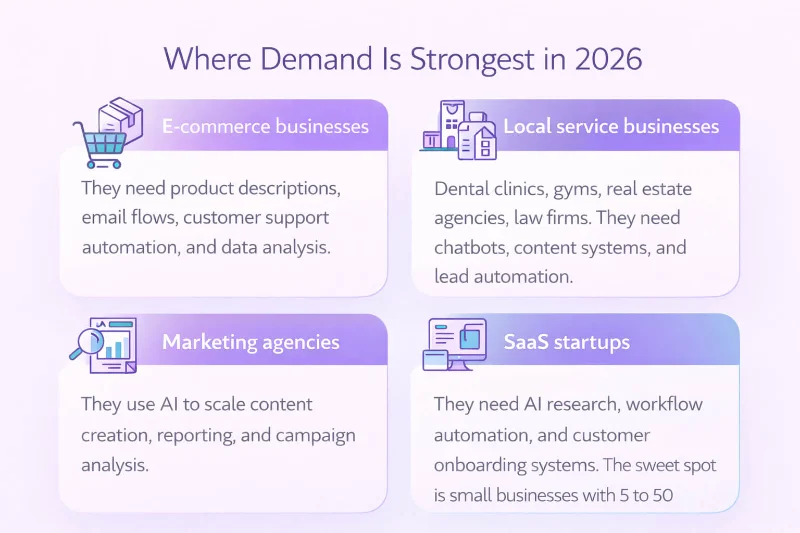
5 AI Services You Can Offer Without Coding
If you are starting AI Freelancing for beginners, you do not need to invent a new business model. You need one clear service that solves one clear problem.
Below are five freelance AI services you can offer right now without writing code. Each includes what problem it solves, what it looks like in real life, pricing range, skill level and delivery time. Pick one. Do not try to offer all five at once.
1. AI Content Workflow Systems
What problem it solves
Businesses create content manually. It is slow, inconsistent, and often low quality.
What this looks like in practice
A real estate agency needs 20 property descriptions every week. Instead of writing each one from scratch, you build a workflow where they input property details into a simple form and receive polished listings in minutes using AI.
You set up structured prompts, templates and quality guidelines.
Deliverables
Content workflow setup
Structured templates
Training document or Loom walkthrough for the client’s team
Skills required
2 out of 5
You need to understand chatgpt or  Claude and basic content structuring.
Pricing range
$500 to $2,000 setup
$300 to $800 per month for updates and support
Time to deliver
1 to 2 weeks
This is one of the easiest entry points for a beginner AI freelancer because content demand is constant.
2. AI Chatbot Implementation
What problem it solves
Businesses lose leads outside working hours and waste staff time answering repetitive questions.
What this looks like in practice
A dental clinic receives 40 calls per day asking about pricing and appointment availability. You set up an AI chatbot on their website that answers common questions and handles booking requests 24 hours a day.
Deliverables
Chatbot configured and trained
Tested and deployed on website
Staff training on how to monitor and adjust responses
Skills required
2 out of 5
Most chatbot platforms are no code.
Pricing range
$500 to $1,500 setup
$200 to $500 per month maintenance
Time to deliver
3 to 7 days
This type of AI gig work is in demand because it directly increases response speed and improves customer experience.
3. AI Enhanced Social Media Management
What problem it solves
Business owners know they need social media but do not have time to create consistent content.
What this looks like in practice
A gym owner wants 30 days of Instagram content. You use AI to generate posts, captions, and hashtags in a few hours, then schedule everything using a management tool.
Deliverables
Monthly content calendar
20 to 30 posts with captions
Scheduling setup
Optional analytics report
Skills required
2 out of 5
Basic content strategy and familiarity with AI writing tools.
Pricing range
$750 to $2,000 per month retainer
Time to deliver
Ongoing, about 5 to 8 hours per week per client
Many AI Freelancing jobs on platforms like Upwork fall into this category.
4. AI Workflow Automation Using Zapier or Make
What problem it solves
Businesses waste hours on repetitive manual tasks.
What this looks like in practice
An e commerce store manually sorts support emails and assigns them to team members. You build an automation that reads the email, categorizes it using AI, drafts a reply, and assigns it automatically.
Deliverables
Automation workflow built and tested
Documentation of process
Short training session
Skills required
3 out of 5
You need to understand automation tools like Zapier or Make and how to connect apps.
Pricing range
$1,000 to $3,000 per project
Time to deliver
1 to 2 weeks
This is one of the higher paying freelance AI services because it directly saves time and reduces staffing costs.
5. AI Research and Market Analysis
What problem it solves
Businesses need competitor and market insights but cannot afford expensive research firms.
What this looks like in practice
A startup wants to understand its competitor landscape. You use AI to analyze 50 competitor websites, pricing pages, and reviews. Then you deliver a structured report with patterns, opportunities and recommendations.
Deliverables
Research report
Competitive analysis summary
Clear recommendations
Skills required
3 out of 5
Strong research ability and critical thinking.
Pricing range
$200 to $800 per report
Time to deliver
2 to 5 days
This service works well for a beginner AI freelancer who enjoys analysis and structured writing.
AI Freelancing vs AI Automation Agency
Many beginners start with AI freelancing for beginners as their entry point. Over time, some evolve into building an AI automation agency. Both paths can work. But they are different in structure, risk and scalability. Let’s compare them clearly.
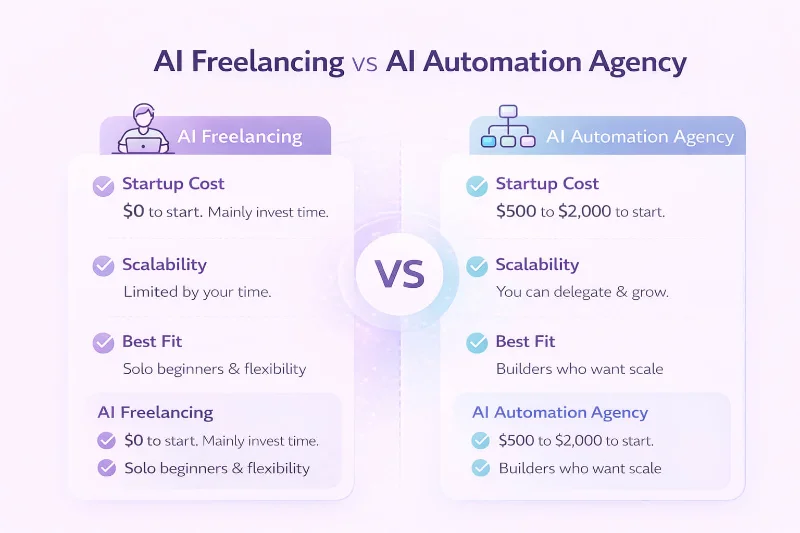
If you are a beginner AI freelancer, do not think about building an agency yet. Focus on landing one client. Then another. Systems come later. If you are still exploring the bigger picture, read our How to Make Money with AI guide to understand the full landscape before choosing your path.
Step by Step: Getting Your First Client
Reading about AI Freelancing for beginners is useful. Executing is what gets you paid. Here is the simple, realistic roadmap to land your first $1,000 as an AI freelancer. Follow these steps in order. Do not skip ahead.
Step 1: Choose One Service
Most beginner AI freelancers fail because they say I do AI. That means nothing to a business owner. Instead, say something specific.
For example:
I set up AI chatbots for dental clinics.
I build AI content systems for real estate agencies.
I create AI automation workflows for e commerce stores.
Specialization builds trust. When you narrow down, you:
Reduce competition.
Speak directly to a problem.
Increase perceived expertise.
Ask yourself:
What industry do I already understand?
Which of the five services can I deliver in under a week?
Which problem feels easiest for me to solve?
Pick one. Do not change it for 30 days.
Step 2: Build a Portfolio Sample in 48 Hours
You do not need clients to build a portfolio. Create a sample for a fake or local business.
Example:
If you want to offer chatbot setup for gyms:
Pick a local gym website.
Identify common questions.
Build a demo chatbot.
Record a Loom walkthrough explaining how it works.
Document:
The problem.
The before situation.
The after system.
The time saved or value created.
Take screenshots. This becomes your portfolio. You do not need ten samples. You need one strong example. This step alone separates serious beginner AI freelancers from random AI gig work sellers.
Step 3: Where to Find AI Freelancing Jobs
Now you move to client acquisition. Here are the best places to start.
Upwork
Search terms like:
AI automation
AI chatbot setup
ChatGPT workflow
AI content system
There are hundreds of AI freelancing jobs posted every week. Focus on jobs that clearly describe a business problem, not vague “AI expert needed” posts.
Fiverr
Create a packaged offer such as:
AI chatbot setup for local businesses
AI content workflow for e commerce stores
LinkedIn
Post short breakdowns of what you built in your portfolio sample.
Explain the business outcome.
Business owners read LinkedIn.
Cold outreach to local businesses
Simple and effective. Look for:
Outdated websites.
No chatbot.
Inconsistent social media.
Manual booking systems.
Then send a short, personalized message.
Reddit and online communities
Look for founders asking questions about automation or AI tools. Wherever you look, remember AI Freelancing jobs go to the person who explains the solution clearly.
Step 4: Outreach Templates That Convert
Keep it short. Keep it specific.
Cold email template:
Hi [Name],
I noticed your website does not have an automated booking or FAQ system. I help [industry] businesses reduce missed leads using simple AI automation. I created a quick example showing how this could work for [business name]. Would you like to see it? No pressure, just sharing what is possible.
[Your Name]
Upwork proposal template:
Hi,
I read your job post about [specific need]. I recently built a similar AI workflow for [type of business]. Here is what I would deliver:
Clear bullet point deliverables
Timeline estimate
Outcome focus
I can complete this within [X days]. Happy to jump on a quick call to explain my approach.
Principles:
Be specific.
Reference their business.
Focus on outcomes.
Keep it short.
Step 5: How to Price Your First Three Projects
Pricing strategy matters more than people think.
First project
Charge 30 to 40 percent below the normal range.
Your goal is proof and testimonial, not maximum profit.
Second project
Charge market rate.
You now have social proof.
Third project
Raise price by 10 to 20 percent.
Especially if you niche down.
Always price by project or retainer. Do not price hourly. Hourly pricing punishes you for being efficient with AI tools. Once you land one client and deliver results, momentum builds faster than you expect.
Tools You Will Need to Get Started
One of the biggest mistakes in AI freelancing for beginners is buying too many tools. You do not need ten subscriptions. You need these core tools and the discipline to master them or visit Tools Directory for more options.
1. ChatGPT or Claude
Purpose:
Content generation
Research
Drafting client deliverables
Structuring workflows
Cost:
Free to $20 per month
This is the foundation for most freelance AI services. Whether you are building content systems, research reports or chatbot responses, this tool will be part of your workflow.
As a beginner AI freelancer, your focus should be learning how to:
Write structured prompts
Refine outputs
Turn raw AI drafts into polished deliverables
2. Zapier or Make
Purpose:
AI workflow automation
Connecting apps
Reducing manual tasks
Cost:
Free tier to start
If you want to offer automation services, this is essential.
For example:
Automatically categorize emails
Send AI generated summaries to Slack
Trigger follow ups after form submissions
Learning one automation platform deeply is more valuable than testing five.
3. Canva
Purpose:
Presentation decks
Reports
Social media posts
Visual workflow explanations
Cost:
Free to $13 per month
Even if your service is technical, presentation matters. Professional visuals increase perceived value and allow you to charge more.
Scaling From $1,000 to $10,000 Per Month
Once you land your first client, the goal shifts. You are no longer proving that AI freelancing works. You are building predictable income. Scaling does not mean working 80 hours per week. It means improving positioning, pricing, and systems. Here is how beginner AI freelancers evolve into consistent earners.
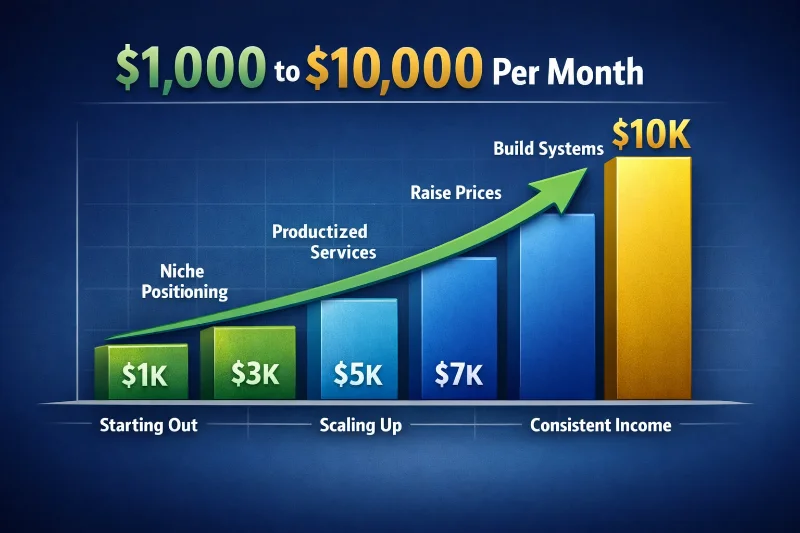
1. Niche Positioning
Stop saying you are an AI freelancer.
Start saying:
I build AI automation for dental clinics.
I create AI content systems for e commerce brands.
I implement AI chatbots for local service businesses.
Specific positioning allows you to:
Charge more
Compete less
Get referrals within the same industry
The more focused your niche, the easier it becomes to win AI Freelancing jobs.
2. Productize Your Service
Custom work slows growth. Instead of reinventing every project, turn your freelance AI services into packages.
Example:
AI Chatbot Setup Package
Discovery call
Chatbot configuration
Testing
Staff training
30 days support
Flat price. Clear scope. Repeatable systems allow you to scale without increasing stress.
3. Raise Prices Every Three Clients
As you deliver more projects:
You get faster.
Your results improve.
Your confidence increases.
That means your pricing should increase too. After every three successful projects, adjust your rates. Do not stay underpriced forever. AI gig work becomes unstable when you compete only on cost.
4. Build Systems
Document everything:
Your onboarding process
Your workflow steps
Your templates
Your proposal format
When your process is clear, you can:
Delegate tasks
Hire help
Transition toward an agency model
Many successful automation agencies started with one beginner AI freelancer documenting their process carefully. Scaling is not about doing more work. It is about doing repeatable work better. If you want to understand how this transition works in detail, explore our AI Automation Business Models guide where we break down the structure behind profitable automation agencies.
Common Mistakes That Stall Growth
Many people start strong with AI Freelancing for beginners, land one client and then stop growing. Not because the market disappears. But because they make avoidable mistakes. Here are the most common ones.
Tool Hopping
Every week there is a new AI tool. Some beginner AI freelancers spend more time watching tutorials than delivering results. Master one tool deeply before adding another. Clients pay for outcomes, not tool knowledge.
Underpricing Forever
Discounting your first project is smart. Never raising your prices is not. If you continue charging beginner rates after delivering results, you:
Attract low quality clients
Work longer hours
Burn out faster
Raise rates as your confidence and skill increase.
Overselling AI Capabilities
Some freelancers promise:
Fully automated systems with zero oversight
Perfect content with no edits
Instant revenue growth
This damages trust. Be realistic. Explain what AI can do and what still requires human review. Honesty builds referrals.
No Niche
Being the AI person is weak positioning. Being “the AI chatbot specialist for dental clinics” is strong positioning. If you do not choose a niche, you compete with everyone. Niche clarity makes freelance AI services easier to sell.
Skipping the Portfolio Step
Many beginners apply to AI Freelancing jobs without proof. Even a simple demo system or mock case study dramatically increases your chances. One strong example beats ten vague claims. Growth stalls when focus disappears. Stay disciplined. Improve one service. Raise prices gradually. Refine positioning.
Start With One Service, One Client, One Project
You do not need to master AI. You do not need ten clients. You need:
One clear service
One portfolio sample
One paying client
That first $1,000 project will teach you more than any course or  YouTube video. AI freelancing for beginners is not about knowing everything. It is about solving one problem well. Pick one service from this guide. Build one sample. Reach out to five businesses this week. Everything else grows from there.