

Web3 Development Cost (2026): What It Actually Costs to Build
Last updated: September 22, 2026 · Synthesized from multiple current industry cost guides
Search this term and you'll get a different number from nearly every source, $20,000 from one guide, $2 million from another. Both can be true. The gap almost entirely comes down to what you're actually building, not inconsistent pricing.
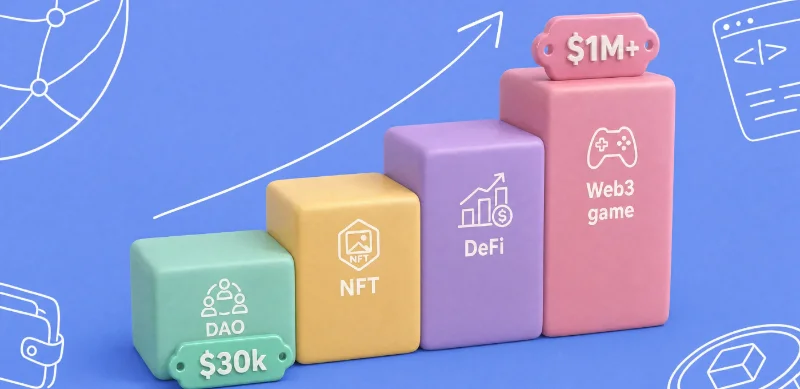
The gist: A basic Web3 app (a simple dApp with wallet connection and token transfers) typically runs $20,000 to $50,000. A standard dApp with more features lands in the $50,000 to $120,000 range. DeFi platforms and NFT marketplaces run considerably higher, $80,000 to $300,000+.
Enterprise or multi-chain blockchain solutions can exceed $500,000 to $2 million. Team model matters as much as project type:  Freelancer typically charge $25 to $150 an hour depending on platform and seniority, agencies run $100 to $300 an hour and a full-time in-house Web3 developer costs $80,000 to $300,000 a year depending on experience.
Cost by project type
Project type | Typical cost range | Timeline |
Basic MVP dApp (wallet connect, simple token transfers) | $20,000 – $50,000 | 6 – 12 weeks |
Standard dApp (multi-contract, dashboard, token integration) | $50,000 – $120,000 | 10 – 18 weeks |
NFT marketplace (minting, royalties, auctions) | $50,000 – $180,000 | 14 – 24 weeks |
DeFi platform (staking, governance, liquidity pools) | $100,000 – $300,000+ | 18 – 30 weeks |
Enterprise / multi-chain blockchain solution | $250,000 – $2,000,000+ | 30+ weeks |
These ranges come from multiple current industry cost guides. While the exact numbers vary source to source, the relative pattern (basic dApp cheapest, DeFi and enterprise most expensive) is consistent across nearly all of them.
What actually drives the cost
Smart contract development is the biggest single line item, typically 25% to 40% of a total project budget. Contracts written in Solidity or Rust require specialized skills that command a real premium, often 20% to 40% higher rates than general web development, plus dedicated Web3 Security Tester (unit tests, integration tests, scenario testing) before anything touches mainnet.
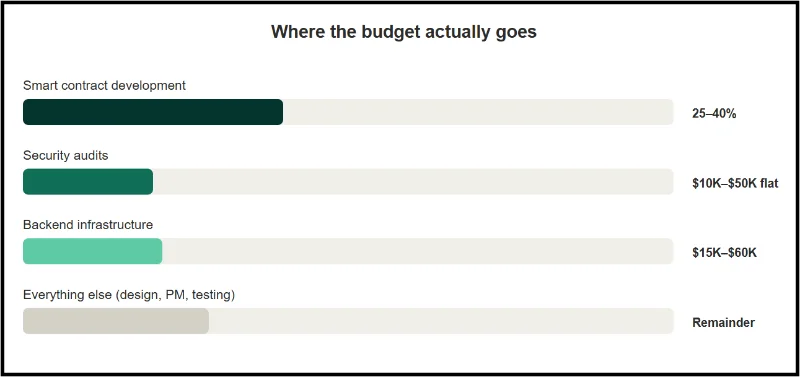
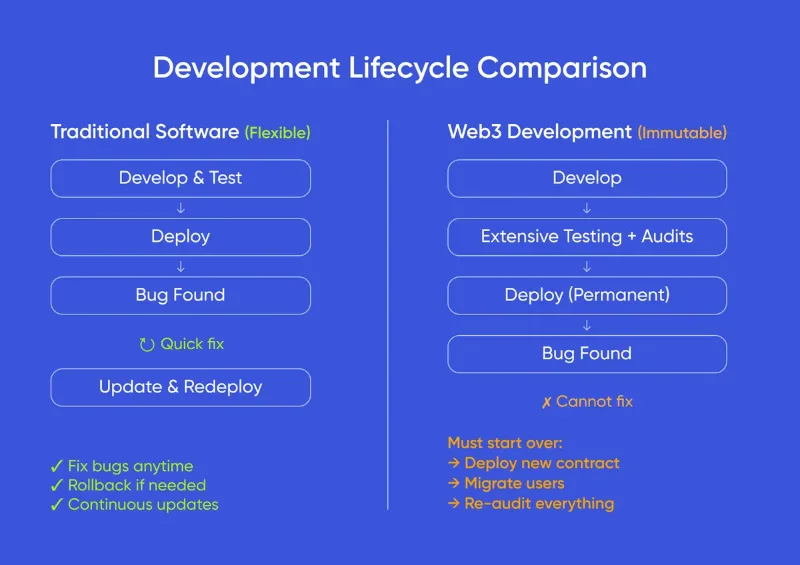
Security audits are a real, often-underestimated cost, commonly $10,000 to $50,000 per contract. This isn't optional for anything handling real funds, a single unaudited vulnerability in a smart contract can be catastrophic and irreversible in a way a normal web app bug isn't.
Backend infrastructure still matters, even for "fully decentralized" apps. Indexers, APIs, off-chain computation and caching typically add $15,000 to $60,000, since most usable Web3 products lean on real backend services for performance even when the core logic lives on-chain.
Team model changes the math significantly:
Model | Typical rate |
| $25 – $60/hr |
| $60 – $150/hr |
Agency | $100 – $300/hr |
In-house, full-time | $80,000 – $300,000+/year |
Freelancer are cheapest but hardest to scale and vet for quality. Agencies cost more per hour but typically deliver faster with less oversight required. In-house hiring makes sense for long-term, ongoing projects rather than a single build.
Learning to build it yourself instead of hiring
If the real goal is reducing cost by doing some or all of the development yourself rather than hiring it out, the foundational web skills matter before the Web3-specific layer does. Solidity and smart contracts sit on top of standard full-stack development, not instead of it. Our reviews of Angela Yu's Web Development Bootcamp and Colt Steele's Web Developer Bootcamp both cover the JavaScript, React and backend fundamentals that most Web3 stacks are actually built on, worth having in place before layering blockchain-specific skills on top.
If you're the one being hired rather than hiring, or you're mapping out where Web3 development fits among other developer paths generally, our Developer moonlite hub covers the wider landscape of specializations, including where a Web3-focused track sits relative to front-end, back-end and app development.
If freelancing your Web3 skills specifically, rather than working in-house, is the plan, our Freelancer moonlite hub cover what going independent actually looks like day to day, worth reading before you decide freelance rates over full-time employment.
If building the product yourself isn't the goal at all and earning inside the Web3 space is, our Blockchain Game Beta Testing moonlite covers a genuinely different, no-development-required way into the same industry, getting paid to test pre-launch Web3 games rather than building them.
A few adjacent connections worth knowing about, stated honestly as broader context rather than a tight match: many Web3 products, especially anything with an off-chain backend, lean on the same workflow automation and AI tooling covered elsewhere on this site. Our guides to LinkedIn's Build AI Agents and Automate Workflows with n8n course and n8n vs. Zapier cover automation skills that show up in backend infrastructure work. Our Akkio review covers no-code predictive modeling if a project needs AI-driven features without a dedicated data science hire.
Our coverage of the IBM AI Engineering Professional Certificate is relevant if you're pairing Web3 skills with AI engineering, an increasingly common combination in newer product builds. If part of your plan is monetizing a build-in-public audience while you learn or freelance, our guide to online passive income ideas for beginners and our Patreon review cover that separate but related path.
Two more genuinely useful, if broader, technical connections: most Web3 backends still run on standard cloud infrastructure underneath the blockchain layer, so our coverage of Microsoft Azure Certifications (AZ-900 and AZ-104) is worth knowing about if cloud deployment is a gap in your skill set. And Python shows up constantly in Web3 tooling, testing scripts and backend services even on projects primarily written in Solidity, so our review of Angela Yu's 100 Days of Code Python Bootcamp is a reasonable starting point if Python specifically is the gap.
How to actually budget for it
Get quotes from more than one team type before committing. The Freelancer-versus-agency-versus-in-house spread is wide enough that the same project scope can cost 3 to 5 times more or less depending purely on who builds it, not what's being built.
Don't cut the audit. Every cost guide we reviewed flags security auditing as the line item most commonly under-budgeted. It's also the one with the highest real downside if skipped, since smart contract bugs are frequently unrecoverable once deployed.
Start with an MVP scope, not the full vision. The $20,000 to $50,000 basic dApp range exists precisely because most successful Web3 products started narrower than their eventual roadmap, wallet connection and a core transaction flow first, staking and governance later.
Frequently asked questions
How much does it cost to build a basic Web3 app?
Typically $20,000 to $50,000 for a basic MVP dApp with wallet integration and simple token transactions.
How much does a Web3 developer cost per hour?
Freelancers run roughly $25 to $150 an hour depending on the platform and experience level; agencies typically charge $100 to $300 an hour.
What's the most expensive part of Web3 development?
Smart contract development, typically 25% to 40% of total project cost, followed by security audits, commonly $10,000 to $50,000 per contract.
How much does a full-time Web3 developer cost annually?
Roughly $80,000 to $300,000 a year depending on experience level and specialization, with senior blockchain-specific engineers at the top of that range.
Why do cost estimates vary so much between sources?
Because "Web3 development" covers an enormous range of project types, from a simple wallet-connect dApp to a full DeFi protocol or enterprise blockchain. Most of the apparent disagreement between guides is really different project scopes, not inconsistent pricing for the same thing.