

100 Days of Code: The Complete Python Pro Bootcamp Review (2026)
If you've read our review of  Angela Yu's Web Development Bootcamp, the instructor background there, a real NHS surgeon turned top
  Udemy instructor, applies here too. This is her other flagship course, built around a genuinely different structure: one project a day, for 100 days, to learn Python.
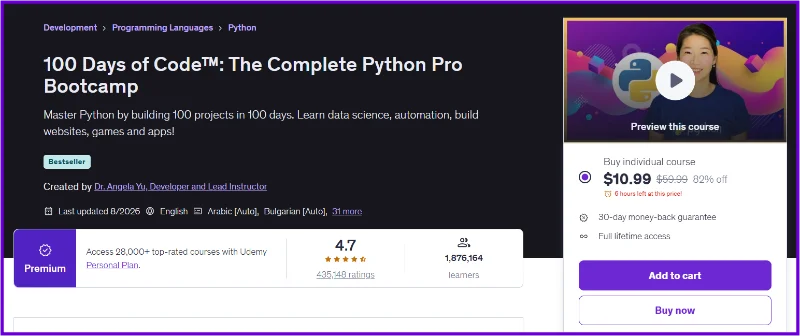
The gist: 100 Days of Code has 435,148 ratings at a 4.7 average and 1,876,164 students, confirmed live directly on Udemy, alongside a confirmed sticker price of $59.99 and a 30-day money-back guarantee.
The course runs through three distinct phases, foundational syntax, then real tools like web scraping and automation, then full deployed applications, building toward a 100-project portfolio rather than abstract exercises. The most repeated criticism, even from very favorable reviews, is that the volume is genuinely large enough to cause burnout if you try to rush it.
Quick verdict
Sticker price | $59.99, confirmed live |
Real price | Rotates via |
Platform | |
Instructor | Dr. |
Rating | 4.7, from 435,148 ratings, confirmed live |
Students enrolled | 1,876,164, confirmed live |
Structure | 100 daily projects across three difficulty phases |
Length | Roughly 60 to 65 hours of video |
Last updated | August 2026 |
Refund policy | 30-day money-back guarantee, confirmed live |
Best for | Beginners who want daily structure and a real project portfolio by the end |
Our rating | 4.6 / 5 |
Scorecard
Criterion | Score | Note |
Independent verification available | 5/5 | 435,148 ratings at 4.7, confirmed live, among the largest evidence bases of any course we've reviewed |
Instructor credibility | 5/5 | Same verified background as our Web Development Bootcamp review, a real medical doctor turned top-selling instructor |
Course structure | 5/5 | A genuine three-phase progression from syntax to real tools to deployed applications, not just 100 disconnected exercises |
Project quality and portfolio value | 5/5 | Named, specific, resume-worthy projects rather than generic to-do-list clones |
Content breadth | 4.5/5 | Spans web scraping, automation, game development, GUIs, APIs, SQL and data visualization in one course |
Sticker-price transparency | 4/5 | $59.99 sticker confirmed live, same pattern as the companion |
Pacing and burnout risk | 3.5/5 | The single most consistent criticism across every independent source, including favorable ones, is that the volume causes real burnout risk around the one-month mark if rushed |
Value at real price | 5/5 | A confirmed discount price under $15 for 60+ hours and a 100-project portfolio is difficult to argue with |
Pros and cons
Pros
Exceptional independent evidence base: 435,148 ratings at a 4.7 average, confirmed live
The same verified, distinctive instructor background as her
 The Complete Web Development Bootcamp by Angela Yu (Udemy), a real former NHS doctor
A genuine three-phase structure, not just 100 disconnected daily exercises: foundational syntax, then real-world tools, then full deployed applications
Specific, named, portfolio-worthy projects, including a Blackjack game, a browser-automation tool, a
 Google Trends data analysis project, a deployed Flask website and a public API
Teaches real, current tools used in professional development: Selenium, Beautiful Soup, Flask, Pandas, SQL and Tkinter for GUIs
Includes cheat sheets, downloadable code, fully explained solutions, quizzes and a free "12 Rules to Learn to Code" ebook
30-day money-back guarantee and full lifetime access, both confirmed live
Cons
The single most repeated criticism, even in strongly positive reviews, is a real risk of burnout partway through if you try to move faster than one project a day
Later modules assume you've genuinely absorbed earlier ones; falling behind compounds rather than resets
Some interface elements in older lessons may not perfectly match current tool versions between update cycles, though the course is updated regularly
Self-paced with no live instructor support or cohort structure, same limitation as every
Udemy courseThe discounted price is a rotating promotion, not a fixed number, so any specific dollar figure quoted anywhere, including in this article, needs reconfirming at the time you actually enroll
How we reviewed this
We did not purchase the course. This review draws on Udemy's own structured data and current course description, a live screenshot of the current listing, competing published reviews (including a direct, detailed comparison against CourseDuck's independent review, currently one of the more thorough alternatives available) and direct comparison against two named alternative Python courses on the same platform.
Verified, confirmed live via a reader-provided screenshot: the current rating (4.7), ratings count (435,148), student count (1,876,164), sticker price ($59.99), a discounted price of $10.99 at time of screenshot (82% off), the 30-day money-back guarantee and full lifetime access.
Verified via Udemy's own listing and structured data separately: the August 2026 update date, the daily-project structure, the free-tools-only software requirement.
Verified via cross-referencing multiple independent reviews: the three-phase content progression, specific named projects and the support-materials list.
Worth stating plainly for transparency: an earlier draft of this article's pricing section relied on a specifically-dated third-party coupon site, which itself turned out to be wrong. A reader-provided live screenshot corrected it.
This is the second companion review in a row where a dated secondary source proved inaccurate against direct verification. The practical standard we now apply: a live screenshot is the only source treated as fully confirmed for pricing, a specifically-dated third-party source is better than an undated one but still not sufficient on its own.
This is the same verification standard we apply to every review on this site, including the companion Angela Yu Web Development Bootcamp review.
Is it actually worth $60? The real pricing
Confirmed | |
Sticker price | $59.99 |
Discounted price at time of research | $10.99 (82% off) |
Refund policy | 30-day money-back guarantee |
Access | Full lifetime access |
Worth being direct about: Udemy's discount pricing rotates through promotional periods rather than staying fixed. The $10.99 figure above is confirmed accurate at the moment we verified it via a live screenshot, but it is not a permanent price.
Treat the sticker price ($59.99) as the stable reference point. Expect the actual checkout price to land somewhere well below it, historically in the $10 to $20 range based on every source we've checked across this review and its companion.
Worth naming directly, since it's a genuinely useful pattern: the sticker price here ($59.99) exactly matches the companion The Complete Web Development Bootcamp by Angela Yu (Udemy)'s confirmed sticker price.
Angela Yu's flagship courses appear to share a standardized $59.99 sticker price across her catalog, a real, observable pattern now confirmed on two separate courses, though the discount floor differs slightly between them, so don't assume every course in her catalog shares an identical discount price even where the sticker matches.
For broader context: even at the sticker price of $59.99, this course covers 60+ hours and 100 projects for less than many single in-person workshop sessions. At the typical discounted price, it costs less than most lunch orders.
What the 100 days actually looks like, phase by phase
This is the part most competing content, including Udemy's own listing, doesn't lay out clearly. The 100 days aren't 100 identical difficulty levels, they run through three genuinely distinct phases.
Days 1 through roughly 30, foundations: core Python syntax, variables, data types, control flow, loops, functions and basic data structures. Early projects are small and concept-specific, for example a Blackjack card game to practice logic and control flow, plus simple games like Pong or Snake to reinforce functions and state.
Days roughly 30 through 70, real-world tools: this is where the course shifts from syntax practice to the tools professional developers actually use. You work with object-oriented programming, APIs and JSON, web scraping with Beautiful Soup, browser automation with Selenium and GUI development with Tkinter. Example projects from this phase include a browser automation tool and data-gathering scripts that pull from real websites and APIs.
Days roughly 70 through 100, full applications: the final phase moves into deployed, portfolio-scale work: building and deploying a Flask web application, creating and exposing your own API, working with SQL databases and building data visualizations, including a project analyzing real Google Trends data. By the end, you're producing work that resembles what junior developers actually do, not just completing exercises.
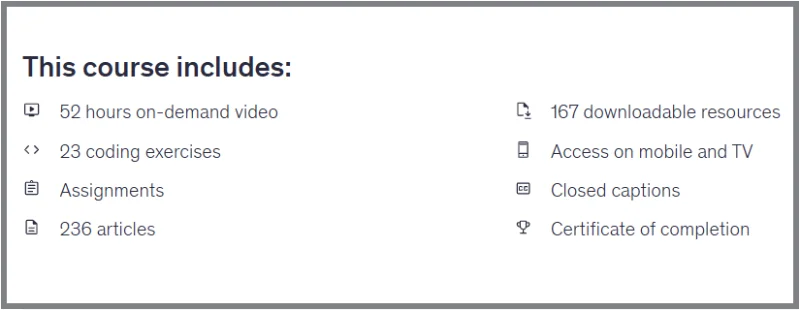
What's included alongside the videos:
Cheat sheets covering common Python syntax
Downloadable code samples for every project
Fully explained solutions, not just answer keys
Quizzes and code challenges to reinforce retention
A free "12 Rules to Learn to Code" ebook
Reusable project templates
If your specific goal is applying Python to data analysis or finance rather than general-purpose development, our coverage of Python for Finance and AI-Driven Market Analysis and the Udacity Data Analyst Nanodegree go deeper into that specific application than a general bootcamp does.
The real risk: burnout, not difficulty
Every independent review we cross-referenced, including the most favorable ones, converges on the same specific criticism. It's worth taking seriously rather than treating as boilerplate.
The risk isn't that the material is too hard. It's that 100 consecutive days of real coding practice is a genuine time commitment. Reviewers consistently report a burnout risk around the one-month mark for anyone trying to move faster than the pacing supports.
The practical fix multiple independent students report: treat "100 days" as a target structure, not a literal deadline. Building in rest days and reviewing earlier material before pushing forward is common practice among students who actually finish, rather than a sign of falling behind.
How it compares to other Python courses on Udemy
Two other named, well-reviewed Python courses come up consistently in the same comparison lists as this one, worth knowing before you commit to any single option.
Angela Yu | Hadelin de Ponteves & Kirill Eremenko | ||
Rating | 4.7, confirmed live | 4.6 | 4.5 |
Ratings count | 435,148, confirmed live | 103,091 | 190,055 |
Length | 60 to 65 hours | 72 hours | 42.5 hours |
Structure | 100 daily projects, three difficulty phases | Traditional modules | Traditional modules |
Sticker price | $59.99, confirmed live | Around $119.99 | Around $119.99 |
Angela Yu's course has the largest independent evidence base of the three by a wide margin. The daily-project, three-phase structure is the clearest differentiator if you specifically want built-in momentum and a portfolio of named projects rather than a traditional module-by-module course.
If you'd rather learn Python through a real, free-content creator instead of a paid course first, our profile of Sentdex, a Python AI and machine learning YouTube educator, is worth a look before committing money anywhere.
Who this is for
Consider it if: you're a genuine beginner who wants daily structure, a real progression from basic syntax to deployed applications and a portfolio of 100 named projects rather than abstract exercises.
Skip it if: you already know Python and want advanced, specialized content. If you specifically want a data-analyst or data-science career track rather than general Python skills, our Analyst moonlite hub covering data-analyst side-income potential is worth reading first, since it lays out the realistic path before you pick a course.
For the data-science angle specifically, the IBM Data Science Professional Certificate is more directly built for that path than a general-purpose Python bootcamp. If part of your goal is building predictive models without deep coding at all, our review of Akkio's no-code machine learning platform is worth reading before you commit to learning Python specifically.
And if learning Python is one option among several you're weighing for building income on the side rather than a specific career move, our guide to online passive income ideas for beginners covers the wider field before you commit real time to any one skill.
The verdict
4.6 / 5.
Every figure in this review is confirmed live via a reader-provided screenshot, including catching and correcting a wrong sticker price that a dated third-party source had reported.
Beyond the numbers, the course itself holds up against the most detailed independent reviews available: a genuine three-phase structure, named and specific projects rather than generic exercises, plus real professional tools taught in context. The one consistent, honest caveat across every source, including the most favorable ones, is the real burnout risk if you try to outrun the pacing.
Our position: one of the stronger course recommendations on this site, backed by an exceptional evidence base and a structure that holds up to close inspection. Pace yourself, use the built-in rest days rather than skipping them and don't rely on any specific discounted price you see quoted anywhere, including here, without checking Udemy directly at the time you enroll.
Frequently asked questions
How much does 100 Days of Code actually cost?
The sticker price is $59.99, confirmed live. Udemy runs frequent discount promotions on top of that; a confirmed discounted price at time of research was $10.99 (82% off), but this rotates and should be reconfirmed at checkout.
Is 100 Days of Code worth it?
Yes, based on an exceptionally large and consistent rating base of 435,148 at 4.7 stars, confirmed live, plus a genuinely structured three-phase curriculum rather than 100 disconnected exercises.
Who teaches 100 Days of Code?
Dr. Angela Yu, the same instructor behind our reviewed Web Development Bootcamp, a former NHS doctor turned top-selling Udemy instructor.
What projects do you actually build in the course?
Specific named examples include a Blackjack card game, simple games like Pong and Snake, a browser automation tool, a Google Trends data analysis project, a deployed Flask web application and a custom public API, spread across three difficulty phases.
Is the course actually 100 days, or can you go faster or slower?
It's self-paced. "100 days" describes the structure and project count, not a deadline. The most consistent advice across independent reviews is to build in rest days rather than rushing, since burnout around the one-month mark is the most common reason students stop.
Do you need to pay for any software?
No, the course teaches entirely with free tools: PyCharm, Jupyter Notebooks and Google Colab.
Does the course include a certificate?
Yes, a standard Udemy completion certificate, plus a 30-day money-back guarantee, confirmed live.
How does it compare to other Python courses on Udemy?
It has a significantly larger independent rating base than the two other most commonly compared alternatives ( Tim Buchalka and the Hadelin de Ponteves/Kirill Eremenko course), plus a distinctive daily-project structure most traditional module-based courses don't offer.