
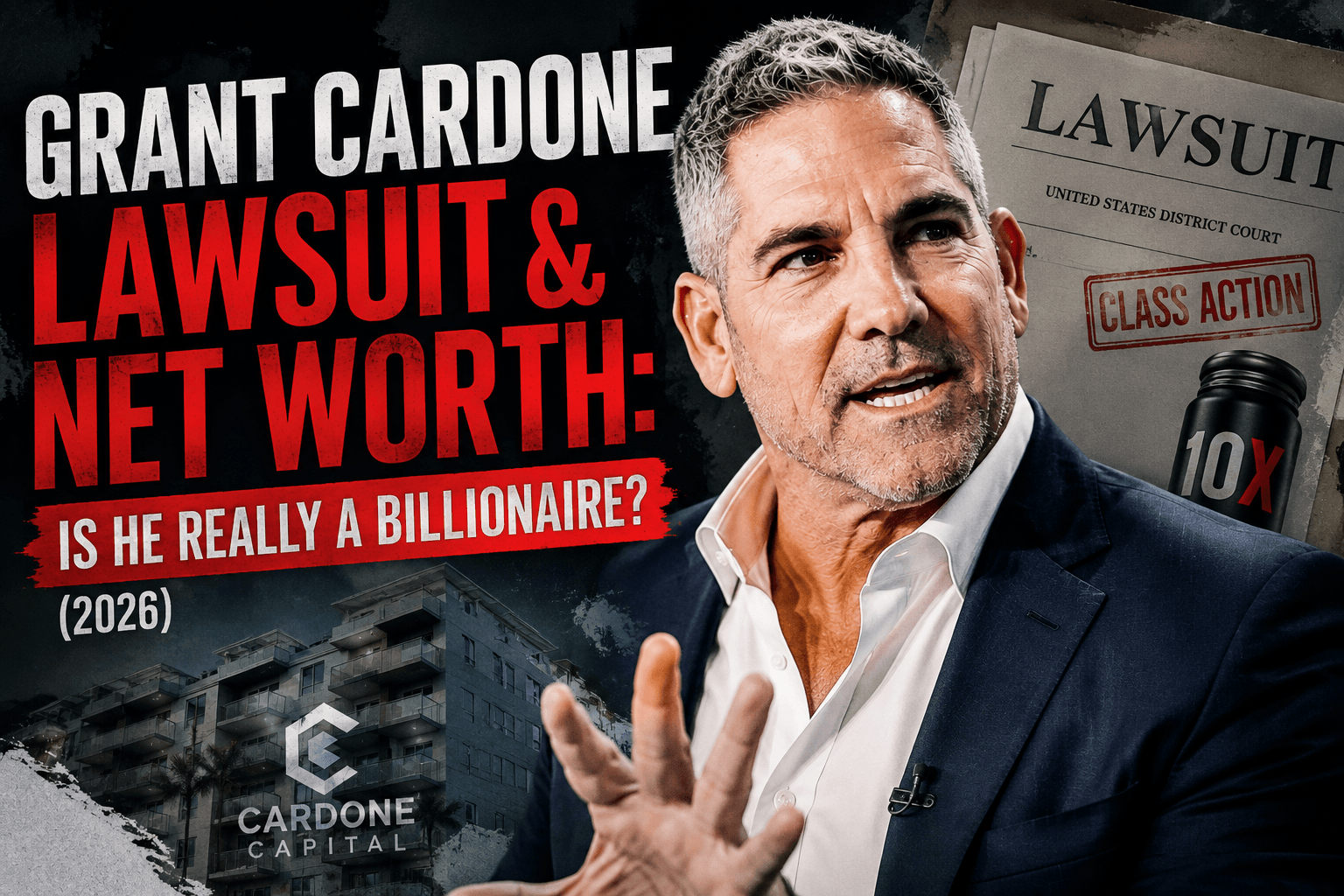
There's a detail buried in  Grant Cardone (Cardone Capital)'s own deposition footage that tells you almost everything about how he operates: with a federal securities case bearing down on him, under oath, being asked hard questions about millions of dollars, he still made sure his branded 10X water bottle was sitting in frame for the whole thing. That's either the most confident man in real estate or the most on-brand one. Possibly both.
Cardone has spent a decade telling people to stop treating their house like an asset and start investing with him instead, promising returns most banks can't touch. Right now, that exact pitch is being tested in federal court, and on July 18, 2026, Cardone did something almost no defendant in a securities case ever does: he posted his own sworn deposition to  YouTube and dared the internet to watch it, captioning it with “who would share a deposition if they had anything to hide?”
So we watched it. Along with the court filings, the fund disclosures, and the numbers Cardone's own team has to report to the SEC. Here's what's actually going on, not just the headline version.
The short version: the real estate business is real. The lawsuit over how he marketed it is also real, and still headed to a jury in 2027. His personal net worth is nowhere near the billion dollars he implies in interviews. All three of those things are true at the same time, and most coverage only ever gives you one of them.
Related reading: we ran the same numbers on another self-made "billionaire" claim in our Sam Ovens net worth breakdown.
Who Is Grant Cardone?
Cardone is a sales trainer turned real estate investor, best known for his “10X Rule” philosophy and his 2010 bestseller If You're Not First, You're Last. He got his start in automotive sales in the 1980s, built Cardone University (a sales training platform), and eventually launched Cardone Capital, a  Real Estate Crowdfunding business that pools investor money to buy multifamily apartment complexes. He's a regular Fox News contributor and, with more than 8 million followers across platforms, one of the most recognizable faces in the “invest with me” corner of the internet. Longer background is on Wikipedia if you want it.
Full creator profile and content breakdown: Grant Cardone (Cardone Capital).
Grant Cardone's Courses, Coaching & Real Estate Education
Before we get to the lawsuit, it's worth understanding the other half of Cardone's business: he doesn't just raise money to buy buildings, he sells an entire Real Estate Investing education pipeline, anchored by  Grant Cardone Training Technologies - Real Estate and a few other storefronts. It's a real, active business with prices ranging from a free membership up to a five-figure coaching program. Here's what's actually for sale right now, pulled directly from his own stores.
Program | What's Included | Price |
|---|---|---|
800+ interactive video segments covering sales, closing & objections, cold calling, negotiation, buyer psychology, personal finance, and business growth, with digital badges and certificates on completion | Free to join; individual courses roughly $79–$297 on promo | |
How to Get Started in Real Estate (Live Training) | Starting out with $10K, choosing partners, and chasing 10X returns in 39 months | $997–$1,997, depending on the current promo |
Introduction to Buying Apartments | First-deal acquisition steps, avoiding costly mistakes, cash-flow strategy | $9,997–$10,000 |
Advanced Deep Dive in Apartment Investing | Forced appreciation, bank financing, and deal-finding techniques | $1,997–$4,997, depending on the bundle/format |
Real Estate Master Class | Capital preservation, financing, targeting 3x returns, and off-market deal access | $10,000 (listed regular price $15,000) |
Real Estate Home Study Course | Self-paced version of the apartment-investing curriculum | $9,997 (listed as reduced from $22,500) |
One-on-one style business coaching under the 10X brand | $27,500 (listed regular price $100,000) | |
Real Estate Club (membership) | Bundles the Intro and Advanced apartment courses with weekly deal-analysis calls, weekly Q&A, the 10X Deal Finder tool (27M+ commercial leads), VIP events, workshops, and a private community | $30,000, or $27,500 one-pay |
Books & lower-cost materials | Titles like How to Create Wealth Investing in Real Estate, workbooks, and audio programs | Roughly $14.97–$25 |
 Grant Cardone Training
 Grant Cardone Training Technologies - The 10X Collection
A few things worth noting before you reach for a card: the same course shows different prices on different Cardone-owned storefronts (training.grantcardone.com, store.grantcardone.com, 10xgc.grantcardone.com), all under “limited time” framing that doesn't seem to expire. And the Real Estate Club's claimed $85,000 “aggregate value” is Cardone's own math, not an independent appraisal of what those components would cost separately. None of that makes the content inside worthless. It just means the pricing is marketing, the same way the 15% return projections at the center of the lawsuit were marketing.
Is Grant Cardone Legit?
The underlying business is real. Cardone Capital genuinely owns apartment buildings, and as of late 2025 the company reported managing roughly $4.8 billion in multifamily real estate. That part isn't in dispute, and it hasn't been the target of the lawsuit.
What is in dispute, and what's currently in front of a federal jury, is whether Cardone misrepresented how well those investments actually perform for the people who put money in. That's the subject of an active lawsuit and a certified class action, both still working through the courts. An independent review of the funds put it bluntly: there's a real gap between what the SEC filings say and what the “doubling your money” marketing promises.
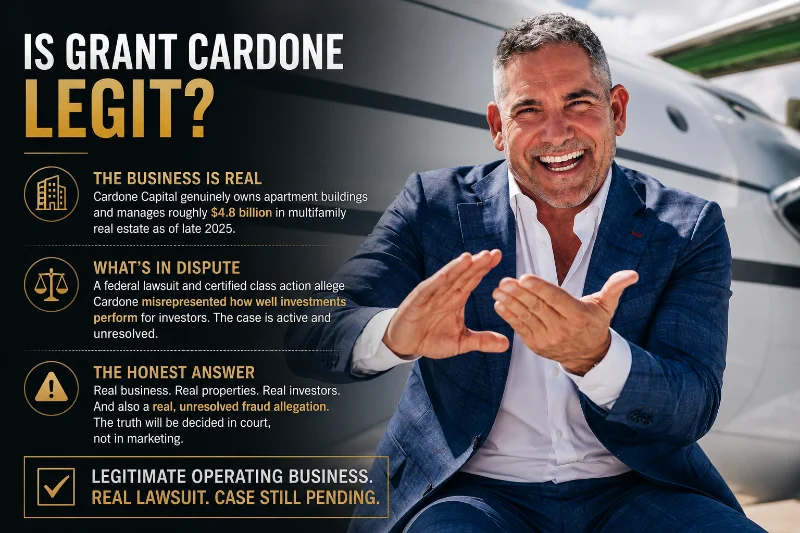
So the honest answer: legitimate operating business, real properties, real investors, and also a real, unresolved fraud allegation. Anyone telling you it's definitely a scam, or definitely nothing to worry about, is getting ahead of a case that hasn't gone to trial yet.
The Grant Cardone Lawsuit, Explained
The case is Pino v. Cardone Capital, and by 2026 standards it has an unusually long history for something still headed to a jury.
Date | What Happened |
|---|---|
2020 | Luis Pino, who invested $10,000 across two Cardone funds, sues Cardone Capital, alleging Cardone misrepresented investment returns and concealed fees |
2023 | A federal court dismisses the case |
June 2025 | The Ninth Circuit Court of Appeals reverses the dismissal, ruling that Cardone's social media posts promoting the funds could count as actionable securities offers, and citing an SEC letter that had already warned him against including projected returns in his marketing |
March 27, 2026 | A related claim covering Cardone Equity Fund V and Fund VI investors is certified as a class action |
July 14, 2026 | The opt-out deadline for the class action passes |
July 18, 2026 | Cardone posts his own deposition video to |
March 9, 2027 | Jury trial scheduled |
Pino died before the case concluded; his daughter Christine has continued it on his behalf. Cardone denies any wrongdoing. In a statement covered by Yahoo Finance, he said Pino “refused” an offer to have his investment returned, called the suit “a legal attempt to get a monetary settlement,” and said he's personally spent millions (reports put the figure somewhere between $3 million and $6 million) defending it. He also points to Cardone Capital distributing $100 million to investors over a recent 12-month period with close to 7% average returns, which he argues beat comparable funds during a rough market.
Watch the Deposition Yourself
This is the part most coverage skips, and it's arguably the most interesting piece of the whole story: Cardone didn't just deny the allegations in a press release, he handed the public hours of himself answering for them under oath.
A few things stand out once you actually sit through it, according to detailed recaps from outlets that logged the footage timestamp by timestamp:
The checks are real, and they're not small. Cardone testified to writing buyout checks totaling roughly $400,000–$500,000 in a single week, sending similar amounts out the following week to investors who opted to be bought out ahead of the class action.
The math on one example investor: a $15,000 investment was bought out for $14,727, on top of $272 already paid in distributions, landing at $14,999 returned, a dollar short of the original $15,000. Cardone characterized this as the investor having “lost no money, not a penny.” It's worth noting that figure lines up almost exactly with the court's own rescission formula (purchase price minus income already received), which is the same math the lawsuit argues investors are owed.
He leaned into the “racket” framing hard, casting the class-action process itself, and the law firm behind it, as the real predatory actor, rather than engaging much with the underlying return numbers.
None of that resolves the case. But if you want to form your own opinion instead of taking either side's summary of it, the full video is sitting there in public, which is more than most defendants in an active securities case ever offer.
What the Fund Filings Actually Show
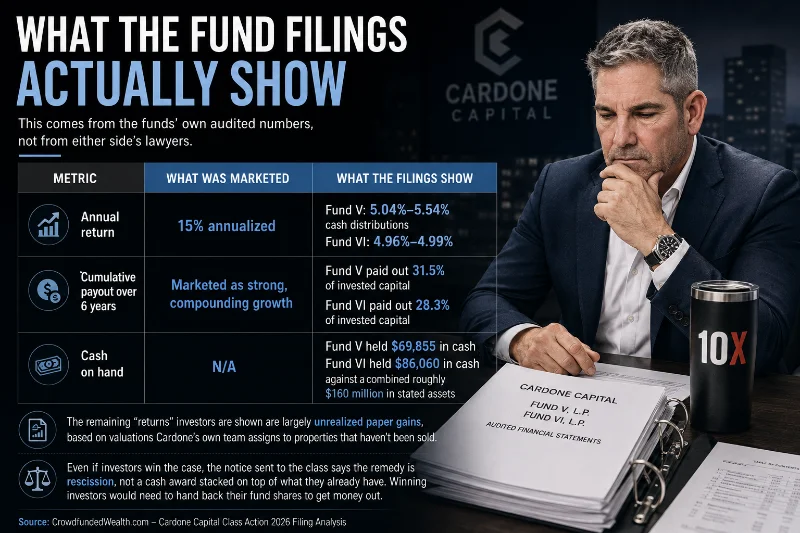
This is the part worth sitting with, because it comes from the funds' own audited numbers, not from either side's lawyers. The core allegation is that Cardone marketed a 15% annualized return while the funds' actual cash performance has looked very different.
Metric | What Was Marketed | What the Filings Show |
|---|---|---|
Annual return | 15% annualized | Fund V: 5.04%–5.54% cash distributions. Fund VI: 4.96%–4.99% |
Cumulative payout over 6 years | Marketed as strong, compounding growth | Fund V paid out 31.5% of invested capital. Fund VI paid out 28.3% |
Cash on hand | N/A | Fund V held $69,855 in cash. Fund VI held $86,060, against a combined roughly $160 million in stated assets |
The remaining “returns” investors are shown are largely unrealized paper gains, based on valuations Cardone's own team assigns to properties that haven't been sold. And even if investors win the case, the notice sent to the class says the remedy is rescission, not a cash award stacked on top of what they already have. Winning investors would need to hand back their fund shares to get money out. Full breakdown via CrowdfundedWealth's filing analysis.
Grant Cardone Net Worth: What Different Trackers Actually Say
The number depends on who you ask, though the estimates cluster closer together than most “guru net worth” pages tend to.
Source | Estimate | Basis |
|---|---|---|
Celebrity Net Worth | $600M | Real estate equity (~$2.7B in properties via Cardone Capital), seven privately held companies, book royalties, speaking income |
Unnetworth (2026) | $400M–$600M, up to $800M with brand value | Equity in Cardone Capital, Cardone Enterprises, and Cardone Training Technologies, plus royalties and media revenue |
Finbold (updated Dec 2025) | $600M | Real estate equity, Cardone University revenue, book royalties, speaking fees, social media |
CoinCodex | $600M | Cardone Group, Cardone Real Estate Acquisitions (6,500+ rental units), media income |
No independent, audited source confirms any of these. They're all estimates built from public information. But four separate trackers landing within spitting distance of $600 million is a meaningful signal on its own. Finbold notes the estimate “hasn't been independently verified to climb significantly since 2023 and 2024,” meaning even the more generous trackers see steady growth, not the explosive wealth his marketing implies.
Is Grant Cardone Actually a Billionaire?
No, and it's worth separating this clearly from the lawsuit above, since the two get conflated constantly. Cardone regularly refers to himself as a billionaire in interviews and on social media. The confusion comes from a real number that gets misapplied: Cardone Capital manages around $4.8 billion in investor real estate. That money belongs to the investors who put it in. It is not Cardone's personal wealth.
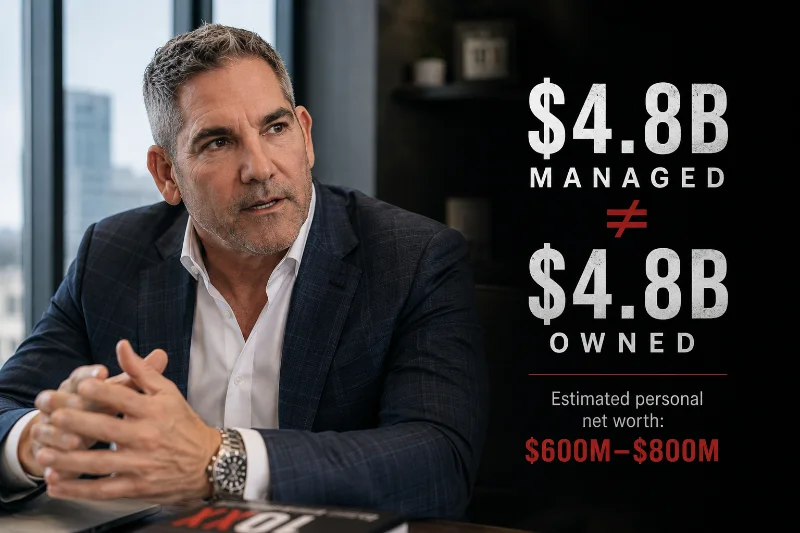
Managing $4.8 billion and personally owning $4.8 billion are very different things, and conflating them is exactly how “Grant Cardone billionaire” claims keep circulating despite no independent source backing them up. His actual personal stake, per every tracker above, tops out around $600 million to $800 million. That's still, to be clear, a genuinely enormous amount of money. It's just not the number he says out loud.
Other Controversies, Briefly
The securities lawsuit is the current headline, but it isn't the only legal friction around Cardone's businesses. A quick scorecard, without turning this into a full rap sheet:
Issue | What Happened |
|---|---|
Religious discrimination complaints (2015–2016) | Former employees filed EEOC complaints alleging they were fired for refusing company training tied to Church of Scientology materials. Cardone and his wife are Scientologists and known donors to the church |
Workforce housing overcharges (2022) | A Palm Beach Post investigation found a Cardone Capital apartment complex had overcharged tenants enrolled in a workforce housing discount program |
Legere defamation suit (2024–2025) | Cardone sued former T-Mobile CEO John Legere for $100 million after Legere called him a “con man” and “a fraud” on a livestream. The two reached a confidential settlement in January 2025 |
Quick FAQ
Is Grant Cardone being sued?
Yes. Pino v. Cardone Capital is an active federal lawsuit, along with a related certified class action covering Cardone Equity Fund V and VI investors. A jury trial is scheduled for March 2027.
Is Grant Cardone a billionaire?
No independent source confirms this. Estimates put his personal net worth around $600 million. The $4.8 billion figure people cite is investor money his company manages, not his personal wealth.
What is the Grant Cardone lawsuit about?
Investors allege he marketed a 15% annualized return on his real estate funds without disclosing that the SEC had already warned him against making that projection, while the funds' actual audited cash distributions have run closer to 5% a year.
Has Grant Cardone been criminally charged?
No. This is a civil securities lawsuit and class action, not a criminal case. Cardone denies all wrongdoing and the case is still headed to trial.
Should I invest with Cardone Capital?
That's not a call anyone but you (and ideally a licensed financial advisor) should make. What you can do is read the actual fund filings instead of the marketing deck, understand that the “15%” figure is disputed in active litigation, and go in with eyes open about the difference between paper gains on unsold property and cash you can actually spend.
Tags: Grant Cardone, Cardone Capital, Pino v Cardone, Pino v Cardone Capital Lawsuit, Grant Cardone Lawsuit, Grant Cardone Net Worth, Grant Cardone Billionaire, Grant Cardone Deposition, 10X Rule, Cardone University, Cardone Equity Fund, Real Estate Crowdfunding, Real Estate Investing, Securities Fraud, Class Action Lawsuit, Net Worth 2026