
Zero Investment Is a Lie. Here's What You're Actually Paying With.
I typed "make money online with zero investment" into Google before writing this. Got back what I expected. Freelancing, affiliate marketing, surveys, blogging, YouTube, virtual assistant. Same six things, over and over, maybe forty times down the page.
They're not wrong. I'm going to cover all six of them too.
But I've never once seen anybody stop and ask what "zero investment" is actually supposed to mean, and I've come to think that's the whole reason most people who read those articles never make a single dollar.
Zero investment is a lie.
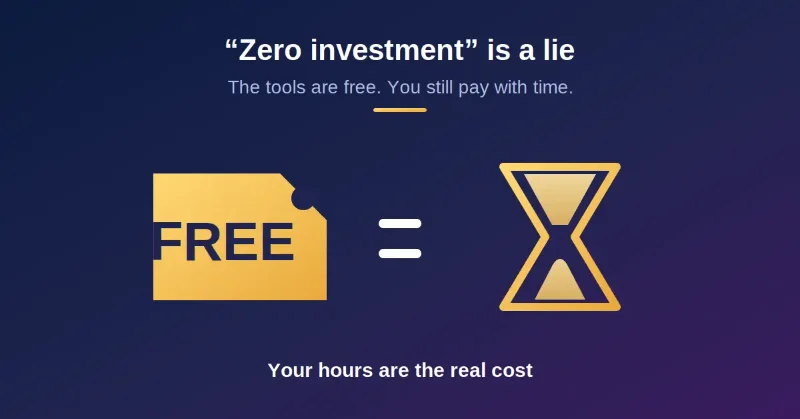
Not a scam-lie. Something more irritating than that. It's the kind of lie where the words are technically true and completely useless at the same time and once you catch it, the entire "make money online" thing suddenly makes a lot more sense than it did five minutes ago.
Let me show you what I mean.
The "with what?" question
You know that thing where a kid asks "why" until you run out of answers? I want to do the opposite of that. I want to ask "with what."
Me: I'm going to make money online. Also me: With what? You have no money. Me: Doesn't matter, the tools are all free. Also me: Okay. So what makes a free tool turn into money? Me: Well, somebody has to pay me. Also me: Why would they? Me: Because I did something worth paying for. Also me: And why would they believe you can, before you've done it? Me: Because I can show them I've got the skill. Or somebody they trust vouches for me. Also me: Right. And where did the skill and the vouching come from? Me:.
Time. That's where. Hours you spent that nobody paid you for.
Doesn't matter which method you run it on. Freelancing, affiliate stuff,  YouTube, VA work every one of them bottoms out in the exact same spot.
You're always paying. Money just isn't the thing you're paying with.
Someone already figured this out and it wasn't a guy with a course
Back in the 80s a French sociologist named Pierre Bourdieu wrote that "capital" doesn't only mean money. His argument was that there are three kinds of it, and that the actual game in your career in class, in most things is quietly turning one kind into another.
The man was obviously not thinking about Upwork. He'd have no idea what Upwork was. But he described it better than any side hustle blog I've ever read.
Economic capital | Cultural capital | Social capital | |
What it is | Money | Skill, know-how, taste, credentials | Relationships, reputation, an audience |
How you get it | Earn it or inherit it | Practice | Show up in public, over and over |
How fast it builds | Instantly, if you've got it | Weeks to months | Months to years |
Does it compound? | Only if you invest it | Yes | Yes and fastest of the three |
Turn it into cash? | It already is cash | Yes, fast, at a capped rate | Yes, slow, at no cap |
That bottom row is the whole article, so read it twice.
Skill converts into money fast, but there's a ceiling. You learn to edit video, you sell an hour of editing, you get paid for an hour of editing. Fair trade. Capped forever.
Trust converts into money slowly, and there's no ceiling. Get ten thousand people to trust what you recommend and one affiliate link earns while you're asleep. Took you a year to get there. Might not have worked at all. But no ceiling.
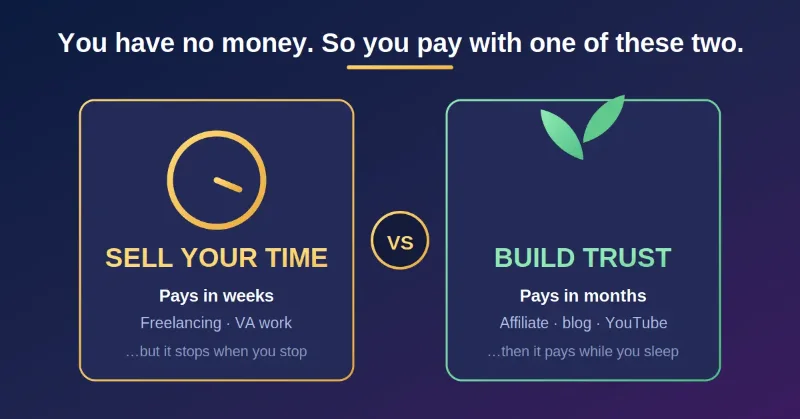
You've got zero of the money kind that's the entire premise here. Which leaves you two doors. And here's the thing I really want you to sit with: almost everybody who fails at this fails because they walked through the wrong one.
The wrong door
Watch this, and see if you recognise yourself. I did, which is partly why I'm writing it.
Someone needs money this month. So they start a blog. Or a YouTube channel. Or they start dropping affiliate links everywhere.
Every one of those is a trust play. They pay nothing for six, eight, nine months not because you did it wrong, but because you're building trust and trust is slow. The waiting isn't a bug. The waiting is the actual mechanism.
Six weeks in, they've made nothing, rent's due and they decide the whole "make money online" thing is a scam and go back to whatever they were doing before.
It's not a scam. They just paid with the wrong currency. Needed a fast conversion, reached for the slowest instrument on the shelf.
There's a quieter version of the same mistake, going the other way. Someone freelances flat out for four years. Makes decent money the whole time, genuinely. And at the end of it they've got.. an hourly rate. That's it. No audience, no asset, nothing that earns a cent while they sleep. They sold their time at a fixed price four thousand times and built nothing that lasts.
Both of them worked hard. Both of them got it wrong.
So here's the rule
One from each door. Every time. One skill thing for cash now. One trust thing for the part that compounds later. Give the fast one your impatience and the slow one your patience, and I'm asking nicely do not try to run three at once.
Here's the full list, sorted by which door each one is.
Method | Which capital | Time to first payment | Skill needed | Ceiling | Still pays if you stop? |
Neither, honestly | 2–7 days | None | Almost none | No | |
Cultural | 1–3 weeks | Low | Medium–High | No | |
Cultural | 2–4 weeks | Medium | High | No | |
Cultural → Social | 3–6 weeks | Low–Medium | High | Sort of | |
Social | 2–6 months | Medium | Very high | Yes | |
Social | 4–9 months | Medium | Very high | Yes | |
Social | 4–12 months | Medium | Very high | Yes | |
Social | 9–18 months | Low | Medium–High | Yes |
There's no row that pays fast AND compounds. There never is. If somebody's promising you one, they're promising you something that doesn't exist.
Door One: skill for cash (weeks, not months)
Freelancing
Fastest honest way to a first payment, because you're not building anything. You're selling something you can already do today.
 upwork and
  fiverr cost nothing to join and the paid tiers aren't worth buying until you've got reviews.
Here's the bit nobody tells you about how to earn extra money on these sites when you're new.
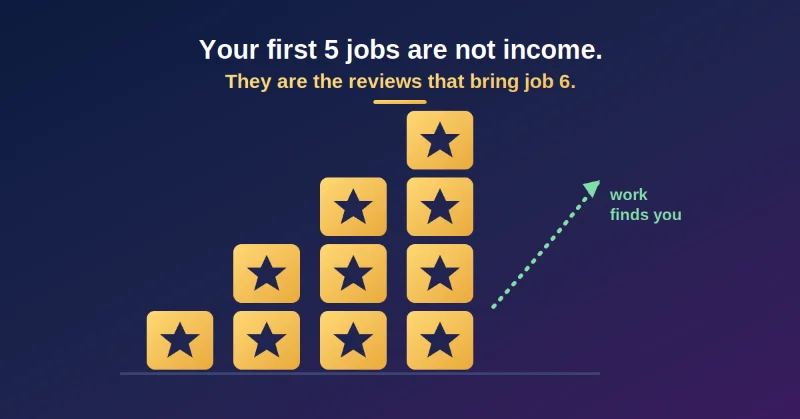
Your first five jobs aren't income. They're stock. You're manufacturing the reviews that make job number six come and find you instead of the other way round. So charge little on those first ones. On purpose. Make your peace with it. Then bump your rate every five clients until somebody balks. If nobody's ever balked at your price, your price is too low and you're leaving money on the table.
And rewrite your headline, because most people's headline is doing nothing. Lead with what the client gets, not with an adjective about yourself.
Not "passionate, detail-oriented content writer." Nobody's buying that.
Try "I write SEO blog posts for SaaS brands that actually rank." One of those is a thing someone can buy. The other one is just a vibe.
What to sell, and what to make it with
Skill | Free tool for it | Why it sells |
Writing & editing |
| Most jobs, everywhere, always |
Graphic design | Every business needs graphics every single week | |
Short-form video editing | Demand is nuts, competition's thin | |
Long-form video editing | Pays more, way fewer people who can do it | |
Repurposing content | Sell it monthly, not as a one-off |
 Descript
 InShot
 DaVinci Resolve
 OpusClip
If you only act on one line in this whole section: go learn short-form video editing. Genuinely. It's a weekend in  CapCut , the demand right now is a bit ridiculous, and it's the one skill on that list that opens a side door into UGC and social media management work both of which pay noticeably better than plain editing does. If you want a starting point, here's our rundown of the best video editing apps for creators.
Virtual assistance the one everyone walks straight past
Everybody stampedes toward freelancing. Almost nobody pitches VA work. Which is exactly why VA work is easier to land. Less crowd.
A  Virtual Assistant deals with the stuff that quietly eats every small business owner alive. Inbox. Scheduling. Data entry. Customer emails. The follow-ups they keep meaning to send and never do. There's a mountain of demand for this because founders hit an admin ceiling long before they hit a money ceiling, and most of them know it and hate it.
What you actually need: write clearly, be reliable, and be comfortable in  Notion, Sheets,
  Airtable and a calendar. That's the list. Reliability is the real product here. Being talented barely enters into it.
But this is where people blow it they go and bid. Don't. Don't be applicant number 400 on some VA listing. Go to  linkedin , find a small business owner, spend four actual minutes looking at how they run things, and message them about one specific thing you spotted.
Not "hi, I'm a VA, I offer VA services." Nobody replies to that.
More like: "you're answering your own booking DMs at 11pm I could clear that inbox for you every morning so you don't have to." That's not a pitch, that's a conversation, and it converts at a rate the generic version never will. It's the cleanest way I know to make at home for money without ever touching a bidding war, and it costs you nothing except paying attention.
Door Two: trust that compounds (months, then it doesn't stop)
Affiliate marketing
You recommend a thing, someone buys it through your link, you get a slice. You never touch inventory or payments or angry customer emails.
Everyone knows how it works. Here's the part that decides whether you make nothing or make four grand a month.
Affiliate money has almost nothing to do with how many links you post. It has everything to do with how much the reader already wanted the thing before they hit your link.
Somebody searching "best budget standing desk under $200" has a card out in another tab. Somebody searching "what is a standing desk" is bored at work. Same link, same product, same you completely different outcome. And most beginner affiliate content is written for the bored person. That's why it earns zero.
Write for the one with the card out. That's the skill. That's basically the entire skill.
Getting going, for actual free
Amazon Associates Program is the normal way in. Free, gigantic catalogue, and it converts well because people already trust Amazon's checkout. The commission percentages are small but small times trusted times high-volume is a genuine business, so don't sniff at it. Places like  ClickBank pay a lot more per sale and need a lot more vetting, because if you push junk you torch the trust you spent nine months building and you do not get it back. The trust is the whole asset. Everything else is just a URL.
Handful of things that actually matter:
Say what's bad about the product. Honest downsides convert better than glowing praise, because they're the only proof you've actually used the thing.
Give it away free while you build
 reddit (act like a person, don't spam),
 X (formerly Twitter),
  TikTok , Pinterest, Medium.
Bolt it onto stuff you're already making. If you're putting together a UGC portfolio, those practice clips can carry
TikTok Shop Affiliate links. Same work, two income streams.Disclose it. It's the law, and it costs you nothing.
Content creation
The slow machine. This is where most of the actually life-changing side hustle ideas live and it's also where most people rage-quit around week seven.
Blogging works when you answer one specific question better than everything currently ranking for it. Not broader. Narrower and better. Traffic piles up over time, then you put ads or affiliate links on it.
YouTube doesn't need your face. Faceless channels tutorials, screen recordings, list videos do great and cost nothing to make: write it in a doc, record with  Loom, cut it in CapCut , thumbnail it in
 canva
canva
Podcasting goes out free to Spotify and Apple, builds the most loyal audience of anything on this list, and also pays the latest of anything on this list. Start one because you want to, not because you need the money this quarter.
And I'll say the warning one more time because it is the entire point of the piece: don't start here if rent is due. Start here next to something from Door One. Not instead of it.
Alright are surveys even "making money online"?
Been looking forward to this bit.
Every single zero-investment article opens with paid surveys, and I want to make the case that they shouldn't be on the list at all.
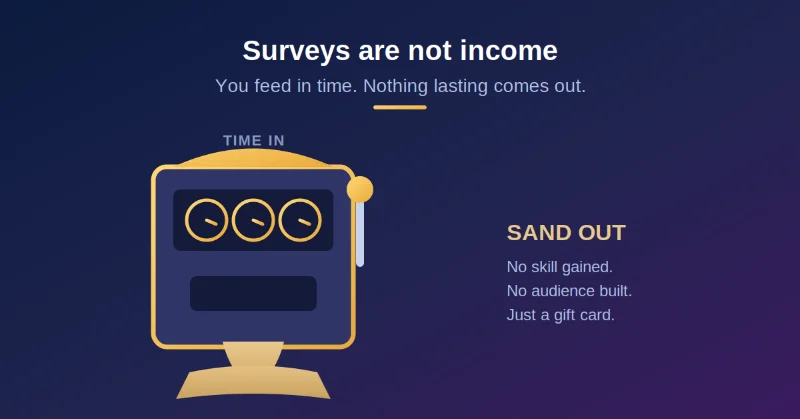
Go back and look at the capital table. Surveys build nothing. Not skill you're no better at surveys in month six than you were in week one, there's nothing to get good at. Not trust nobody knows you did them, you walk away with no audience, no reputation, no portfolio, no referral, nothing. And not money, unless we're being generous enough to call that amount of money "money."
Freelancing at least leaves you with a skill and a review. Virtual Assistant work leaves you with a client. UGC Creator leaves you a portfolio. Surveys leave you a gift card.
You're selling the single most finite thing you will ever own hours off the actual clock of your one actual life at the worst exchange rate on the internet, and you finish the trade owning precisely what you owned before it, minus the time. That's the deal. That's the whole deal.
Every hour on surveys is an hour you didn't spend learning CapCut . One of those hours would've compounded. The other one just evaporated.
So no. Surveys aren't making money online. They're a slightly classier way of doing nothing.
Okay. Now let me argue with myself for a second, because I think I'm about 80% right and the last 20% is worth being honest about.
There are two situations where surveys are genuinely the correct move, and I'd be lying if I pretended otherwise.
One: you need twenty bucks and you need it Thursday. Not as a plan as an emergency. When the alternative is actually zero, a terrible exchange rate beats no exchange rate every time, and nobody with a newsletter about compounding gets to lecture you about it while your power's about to be cut.
Two and this one's more interesting to me it's a test of whether you'll actually show up. Most people who swear they're going to build an online income have never once done boring, unglamorous, unrewarded work at a screen with nobody standing over them. Surveys are a cheap way to find out if you're that person, before you pour three months into a blog. Do two weeks of them. If you can't even sustain that, the blog was never happening, and at least you found out for free.
So: not income. But maybe an emergency, or maybe a mirror.
If you do them anyway and let's be honest, some of you will two rules:
Fill your demographic profile all the way out. The good-paying studies target narrow profiles, and a half-empty profile means getting screened out five unpaid minutes into everything.
Watch your screen-out rate. If a platform keeps kicking you out late in surveys, it's farming your answers for free. Walk.
The baseline nobody admits to
You can't build any of this from actual zero. There are conditions, and everyone glosses over them, and I think that's dishonest.
You need | Why it's non-negotiable | If you haven't got it |
Somewhere to get paid | You literally cannot be paid if there's nowhere to receive it. This stops more beginners than any missing skill does. | Sort this out first. Before the profile. Before anything. |
Two uninterrupted hours a day | Not two hours with the laptop open near you. Two hours where nobody needs you. | Find them, or accept a slower timeline. Don't lie to yourself about which. |
Internet good enough to upload | Uploading video on flaky data will genuinely break your spirit. | Pick text work writing, VA over video. |
A device that's yours | You can't build on a phone three people share. | Any laptop at all. It does not have to be nice. |
Three months of patience | Door Two pays nothing before then. That's the timetable, not a failure. | Then run Door One only, and be straight with yourself that that's the plan. |
Nobody doing well online started from nothing. They started from not much, which is a completely different starting line, and pretending the two are the same just makes people feel like failures for having a life to live.
The payout reality check
This is honestly the section I wrote the whole article to get to, because it's the thing that stops people after they've done all the work, which is so much crueller than being stopped before.
Signing up is free everywhere. Getting your money out is not.
Payout thresholds, how you actually get the money, and how long you wait for it. Check these before you sink twenty hours into a platform, not after you've earned money that's then stuck behind a minimum you can't hit.
Platform | Type | Payout minimum | How you get paid | How long it takes |
Freelance | No minimum (ACH) | Direct deposit, | 5-day security hold; 5–10 days on your first payment | |
Freelance | Small | Direct deposit, | 14-day clearance, then fast | |
$10 direct deposit / $100 check | Direct deposit, gift card, check | Paid ~60 days after the month's end | ||
YouTube Partner Program | Ads | Threshold applies | AdSense direct deposit | Monthly, once you cross the threshold |
Low |
| Gift cards fast, cash slower | ||
Low |
| Fast once you hit the minimum |
 PayPal
 swagbucks.com
Two things in that table trip up first-timers more than anything else. The affiliate delay Amazon and most affiliate programs pay you around 60 days after the month you earned it, so a January commission lands in late March, and your very first payment can feel like it takes forever.
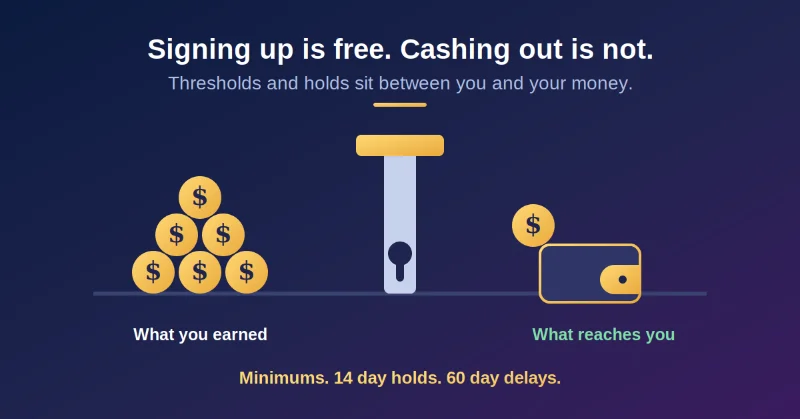
Plan your rent around that, not around the day the sale shows up in your dashboard. And the early-job holds on freelance platforms, where your first payments sit frozen for a week or two before you can touch them. Neither is a scam. They're just how the plumbing works, and nobody mentions it until you're staring at a balance you can't withdraw.
One more that surprises people: once you clear a certain amount, these platforms report your income to the IRS and you'll get a 1099 at tax time. That's a sign it's real money, not a problem but set aside a slice for taxes from your first payout so it isn't a shock in April.
And a ten-second scam test
Zero-investment methods attract predators, because a person with no money is a person who badly wants to believe. One rule handles about 95% of them: a real platform never asks you to pay in order to work.
Red flag | What's actually going on |
"Small registration fee" | You're the product |
Paid training before you can start | It's a course in a job costume |
Wants your bank password or an OTP | Account takeover |
Guarantees you a specific income | Nobody alive can guarantee that |
Pays you to recruit other people | Pyramid |
Mails you a check, asks you to forward part of it | Check fraud, and you're the one who's liable |
Real platforms make money when you make money. If their income comes from you rather than from your work, you were never the earner in that arrangement. You were the product.
Your first 30 days
Reading isn't doing. So here's how to make additional money starting from nothing, in the only order I've seen actually work one track from each door, both running at the same time.
Week | Door One (cash now) | Door Two (compounds later) |
1 | Set up where you'll get paid. Build one profile. Outcome in the headline. Two free samples. | Pick one narrow thing you could talk about for a year. |
2 | Apply to 10 small jobs. Underprice on purpose. Send 5 direct LinkedIn VA messages. | Publish piece one. Ship it rough. Rough is fine. |
3 | Deliver it. Over-deliver, actually. Then ask for the review. | Publish two and three. Notice which one people responded to. |
4 | Put your rate up. Apply to 10 more. | Publish four, on the thing that worked. Drop your first affiliate link in. |
End of the month you're holding: one payment, one review, four published things, and real data about which of them anyone actually cared about.
That's not a fortune. But it's the only starting position I've ever watched reliably turn into one.
So now what
Two ways to make extra money online with no money. Sell a skill, or build trust. Every platform, every tool, every one of those forty near-identical listicles all of it is one of those two things in a different outfit.
These really are the real ways to make money from home for free. Not because they're free. Because the price was never money in the first place.
The price is your hours, and you're spending those regardless. The only real question is whether you've got anything to show for them at the end.
Now it gets specific, and these are the ones only you can answer:
What's the fastest skill you could actually sell? Not the most impressive. The fastest.
What's the one topic you could talk about for a year without wanting to die of boredom? Because Door Two takes roughly that long.
Which of your baselines is actually missing right now? Go fix that one. Today. Before anything else in this piece.
And what are you shipping this week?
Not next month. This week. Door One or Door Two, doesn't matter which. Just open the thing.
FAQs
Is "zero investment" actually a real thing?
Zero money, yes. Zero cost, no. Everything here is free to start and the tools (canva, CapCut, Notion, Google Workspace) have free tiers that are fine for real client work. What you pay with is time the whole article is about spending it on the right door.
How fast can I earn my first dollar?
Depends which door. Skill-based work (VA, freelancing) pays in one to four weeks. Trust-based work (affiliate, blogging, YouTube) usually pays nothing for three to nine months and then keeps paying. Need money this month? Don't start a blog this month.
Best method if I've got no skills at all?
Virtual Assistant. Lowest real barrier of anything that pays properly, rewards reliability over talent, and pitching directly means you dodge the bidding wars.
Do I need a website for affiliate marketing?
No. Start free reddit, TikTok Pinterest, X (formerly Twitter), Medium. Build a site once you've got proof people click your links. Not before.
How much can I realistically make?
Freelancing and VA scale with your rate and hours and can go full-time, but stop when you stop. Affiliate and content have no ceiling and no floor. Surveys make pocket change. Anyone quoting you a specific monthly number is guessing or selling.
Are these platforms safe?
The established ones, yes. The rule doesn't bend: a real platform never asks you to pay to work. Upfront fees, forced paid training, or anyone wanting your banking login means it's a scam, however slick the site looks.
Should I run more than one at a time?
Two. One from each door. Three or more and you'll do all of them badly, which is how most people quietly give up without ever admitting they gave up.