

Where to Sell Handmade Crafts (2026): The Real Fee Comparison
Last updated: September 30, 2026 · Verified against multiple independent 2026 fee comparison sources
 Etsy or
  ebay, cheaper? You'll find confident, contradictory answers to that exact question across the web. Some say Etsy wins, some say ebay does and both are citing real numbers. The actual answer depends on one detail almost none of them mention clearly: how much you sell.
The gist: For most handmade sellers under $10,000 a year in sales, Etsy is the cheapest paid option at roughly 9.5% to 10.4% per sale. Cross that threshold and Etsy's mandatory Offsite Ads fee (12% to 15%, no opt-out) can push your real cost above ebay's flat 13.25% to 14.4%.  Amazon Handmade charges a flat 15% with no listing fees.
  Facebook Marketplace is free for local sales but offers no built-in shipping, protection or handmade-specific audience.
The direct fee comparison
Platform | Listing fee | Core transaction fee | Effective total (typical $50 sale) |
$0.20/item | 6.5% + 3% + $0.25 payment processing | ~9.5%–10.4% (up to 21%–25%+ with mandatory Offsite Ads over $10K/year) | |
None (250 free listings/month) | 13.25%–13.6% final value fee + 0.30–0.40/order | ~13.6%–14.4% | |
| None | 15% flat referral fee | 15% (professional monthly fee waived for approved artisans) |
| None | None for local peer-to-peer sales | 0% (no shipping protection, no built-in handmade audience) |
These figures come from cross-referencing multiple independent 2026 fee-tracking sources, not a single blog's claim. Where sources disagreed slightly (eBay's rate is reported as both 13.25% and 13.6% depending on category and source date), we used the more recent, more specific figure and noted the range rather than picking one number to sound more confident than the data supports.
Etsy: the mandatory fee most guides don't explain clearly
Etsy's base fees are genuinely the cheapest of the paid platforms for most sellers: a $0.20 listing fee, a 6.5% transaction fee and roughly 3% plus $0.25 in payment processing. On a $50 sale, that's about $5.20, meaningfully less than ebay's roughly $7.20 or Amazon's $7.50 on the same sale.
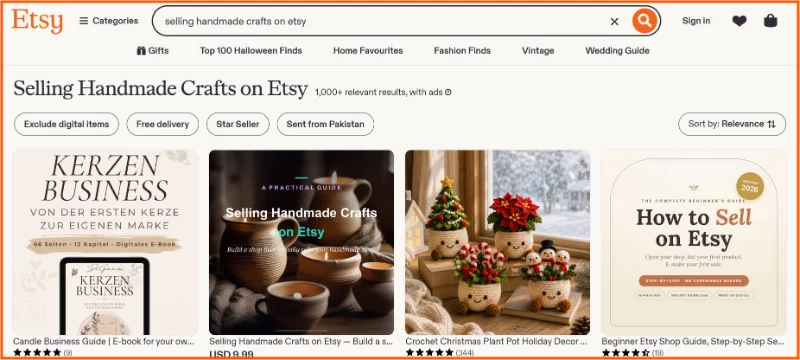
The catch: once a shop crosses $10,000 in trailing annual sales, Etsy automatically enrolls sellers into its Offsite Ads program, an additional 12% to 15% fee on sales that come through those ads. Sellers cannot opt out. This is the detail that flips the comparison for established shops. Below that threshold, Etsy is close to unambiguously the cheapest paid option for handmade goods. Above it, the real math gets much closer to eBay's flat rate. In some scenarios, ebay comes out ahead.
Amazon Handmade: simple math, higher floor
Amazon Handmade's fee structure is the easiest to calculate: a flat 15% referral fee, no listing fees and the $39.99 monthly Professional plan fee is waived for approved artisans. The tradeoff is access. Amazon Handmade requires an application and verification process. It's stricter about what qualifies as genuinely handmade than Etsy is.
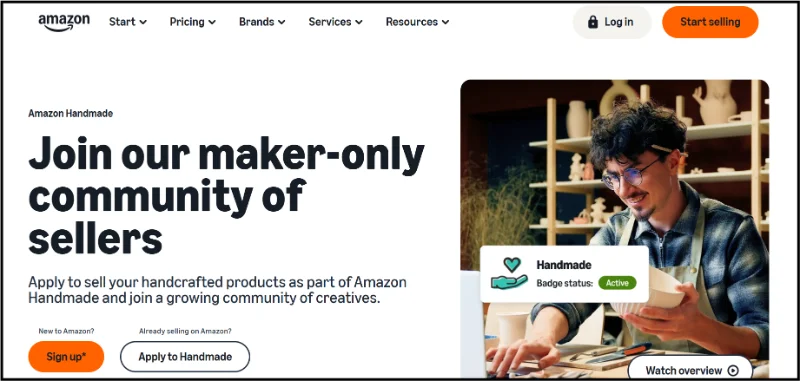
Where it wins: items priced above roughly $30 to $40, where Amazon's flat 15% can end up cheaper than Etsy's stacked fees once Offsite Ads apply. Also a fit for sellers who want access to Amazon's roughly 300 million-plus shoppers rather than Etsy's smaller, more handmade-specific audience of around 90 million.
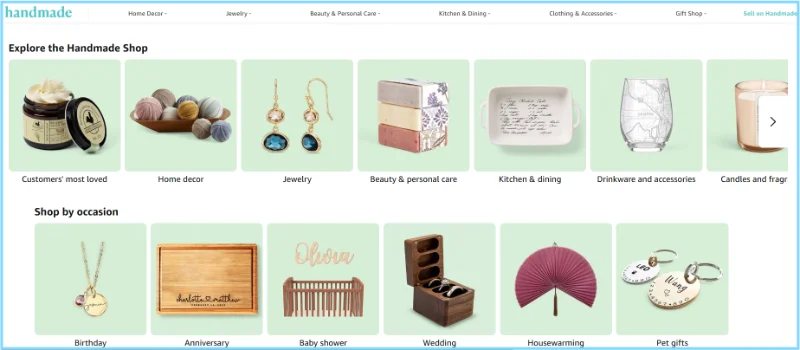
eBay: worse at low prices, more predictable at scale
ebay's roughly 13.25% to 13.6% final value fee plus a small per-order fee is higher than Etsy's base rate for most typical transactions. Its real advantage is predictability: there's no equivalent of Etsy's automatic Offsite Ads jump, so what you calculate at $10,000 in sales is the same rate you'll pay at $100,000. ebay also offers 250 free listings a month, more generous than Etsy's per-listing charge regardless of volume.
Where it wins: high-volume sellers who want a flat, predictable fee structure without a scaling penalty. Also a fit for sellers of vintage, collectible, or one-of-a-kind items where eBay's broader (not handmade-specific) audience is less of a disadvantage.
Facebook Marketplace: genuinely free, genuinely limited
For local sales, Facebook Marketplace charges nothing, no listing fee, no transaction fee. That makes it the cheapest option outright for anyone selling locally, especially bulkier or lower-margin items like seasonal decor, kids' crafts and party favors where shipping costs would eat into margin anyway. The tradeoff: no built-in payment protection, no shipping infrastructure and no audience specifically searching for handmade goods the way Etsy's does.

Which platform actually fits your situation
New sellers, under $10,000/year: Etsy, by a clear margin on fees, plus the advantage of a buyer base already searching for handmade specifically.
Established shops approaching or past $10,000/year: run the comparison again, Etsy's mandatory Offsite Ads may have closed or reversed the gap with ebay, depending on your specific sale mix.
Higher-priced items ($30-plus): Amazon Handmade's flat 15% is worth comparing directly against Etsy's stacked fees at that price point.
Local, bulky, or low-margin items: Facebook Marketplace, since shipping costs on Etsy, Amazon or ebay would likely erase the margin anyway.
Vintage, collectible, or non-handmade-specific items: ebay's broader audience and flat fee structure fit better than Etsy's handmade-focused buyer base.
If crafting is one option you're weighing among several ways to build income, our DIY Projects moonlite covers the wider landscape of maker-focused side hustles. Our guide to online passive income ideas for beginners covers the broader picture before you commit to any one path.
Beyond the marketplace: building your own audience
Selling on a marketplace means competing inside someone else's search results. An alternative, or a complement, is building a following that already trusts you before they ever see your product listing. Our creator profile of Hannah Ebeling, a Print on Demand and Etsy educator, covers exactly this approach, using content to drive buyers directly to a shop rather than relying entirely on marketplace search.
If you're specifically using AI tools to speed up the Etsy side of this (listing optimization, mockups, product research), our Krafie review covers one option built specifically for  Etsy Seller. And if part of your plan is monetizing a following directly rather than only through product sales, our Content Creator moonlite and Patreon review cover that adjacent path.
If handmade crafts specifically isn't the right fit
Not every reader who searches this is set on handmade goods specifically, some are really asking "what online-selling side hustle should I start." If that's closer to your actual situation, our reviews of God Tier Ecom, the Dropshipping Guild, the Justin Cener Bootcamp and the Biaheza Dropshipping Course all cover a genuinely different online-selling model, no handmade production required, worth knowing about as a real point of comparison. Our Freelancer moonlite covers yet another different path if selling a physical product at all isn't actually the goal.
Frequently asked questions
Which is cheaper, Etsy or eBay?
Etsy, for most sellers under $10,000 in annual sales, at roughly 9.5% to 10.4% versus eBay's 13.25% to 14.4%. Above that threshold, Etsy's mandatory Offsite Ads fee can close or reverse the gap.
Is Amazon Handmade worth the higher fee?
Its flat 15% fee can beat Etsy's stacked fees on higher-priced items. It also gives access to a much larger general shopper base, though the application process is stricter.
Is Facebook Marketplace actually free?
Yes, for local, peer-to-peer sales, no listing or transaction fees, but no shipping infrastructure or payment protection either.
What's the biggest hidden cost on Etsy?
The mandatory Offsite Ads fee, 12% to 15%, that automatically applies once a shop passes $10,000 in trailing annual sales, with no way to opt out.
Can I sell on more than one platform at once?
Yes, many sellers list the same products across Etsy, eBay and Amazon Handmade simultaneously, adjusting pricing per platform to account for each one's different fee structure and buyer expectations.